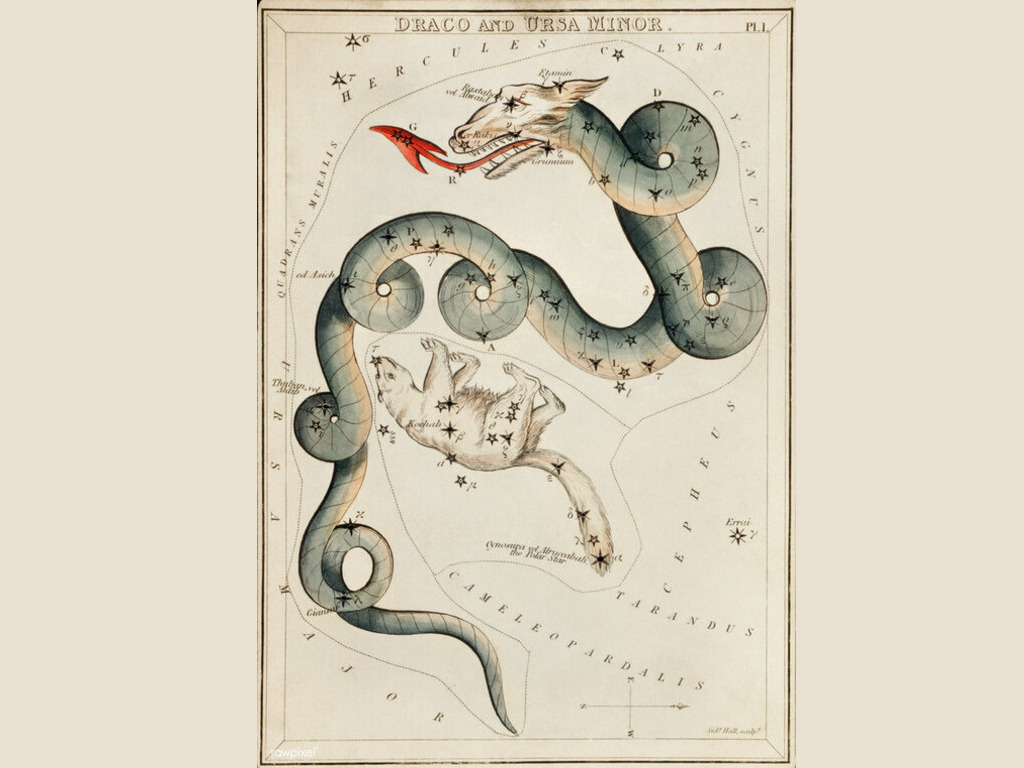
Constellations of the Month: July – Draco:
We start July with the first constellation of the month, Draco, “The Dragon.”

Draco constellation map courtesy of Openverse
Draco, “The Dragon” – The Draco constellation is located in the northern hemisphere, and symbolizes “the dragon.” Draco is one of the largest constellations in the northern sky, representing Ladon, the dragon from Greek mythology. Catalogued by the Greek astronomer Ptolemy in the 2nd century, Draco is a circumpolar constellation, which means it never sets below the horizon for many northern observers. It includes notable deep sky objects such as the Cat’s Eye Nebula, the Spindle Galaxy, the Tadpole Galaxy, and the Splinter Galaxy.

Cat’s Eye Nebula Hangs in Space (NASA, Chandra, 7/30/08) courtesy of Openverse
Key points regarding Draco:
- Meaning: The term “Draco” translates to “The Dragon” in Latin. The constellation Draco belongs to the Ursa Major family and has nine stars with known planets. Its brightest star is Eltanin. The constellation has one Messier object, M102, and is associated with the Draconids meteor shower. There are 17 formally named stars in Draco.
- Notable stars: Alpha Draconis, Thuban is pretty inconspicuous, having an apparent magnitude of 3.6452. Gamma Draconis, also known as Eltanin or the Zenith Star, is the brightest star in Draco, located 154.3 light years away. It is an evolved giant star that is 471 times more luminous than the Sun. Eta Draconis is the second brightest, with a magnitude of 2.73, 92.1 light years away, and is a 550-million-year-old giant star. Beta Draconis, the third brightest, is 380 light years away and 950 times more luminous than the Sun. Other notable stars include Delta Draconis, Zeta Draconis, Iota Draconis, Chi Draconis, Phi Draconis, Thuban, and Xi Draconis, each with unique characteristics and distances from Earth. Tyl is a yellow giant star located about 148 light years away with a visual magnitude of 3.9974. It is 60 times more luminous than the Sun and has a companion orange dwarf. Kappa Draconis is a blue giant, 490 light years away, 1400 times brighter than the Sun, believed to be becoming a red giant. Theta Draconis is a yellow-white star, 68.6 light years away, and a spectroscopic binary. Omicron Draconis, a giant star, is 322.93 light years away. Alsafi is a smaller main sequence dwarf, only 18.77 light years distant. The text also mentions several other star systems, including BY Draconis, Struve 2398, and Kepler-10, which have interesting features or discoveries.
- Other features: The Cat’s Eye Nebula, located about 3,300 light years from Earth, is a complex planetary nebula formed around 1,000 years ago from a bright star. It is thought to be a binary star and is losing mass rapidly. The Spindle Galaxy, discovered in 1781, has a unique dust disk and is about 50 million light years away. The Draco Dwarf Galaxy, a satellite of the Milky Way, was discovered in 1954 and is 260,000 light years distant, containing various stars and possibly dark matter. Abell 2218, a galaxy cluster, acts as a gravitational lens to study distant objects. The Tadpole Galaxy, about 400 million light years away, has a long trail of stars due to gravitational interactions. Q1634+706 is a notable quasar, while several other galaxies in Draco, like NGC 6340 and NGC 4319, have unique characteristics.
- Mythology: The constellation Draco is linked to various myths, especially one involving Heracles and his 12 labors, where Draco represents Ladon, the dragon protecting the golden apples in the garden of the Hesperides. This garden was a gift to Hera from Zeus, and she entrusted her daughters, the Hesperides, and the dragon Ladon to guard the apples. In some tales, Ladon had a hundred heads and was born from the monster Typhon and Echidna, while in others, he was the child of sea deities, Ceto and Phorcys. Heracles, tasked with stealing the apples, defeated Ladon using poisoned arrows. In memory of the dragon, Hera placed its image in the sky as the constellation Draco, which is often shown coiled around the North Pole, with Heracles standing on its head. In Roman mythology, Draco was a Titan who fought the Olympian gods and was defeated by Minerva, ending up frozen in the sky.
- Visibility: Draco is the 8th largest constellation, covering 1083 square degrees in the northern hemisphere. It can be seen at latitudes between +90° and -15° and is bordered by several other constellations, including Boötes, Ursa Major, and Ursa Minor. The name Draco, meaning Dragon, is pronounced /ˈdreɪkoʊ/, and in star names, it is referred to as Draconis.
⁺‧₊☽◯☾₊‧⁺⋆⁺‧₊☽◯☾₊‧⁺⋆⁺‧₊☽◯☾₊‧⁺⋆⁺‧₊☽◯☾₊‧⁺⋆⁺‧₊☽◯☾₊‧⁺⋆⁺‧₊☽◯☾₊‧⁺⋆
Constellations:
| Constellations by Month | ||
| JANUARY [8] | FEBRUARY [7] | MARCH [7] |
| Taurus | Camelopardalis | Ursa Major |
| Orion | Auriga | Cancer |
| Lepus | Gemini | Canis Minor |
| Caelum | Monoceros | Pyxis |
| Reticulum | Canis Major | Vela |
| Dorado | Columba | Carina |
| Pictor | Puppis | Volans |
| Mensa | ||
| APRIL [8] | MAY [7] | JUNE [6] |
| Ursa Major | Canes Venatici | Ursa Minor |
| Leo Minor | Coma Berenices | Boötes |
| Leo | Virgo | Libra |
| Sextans | Corvus | Lupus |
| Crater | Centaurus | Circinus |
| Hydra | Crux | Apus |
| Antlia | Musca | |
| Chamaeleon | ||
| JULY [9] | AUGUST [9] | SEPTEMBER [6] |
| Draco | Lyra | Cygnus |
| Corona Borealis | Vulpecula | Delphinus |
| Hercules | Sagitta | Equuleus |
| Serpens | Aquila | Capricornus |
| Ophiuchus | Scutum | Microscopium |
| Scorpius | Sagittarius | Indus |
| Norma | Corona Australis | |
| Ara | Telescopium | |
| Triangulum Australe | Pavo | |
| OCTOBER [7] | NOVEMBER [8] | DECEMBER [6] |
| Cepheus | Cassiopeia | Perseus |
| Lacerta | Andromeda | Triangulum |
| Pegasus | Pisces | Aries |
| Aquarius | Cetus | Eridanus |
| Piscis Austrinus | Sculptor | Fornax |
| Grus | Phoenix | Horologium |
| Octans | Tucana | |
| Hydrus | ||

Sidney Hall’s (1831) astronomical chart illustration of the Draco and the Ursa Minor. Original from Library of Congress. Digitally enhanced by rawpixel. courtesy of Openverse
Constellations of the Month:
July – Draco
Material may be shared for personal and educational use, Share with family and friends. The material cannot be used in an educational setting whereby a “book fee” is charged in or above tuition costs, and the material here is being used without paying a licensing fee.. AI must file an application for use of such material.
| You May Also Like. . . | |
 NASA 1997 Liftoff Special |
 NASA Mission Patch Party |
More on Versatileer:
![florida_walt-disney-world-lion-king-in-parade.png]()
Photo of the Day: Lion King at Disney Festival of Fantasy Parade – Walt Disney World – Florida
04/30/2020![Ends 11-01 – 13 Day Long Giveaway: 31 Days of Halloween + $13.13 + 2 x $6.66 Amazon/PayPal Hallowe...]()
Ends 11-01 – 13 Day Long Giveaway: "31 Days of Halloween" + $13.13 + 2 x $6.66 Amazon/PayPal Hallowe...
10/18/2024![A Vampire’s Star__Flat Lay Fall Leaves.png]()
Ends 11-27 – A Vampire’s Star by Marie-Claude Bourque Book Blitz +$25 Amazon Gift Card & Vampire Ser...
11/18/2024![Happy Star Wars Day – 2022]()
Happy Star Wars Day – 2022
05/05/2022![CINDER31LA__2.png]()
Ends 09-11 – CINDER31LA by Freida Kilmari Book Blitz + $50 Amazon Gift Card & Signed Copy Giveaway
08/30/2024