Constellations of the Month: November – Hydrus:
We continue November with the last constellation of the month, Hydrus, “The Male Water Snake.”
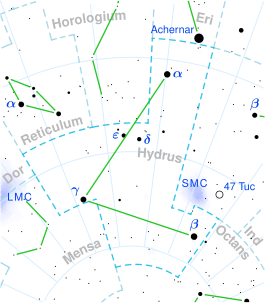
Hydrus constellation map courtesy of Openverse
Hydrus, “The Male Water Snake” – The Hydrus constellation is located in the southern hemisphere, symbolizing the male water snake in Latin. Hydrus is also referred to as “the lesser water snake,” serving as the counterpart to the larger Hydra constellation. It is separated from Hydra by the constellations Eridanus and Orion, as well as by the Milky Way. Hydrus is positioned between the two Magellanic Clouds, situated between Eridanus and the south celestial pole. Hydrus was among the constellations that were first depicted on a celestial globe by the Dutch astronomer Petrus Plancius in 1597. It was later included in Johann Bayer’s star atlas, Uranometria, published in 1603. The constellation was established by Plancius based on the observations made by Dutch sailors Frederick de Houtman and Pieter Dirkszoon Keyser during the late 16th century.
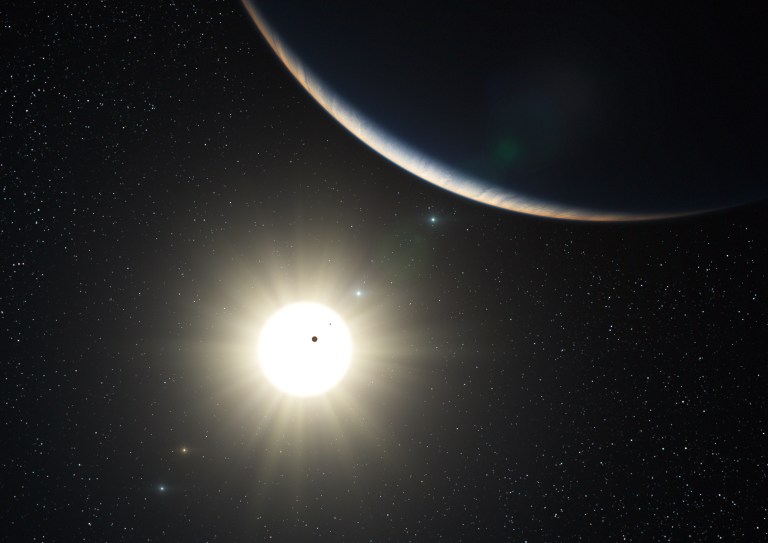
HD 10180 system courtesy of Openverse
Key points regarding Hydrus:
- Meaning: The term “Hydrus” translates to “The Male Water Snake.” Hydrus comprises four stars that have known planets and lacks any Messier objects. The most luminous star in this constellation is Beta Hydri, which has an apparent magnitude of 2.80. Additionally, it is the closest star to Earth within the Hydrus constellation, situated merely 24.38 light years away. This constellation does not feature any named stars. Furthermore, there are no meteor showers linked to this constellation.
- Notable stars: Beta Hydri is the brightest star in its constellation, located 24.33 light years from the Sun. It is a yellow subgiant star, 3.494 times more luminous than the Sun and possibly has a Jupiter-analogue companion. Alpha Hydri, the second brightest, is a yellow-white subgiant 71.8 light years away, 32 times more luminous than the Sun. Gamma Hydri is a luminous red giant 214 light years distant, 655 times brighter than the Sun. Delta Hydri is a white dwarf, about 140 light years away, and Epsilon Hydri is a blue-white giant with a magnitude of 4.06. Eta-2 Hydri hosts an extrasolar planet discovered in 2005. Nu Hydri, Zeta Hydri, GJ 3021 (which has a Jovian planet), and HD 10180 (with a large planetary system) are other noteworthy stars in Hydrus.
- Other features: IC 1717 is a deep sky object discovered by astronomer John Louis Emil Dreyer. He described it as a small, faint object near the star Eta-2 Hydri, with specific coordinates. However, this object is no longer at those coordinates, and it is thought that it may have been the site of a destroyed planet rather than a supernova. NGC 1511 is a spiral galaxy in Hydrus, discovered by John Herschel in 1834, with an apparent magnitude of 11.0. NGC 1466, also discovered by Herschel in 1834, is a globular cluster in Hydrus with an apparent magnitude of 11.4, located about 14,000 light-years away and known for its variable stars. NGC 1473 is an irregular galaxy in Hydrus, discovered by Herschel with an apparent magnitude of 13.0. The White Rose Galaxy is a lenticular galaxy about 345 million light-years away, noted for its petal-like shells from a merger with another galaxy.
- Mythology: Hydrus is not linked to any legends. It is a constellation located in the southern hemisphere, which was not observable by the ancient Greeks or Romans. This constellation was charted by Dutch navigators and symbolizes the sea serpents they encountered during their explorations. The French astronomer Nicolas Louis de Lacaille designated the constellation as l’Hydre Mâle to highlight the gender distinction between Hydrus and Hydra in his southern sky planisphere, published in 1756. Lacaille also relocated several stars to the constellations Tucana, Octans, Horologium, and Reticulum. In Bayer’s Uranometria (1603), the tail of Hydrus was depicted as extending to the star Lambda Octantis, which was once part of Hydrus but is now included in the constellation Octans.
- Visibility: Hydrus is the 61st largest constellation, covering 243 square degrees. It is situated in the first quadrant of the southern hemisphere (SQ1) and is visible at latitudes ranging from +8° to -90°. The constellations that border it include Dorado, Eridanus, Horologium, Mensa, Octans, Phoenix, Reticulum, and Tucana. The name Hydrus is pronounced /ˈhaɪdrəs/. In English, this constellation is referred to as the Male Water Snake. The genitive form of Hydrus, which is used in the naming of stars, is Hydri (pronunciation: /ˈhaɪdraɪ/). The three-letter abbreviation, which was established by the International Astronomical Union (IAU) in 1922, is Hyi. Hydrus is part of the Johann Bayer family of constellations, which also includes Apus, Chamaeleon, Dorado, Grus, Indus, Musca, Pavo, Phoenix, Tucana, and Volans.
⁺‧₊☽◯☾₊‧⁺⋆⁺‧₊☽◯☾₊‧⁺⋆⁺‧₊☽◯☾₊‧⁺⋆⁺‧₊☽◯☾₊‧⁺⋆⁺‧₊☽◯☾₊‧⁺⋆⁺‧₊☽◯☾₊‧⁺⋆
Constellations:
| Constellations by Month | ||
| JANUARY [8] | FEBRUARY [7] | MARCH [7] |
| Taurus | Camelopardalis | Ursa Major |
| Orion | Auriga | Cancer |
| Lepus | Gemini | Canis Minor |
| Caelum | Monoceros | Pyxis |
| Reticulum | Canis Major | Vela |
| Dorado | Columba | Carina |
| Pictor | Puppis | Volans |
| Mensa | ||
| APRIL [8] | MAY [7] | JUNE [6] |
| Ursa Major | Canes Venatici | Ursa Minor |
| Leo Minor | Coma Berenices | Boötes |
| Leo | Virgo | Libra |
| Sextans | Corvus | Lupus |
| Crater | Centaurus | Circinus |
| Hydra | Crux | Apus |
| Antlia | Musca | |
| Chamaeleon | ||
| JULY [9] | AUGUST [9] | SEPTEMBER [6] |
| Draco | Lyra | Cygnus |
| Corona Borealis | Vulpecula | Delphinus |
| Hercules | Sagitta | Equuleus |
| Serpens | Aquila | Capricornus |
| Ophiuchus | Scutum | Microscopium |
| Scorpius | Sagittarius | Indus |
| Norma | Corona Australis | |
| Ara | Telescopium | |
| Triangulum Australe | Pavo | |
| OCTOBER [7] | NOVEMBER [8] | DECEMBER [6] |
| Cepheus | Cassiopeia | Perseus |
| Lacerta | Andromeda | Triangulum |
| Pegasus | Pisces | Aries |
| Aquarius | Cetus | Eridanus |
| Piscis Austrinus | Sculptor | Fornax |
| Grus | Phoenix | Horologium |
| Octans | Tucana | |
| Hydrus | ||

hydrus courtesy of Openverse
Constellations of the Month:
November – Hydrus
Material may be shared for personal and educational use, Share with family and friends. The material cannot be used in an educational setting whereby a “book fee” is charged in or above tuition costs, and the material here is being used without paying a licensing fee.. AI must file an application for use of such material.
| You May Also Like. . . | |
 NASA 1997 Liftoff Special |
 NASA Mission Patch Party |
More on Versatileer:
![How to Turn Your Photography Hobby into a Real Business__BUTTON.jpg]()
How to Turn Your Photography Hobby into a Real Business
04/15/2023![INSTA_TheSheikAndtheSlave_.png]()
Ends 03-18 – The Sheik and the Slave by Nicola Italia Book Blitz + $25 Amazon Gift Card Giveaway
03/12/2026![2023SpringGiftGuideBanner.jpg]()
2023 Spring Gift Guide – 02-15 to 03-31
01/30/2023![Featured Photo: Architecture, Part 2 – Vintage Architecture – Victorian Stick-Style Home in Oak Lawn...]()
Featured Photo: Architecture, Part 2 – Vintage Architecture – Victorian Stick-Style Home in Oak Lawn...
04/13/2021![Tom Skilling Retires on Wednesday After Almost 46 Years of Weather Forecasting]()
Tom Skilling Retires on Wednesday After Almost 46 Years of Weather Forecasting
02/25/2024































This is fascinating