Constellations of the Month: April – Sextans:
We continue April with the next constellation of the month, Sextans, “The Astronomical Sextant.”

Sextans constellation map courtesy of Openverse
Sextans, “The Astronomical Sextant” – The Sextans constellation is an equatorial constellation located in both the northern hemisphere and the southern hemisphere (brighter stars south of the equator), and symbolizes “the astronomical sextant” in Latin. Sextans is found in a dim area between the constellations Hydra, Crater, and Leo, created by Johannes Hevelius in the 17th century. Notably, it features deep sky objects like the Spindle Galaxy, NGC 3166, NGC 3169, Sextans A, Sextans B, the distant galaxy cluster CL J1001+0220, and the Cosmos Redshift 7 galaxy.
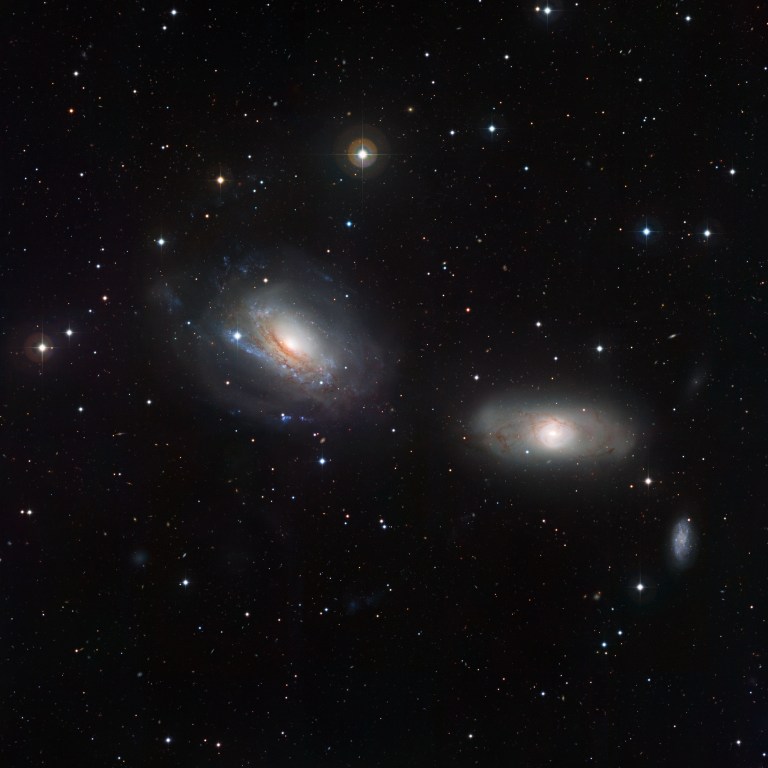
NGC 3169 NGC 3166 courtesy of Openverse
Key points regarding Sextans:
- Meaning: The term “Sextans” translates to “The Astronomical Sextant.” Sextans is a constellation that is part of the Hercules family. Other constellations in the Hercules family include Aquila, Ara, Centaurus, and more. Sextans has no Messier objects. It features the Sextantids meteor shower in late October and early November. Two named stars in Sextans are Bibhā (HD 86081) and Gnomon (WASP-43). Sextans is a notable constellation with unique characteristics and associations within its family.
- Notable stars: Alpha Sextantis is a bright white giant star classified as A0III. It has a brightness of 4.48 and is about 287 light years from Earth, making it the brightest star in the Sextans constellation. The star is 122 times more luminous than the Sun and has three times its mass. It is roughly 300 million years old and is informally known as an “equator star,” currently located less than a quarter degree south of the celestial equator. Gamma Sextantis is a triple star system in the Sextans constellation with a brightness of 5.07, located about 262 light years away. It consists of a close binary pair and a third star, with the binary stars orbiting each other every 77.6 years. Beta Sextantis, a blue-white dwarf star classified as B6V, has a brightness between 5. 0 and 5.1, found about 345 light years from Earth. It is an Alpha-2 Canum Venaticorum variable star. Delta Sextantis is another blue-white dwarf classified as B9. 5V, with a brightness of 5. 19 and a distance of about 300 light years. Epsilon Sextantis is a yellow-white giant star, F2 III, with a brightness of 5.25 and 183 light years away. 24 Sextantis is a yellow subgiant with a brightness of 6. 61, located 253 light years away, and has two planets orbiting it. LHS 292 is a red dwarf star, M6. 5 V, with a brightness of 15.73, only 14.8 light years from Earth. HD 92788 is a class G5 star, has a brightness of 4.72 and is 107.1 light years away, with a massive planet orbiting it. Other stars mentioned include HD 86081, BD-08°2823, and WASP-43, each with their unique characteristics and distant planets.
- Other features: The Spindle Galaxy, a lenticular galaxy in Sextans, is about 31.6 million light years from Earth and is larger than the Milky Way. It has a supermassive black hole at its center and was discovered by William Herschel in 1787. It has mostly old stars and little gas for new star formation. NGC 3169, a spiral galaxy situated 70 million light years away, shows distortion due to a nearby galaxy, NGC 3166, which is about 50,000 light years from it. Both were discovered in 1783, and NGC 3169 had a supernova, SN 2003cg, found in 2003. Sextans A and B are small dwarf irregular and irregular galaxies, respectively, located near each other and within the Local Group, each about 4.3 to 4.44 million light years away. The Sextans Dwarf Spheroidal galaxy, or Sextans I, is part of the Milky Way’s satellites and was discovered in 1990. UGC 5797 is an emission line galaxy with active star formation located 34 million light years away. CL J1001+0220 is the most distant known galaxy cluster, while Cosmos Redshift 7 is a very old, distant galaxy. CID-42 is a quasar believed to result from the collision of two smaller galaxies. The Cosmic Evolution Survey studied over 2 million galaxies in this field.
- Mythology: The Sextans constellation lacks any mythological associations. It was established by the Polish astronomer Johannes Hevelius in 1687. Initially, Hevelius referred to the constellation as Sextans Uraniae, named after the instrument he utilized for measuring star positions, which was unfortunately lost in a fire at his observatory in 1679. Despite having access to telescopes, Hevelius favored the sextant for his observations and maintained this preference throughout his lifetime.
- Visibility: Sextans is the 47th largest constellation, covering 314 square degrees. It is one of the 15 equatorial constellations, located in the southern hemisphere and visible at latitudes from +80° to -90°. Nearby constellations include Crater, Hydra, and Leo. Sextans is pronounced /ˈsɛkstənz/ and is known as the Sextant in English. Its genitive form is Sextantis, pronounced /sɛksˈtæntɪs/, and the three-letter abbreviation is Sex. Sextans has no stars brighter than magnitude 3.00 and includes five stars within 10 parsecs of Earth. The brightest star is Alpha Sextantis, with a magnitude of 4.49, while the nearest star is LHS 292, 14.8 light years away. Sextans contains five stars with confirmed exoplanets, including HD 86081, HIP 49067, WASP-43, 24 Sextantis, and HD 92788. WASP-43 hosts the closest hot Jupiter discovered at its time, and the two planets around 24 Sextantis have a 2:1 resonance.
⁺‧₊☽◯☾₊‧⁺⋆⁺‧₊☽◯☾₊‧⁺⋆⁺‧₊☽◯☾₊‧⁺⋆⁺‧₊☽◯☾₊‧⁺⋆⁺‧₊☽◯☾₊‧⁺⋆⁺‧₊☽◯☾₊‧⁺⋆
Constellations:
| Constellations by Month | ||
| JANUARY [8] | FEBRUARY [7] | MARCH [7] |
| Taurus | Camelopardalis | Leo Minor |
| Orion | Auriga | Cancer |
| Lepus | Gemini | Canis Minor |
| Caelum | Monoceros | Pyxis |
| Reticulum | Canis Major | Vela |
| Dorado | Columba | Carina |
| Pictor | Puppis | Volans |
| Mensa | ||
| APRIL [8] | MAY [7] | JUNE [6] |
| Ursa Major | Canes Venatici | Ursa Minor |
| Leo Minor | Coma Berenices | Boötes |
| Leo | Virgo | Libra |
| Sextans | Corvus | Lupus |
| Crater | Centaurus | Circinus |
| Hydra | Crux | Apus |
| Antlia | Musca | |
| Chamaeleon | ||
| JULY [9] | AUGUST [9] | SEPTEMBER [6] |
| Draco | Lyra | Cygnus |
| Corona Borealis | Vulpecula | Delphinus |
| Hercules | Sagitta | Equuleus |
| Serpens | Aquila | Capricornus |
| Ophiuchus | Scutum | Microscopium |
| Scorpius | Sagittarius | Indus |
| Norma | Corona Australis | |
| Ara | Telescopium | |
| Triangulum Australe | Pavo | |
| OCTOBER [7] | NOVEMBER [8] | DECEMBER [6] |
| Cepheus | Cassiopeia | Perseus |
| Lacerta | Andromeda | Triangulum |
| Pegasus | Pisces | Aries |
| Aquarius | Cetus | Eridanus |
| Piscis Austrinus | Sculptor | Fornax |
| Grus | Phoenix | Horologium |
| Octans | Tucana | |
| Hydrus | ||
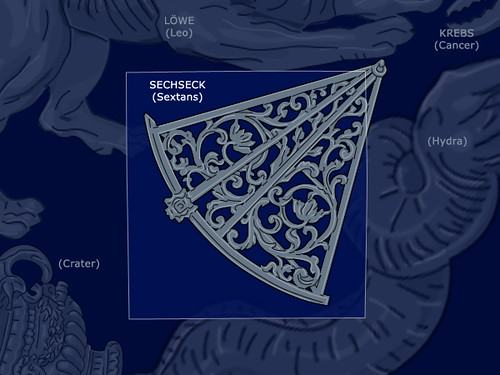
sextans courtesy of Openverse
Constellations of the Month:
April – Sextans
Material may be shared for personal and educational use, Share with family and friends. The material cannot be used in an educational setting whereby a “book fee” is charged in or above tuition costs, and the material here is being used without paying a licensing fee.. AI must file an application for use of such material.
| You May Also Like. . . | |
 NASA 1997 Liftoff Special |
 NASA Mission Patch Party |
More on Versatileer:
![photo-of-periodic-table-of-elements-3735778 chemistry_1675651086.jpeg Polina Tankilevitch at Pexels]()
Happy National Periodic Table Day – 2023
02/07/2023![wp-17619693605272752435226638874736.jpg]()
Featured Photo & Video: The 31 Days of Halloween – Bonus Photo Set: Haunt On 73rd, Palos Heights
11/01/2025![wp-17007155759591345832697304505224.jpg]()
Featured Photo: Flower of the Day – Lemon Ball Moss Stonecrop (Mum)
11/22/2023![Featured Photos Montage: The 31 Days of Halloween – 2025]()
Featured Photos Montage: The 31 Days of Halloween – 2025
11/01/2025![Ministers' statement on Skilled Trades and Technology Week.jpg]()
Happy National Skilled Trades Day – 2025
05/07/2025




























So fascinating! I could look at the sky all night!