
Constellations of the Month: November – Andromeda:
We continue November with the next constellation of the month, Andromeda, “Daughter of Queen Cassiopeia.”
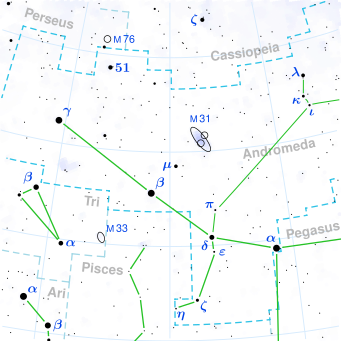
Andromeda constellation map courtesy of Openverse
Andromeda, “Daughter of Queen Cassiopeia” – The Andromeda constellation is located in the northern hemisphere, and symbolizes “daughter of Queen Cassiopeia.” Andromeda is positioned between the W asterism of Cassiopeia and the Great Square of Pegasus. It ranks among the 48 Greek constellations, which were first cataloged in Claudius Ptolemy’s Almagest during the 2nd century CE. This constellation derives its name from the legendary princess Andromeda, who is the daughter of Queen Cassiopeia and the spouse of the Greek hero Perseus. It is also referred to as the Princess, the Chained Maiden, Persea (the wife of Perseus), or Cepheis (the daughter of Cepheus). In addition to other significant deep sky objects, the Andromeda constellation houses the renowned Andromeda Galaxy (Messier 31) along with the dwarf elliptical galaxies Messier 32 and Messier 110. The constellation’s brightest stars — Alpheratz, Mirach, and Almach — create a line connecting the Great Square of Pegasus and the constellation Perseus. More modernly, the term Android was fit to mean “. . .of/from, the Andromeda Galaxy.”

The Andromeda Galaxy, Messier 31 courtesy of Openverse
Key points regarding Andromeda:
- Meaning: The term “Andromeda” translates to “Daughter of Queen Cassiopeia” in Greek. The constellation Andromeda contains 17 named stars approved by the International Astronomical Union. Some of these stars include Adhil, Almach, Alpheratz, and Mirach. Andromeda has many stars with confirmed exoplanets, like Titawin, which has three known planets, and Kappa Andromedae, known for its large confirmed exoplanet. Other stars with exoplanets include HD 5608 and HD 8673, which has a substellar companion. Andromeda is part of the Perseus family of constellations and includes three Messier objects: Messier 31, 32, and 110. The constellation is linked to the Andromedids meteor shower, first documented in 1741, with activity still observable in mid-November. The best time to observe Andromeda is in November, around 9 pm when it is higher in the sky.
- Notable stars: The brightest star in the Andromeda constellation is Alpheratz, also known as Alpha Andromedae or Sirrah. It is 97 light years from Earth and classified as a B8 subgiant blue star with a binary star system. Alpheratz has a magnitude of +2.06 and is the brightest mercury-manganese star known, with a luminosity 200 times that of the Sun. Its mass is around 3.6 solar masses, and its companion star is about 10 times more luminous than the Sun. Alpheratz was once part of the Pegasus constellation and connects Andromeda with Pegasus, known for the horse that rescued Andromeda. Mirach, or Beta Andromedae, is similar in apparent magnitude to Alpheratz, varying from +2.01 to +2.10. It is a cool red giant star about 200 light years away, much more luminous and massive than the Sun. Mirach has a faint companion star and is also linked to an asterism called the girdle.
- Other features: Messier 31, known as the Andromeda Galaxy, is a spiral galaxy located 2.5 million light years away and is the closest spiral galaxy to the Milky Way. It contains about a trillion stars, making it larger than the Milky Way. Andromeda has at least 14 dwarf galaxies orbiting it and is part of the Local Group of galaxies. Notable features include NGC 206, a prominent star cloud, and Mayall II, a bright globular cluster. Additionally, Andromeda has two notable elliptical satellite galaxies, Messier 32 and Messier 110. NGC 752 is an open cluster that is also visible from Earth. NGC 891 is an edge-on spiral galaxy, visible east of Almach, at a distance of about 27.3 million light years. It has an apparent magnitude of 10.8 and was discovered by William Herschel in 1784. NGC 7686 is a nearby open cluster with around 80 stars, located 900 light years away. The Blue Snowball Nebula, or NGC 7662, is a planetary nebula with an apparent magnitude of 8.6 and is estimated to be between 2,000 and 6,000 light years away. The NGC 68 Group, discovered by Herschel, contains over 40 galaxies, with NGC 68 being the largest. NGC 90 and NGC 93 are a pair of interacting spiral galaxies. NGC 404 is a dwarf lenticular galaxy located 10 million light years from Earth, known as the Ghost of Mirach. Other deep sky objects in Andromeda include various open clusters, spiral, lenticular, and elliptical galaxies listed in the New General Catalogue.
- Mythology: In Greek mythology, Andromeda was the offspring of King Cepheus of Ethiopia and Queen Cassiopeia, who angered the Nereids (sea nymphs) by asserting that she was more beautiful than they were. The nymphs voiced their grievances to the sea god Poseidon, who retaliated by sending a sea monster, Cetus, to inundate and devastate Cepheus’ territories as retribution for his wife’s arrogance. When the king consulted the Oracle of Ammon for guidance on how to avert the total ruin of his lands, he was informed that the sole means to placate the gods and nymphs was to offer his daughter as a sacrifice to Cetus. Consequently, Andromeda was bound to a rock and would have been left to the monster had not the hero Perseus intervened and rescued her. The two subsequently wed and had six offspring, including Gorgophonte, who became the father of Tyndareus, the renowned Spartan king, and Perses, who was an ancestor of the Persians. In this narrative, it was the goddess Athena who honored the princess Andromeda by positioning her likeness among the stars, adjacent to the constellations that symbolize her husband Perseus and her mother Cassiopeia.
- Visibility: Andromeda is the 19th largest constellation, covering 722 square degrees. It is situated in the first quadrant of the northern hemisphere (NQ1). This constellation is observable from locations with latitudes ranging from +90° to -40°. Its neighboring constellations include Cassiopeia, Lacerta, Pegasus, Perseus, Pisces, and Triangulum. The name Andromeda is pronounced /ænˈdrɒmɪdə/. In English, it is referred to as Andromeda, the Princess, or the Chained Maiden. The genitive form of Andromeda, which is utilized in the naming of stars, is Andromedae (pronunciation: /ænˈdrɒmɪdiː/). The three-letter abbreviation, which was officially adopted by the International Astronomical Union (IAU) in 1922, is And. Andromeda contains three stars that are brighter than magnitude 3.00 and three stars that are situated within 10 parsecs (32.6 light years) of Earth. The most luminous star in this constellation is Alpha Andromedae, which is also known by its traditional name, Alpheratz. The closest star to Earth is Ross 248 (spectral class M6V), also referred to as HH Andromedae. It is located at a mere distance of 10.306 light years from our planet.
⁺‧₊☽◯☾₊‧⁺⋆⁺‧₊☽◯☾₊‧⁺⋆⁺‧₊☽◯☾₊‧⁺⋆⁺‧₊☽◯☾₊‧⁺⋆⁺‧₊☽◯☾₊‧⁺⋆⁺‧₊☽◯☾₊‧⁺⋆
Constellations:
| Constellations by Month | ||
| JANUARY [8] | FEBRUARY [7] | MARCH [7] |
| Taurus | Camelopardalis | Ursa Major |
| Orion | Auriga | Cancer |
| Lepus | Gemini | Canis Minor |
| Caelum | Monoceros | Pyxis |
| Reticulum | Canis Major | Vela |
| Dorado | Columba | Carina |
| Pictor | Puppis | Volans |
| Mensa | ||
| APRIL [8] | MAY [7] | JUNE [6] |
| Ursa Major | Canes Venatici | Ursa Minor |
| Leo Minor | Coma Berenices | Boötes |
| Leo | Virgo | Libra |
| Sextans | Corvus | Lupus |
| Crater | Centaurus | Circinus |
| Hydra | Crux | Apus |
| Antlia | Musca | |
| Chamaeleon | ||
| JULY [9] | AUGUST [9] | SEPTEMBER [6] |
| Draco | Lyra | Cygnus |
| Corona Borealis | Vulpecula | Delphinus |
| Hercules | Sagitta | Equuleus |
| Serpens | Aquila | Capricornus |
| Ophiuchus | Scutum | Microscopium |
| Scorpius | Sagittarius | Indus |
| Norma | Corona Australis | |
| Ara | Telescopium | |
| Triangulum Australe | Pavo | |
| OCTOBER [7] | NOVEMBER [8] | DECEMBER [6] |
| Cepheus | Cassiopeia | Perseus |
| Lacerta | Andromeda | Triangulum |
| Pegasus | Pisces | Aries |
| Aquarius | Cetus | Eridanus |
| Piscis Austrinus | Sculptor | Fornax |
| Grus | Phoenix | Horologium |
| Octans | Tucana | |
| Hydrus | ||
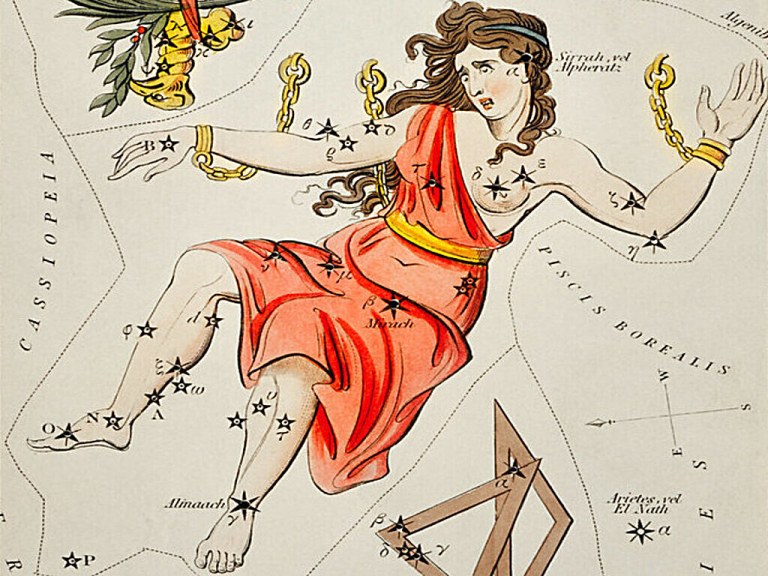
Sidney Hall’s (1831) astronomical chart illustration of Gloria Frederici, Andromeda. Original from Library of Congress. Digitally enhanced by rawpixel. courtesy of Openverse
Constellations of the Month:
November – Andromeda
Material may be shared for personal and educational use, Share with family and friends. The material cannot be used in an educational setting whereby a “book fee” is charged in or above tuition costs, and the material here is being used without paying a licensing fee.. AI must file an application for use of such material.
| You May Also Like. . . | |
 NASA 1997 Liftoff Special |
 NASA Mission Patch Party |
More on Versatileer:
![Smooth-Hoperator-Now-Available1.jpg]()
Ends 07-12 – Smooth Hoperator by Sylvie Stewart Book Blitz + $25 Amazon Gift Card Giveaway
07/08/2023![INSTA_MidnightRapture.png]()
Midnight Rapture by Anya Summers Cover Reveal – Coming Release Date 06-27
06/09/2023![Pink Ribbon on Pink Surface.jpg]()
National Mammography Day + Breast Cancer Awareness Month – 2024
10/19/2024![New Beginnings in Twinkle Falls__image0.jpeg]()
Ends 12-18 – New Beginnings in Twinkle Falls by Freda Ann Book Blitz + 2 x $15 Amazon Gift Card & eB...
12/04/2024![wp-17669013354098426256872464423274.jpg]()
Featured Photo + Video: The 25 Days of Christmas – Day 21: Yuletide at the Hirsch Christmas Lights, ...
12/27/2025





























Very nice
I love this art series. It’s some great work.