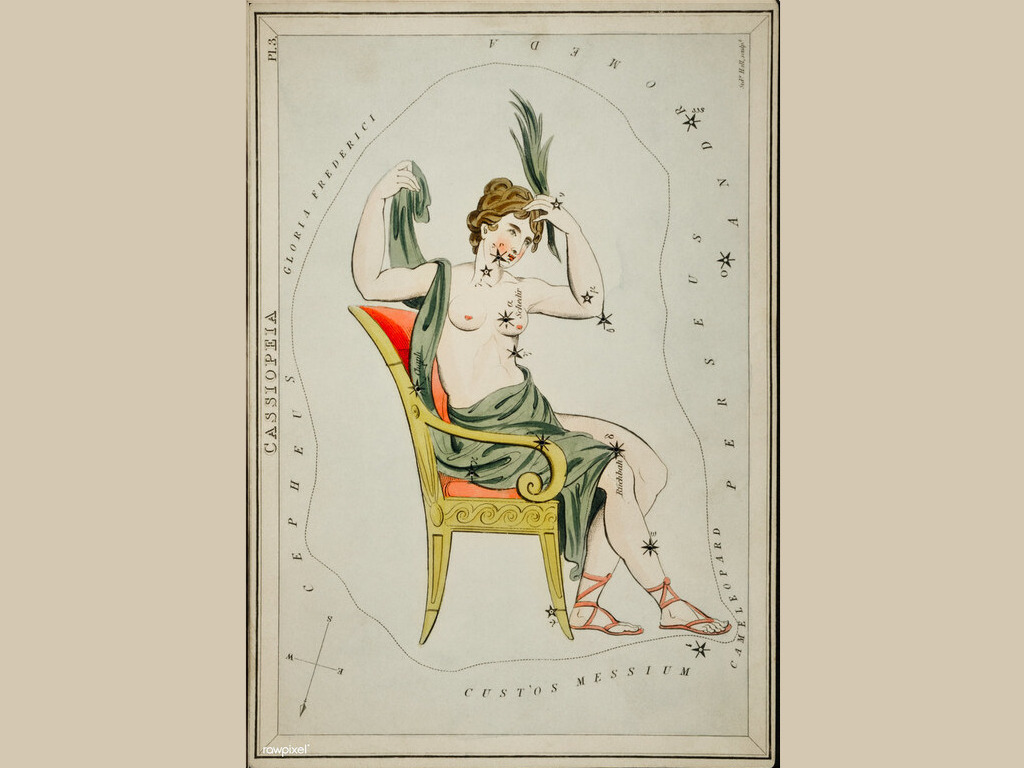
Constellations of the Month: November – Cassiopeia:
We start November with the first constellation of the month, Cassiopeia, “Queen Cassiopeia.”
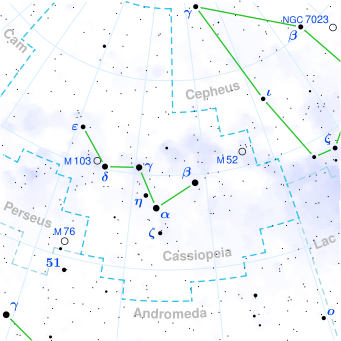
Cassiopeia constellation map courtesy of Openverse
Cassiopeia, “Queen Cassiopeia” – The Cassiopeia constellation is located in the northern hemisphere, and symbolizes “the queen of Aethiopia, wife of King Cepheus.” Cassiopeia derives its name from Cassiopeia, the proud and self-important queen in ancient Greek mythology. Commonly referred to as the W constellation, Cassiopeia is easily identifiable due to the distinctive W asterism created by its five brightest stars. The constellation Cassiopeia was initially documented by the Greek astronomer Ptolemy during the 2nd century CE, alongside other constellations from Greek tradition. Cassiopeia is home to numerous significant deep sky objects, including the open clusters Messier 52 and Messier 103, the Bubble Nebula, the Heart Nebula, and the Soul Nebula, as well as the Little Rosette Nebula, the remnants of supernovae such as Cassiopeia A and Tycho’s Supernova, the Owl Cluster, Caroline’s Rose Cluster, and the star-forming region commonly known as the Pacman Nebula. Cassiopeia is a constellation in the northern sky known for its distinct W shape formed by its five brightest stars: Schedar, Caph, Gamma Cassiopeiae, Ruchbah, and Segin. Four of these stars are evolved, while Segin remains on the main sequence. All five stars are larger and more luminous than the Sun, with Segin and Gamma likely to end their lives as supernovae. The W pattern changes to an M shape in winter. Cassiopeia’s W and the Big Dipper help locate Polaris, the North Star, which is found by drawing lines from the stars of both asterisms.
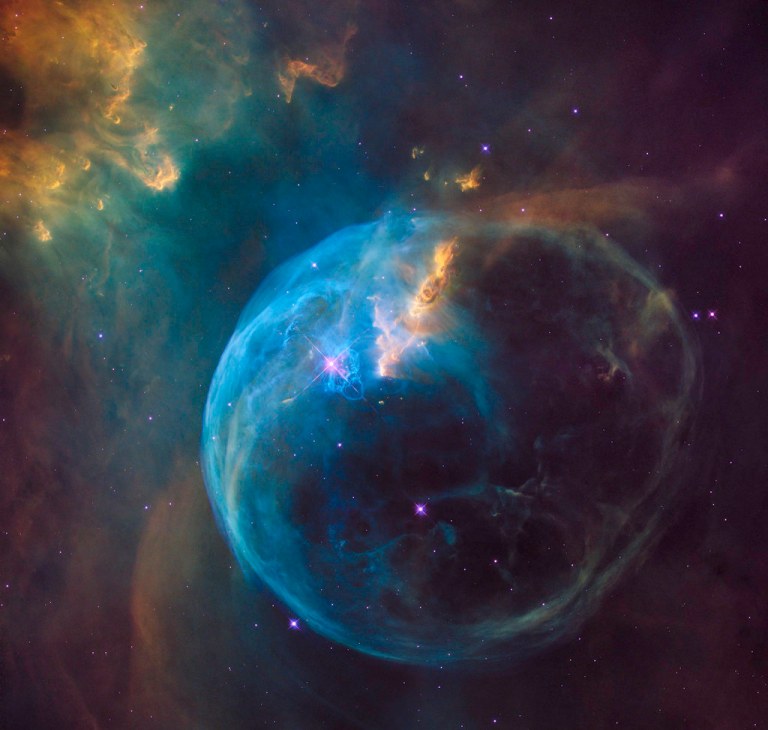
NGC 7635, The Bubble Nebula courtesy of Openverse
Key points regarding Cassiopeia:
- Meaning: The term “Cassiopeia” translates to “Queen Cassiopeia” in Greek. The constellation Cassiopeia features luminous star, Schedar, which exhibits a brightness of magnitude 2.24 from a distance of 228 light-years. It ranks among the 157 stars visible in the constellation (those brighter than or equal to magnitude 6.5). The closest star in Cassiopeia is Achird (Eta Cassiopeiae), situated 19.32 light-years away. Cassiopeia comprises 14 stars with confirmed planets and eight stars that have been designated with names. The official names of stars recognized by the International Astronomical Union (IAU) include Achird (Eta Cassiopeiae A), Caph (Beta Cassiopeiae), Castula (Upsilon2 Cassiopeiae), Fulu (Zeta Cassiopeiae), Nushagak (HD 17156), Ruchbah (Delta Cassiopeiae Aa), Schedar (Alpha Cassiopeiae), and Segin (Epsilon Cassiopeiae). The constellation features two Messier objects: Messier 103 (NGC 581) and Messier 52 (NGC 7654). It is linked to a single meteor shower, the December Phi Cassiopeiids. Additionally, the Perseid meteor shower is also connected to this constellation.
- Notable stars: Cassiopeia is home to numerous exceptionally large, massive, and luminous stars. The five brightest stars in the constellation create a W shape, a distinctive star pattern that facilitates the identification of other stars within Cassiopeia, as well as its numerous bright deep-sky objects. The Cassiopeia constellation features 157 visible stars, all of which are brighter than magnitude 6.5. However, it does not include any stars of first magnitude. The brightest stars in this constellation, namely Schedar (Alpha Cassiopeiae), Caph (Beta Cassiopeiae), and Gamma Cassiopeiae, shine at a second magnitude. Ruchbah (Delta Cassiopeiae) is the only other star that exceeds magnitude 3.0, while Segin (Epsilon Cassiopeiae), Achird (Eta Cassiopeiae), Fulu (Zeta Cassiopeiae), and 50 Cassiopeiae are all brighter than magnitude 4.0.
- Other features: Cassiopeia is home to numerous luminous star clusters and nebulae that can be observed using small to medium-sized telescopes. It features two Messier objects: the open clusters Messier 52 (NGC 7654, known as the Scorpion Cluster) and Messier 103 (NGC 581). Additionally, it includes six objects from the Caldwell catalogue: the open clusters NGC 559 (Caldwell 8), NGC 663 (Caldwell 10), and NGC 457 (Caldwell 13, referred to as the Owl Cluster or the E. T. Cluster), along with the emission nebula NGC 7635 (Caldwell 11, known as the Bubble Nebula), and the dwarf spheroidal galaxies NGC 147 (Caldwell 17) and NGC 185 (Caldwell 18). This constellation also contains 16 deep sky objects that are part of the Herschel 400 catalogue. Similar to the Messier and Caldwell objects, those included in the Herschel 400 observing list are visible through amateur telescopes. In addition to the galaxy NGC 185 and the open clusters NGC 457, NGC 559, and NGC 663, the list comprises the open clusters NGC 129, NGC 136, NGC 225, NGC 381, NGC 436, NGC 637, NGC 654, NGC 659, NGC 1027, NGC 7789 (known as Caroline’s Rose Cluster), and NGC 7790, as well as the galaxy NGC 278.
- Mythology: In mythology, Queen Cassiopeia was the wife of King Cepheus of Aethiopia and the mother of Princess Andromeda. The queen boasted about her beauty, claiming she was more beautiful than the sea nymphs known as the Nereids. Angered by her pride, the Nereids asked the sea god Poseidon to punish Cassiopeia. In response, Poseidon sent the sea monster Cetus to terrorize Cepheus’ kingdom. To save their land, Cepheus consulted an oracle, who instructed him and Cassiopeia to sacrifice Andromeda to the monster. They complied, chaining her to a rock. Fortunately, the Greek hero Perseus saved Andromeda just in time. Later, Perseus and Andromeda married, but trouble arose when a former suitor, Phineus, claimed the right to marry her. During the ensuing fight, Perseus used the head of Medusa, which turned his attackers to stone, but Cassiopeia and Cepheus also perished. As punishment for her vanity, Poseidon placed Cassiopeia and Cepheus in the sky, with Cassiopeia eternally circling upside down while combing her hair.
- Visibility: Cassiopeia is the 25th largest constellation, covering 598 square degrees. It is situated in the first quadrant of the northern hemisphere (NQ1). The entire constellation is visible from locations with latitudes ranging from +90° to -20°. The neighboring constellations include Andromeda, Camelopardalis, Cepheus, Lacerta, and Perseus. The name Cassiopeia is pronounced /ˌkæsioʊˈpiːə/. In English, it is referred to as Cassiopeia, the Queen, or the Seated Queen. The genitive form of Cassiopeia, which is used in the naming of stars, is Cassiopeiae (pronunciation: /ˌkæsioʊˈpiːiː/). The three-letter abbreviation, which was adopted by the International Astronomical Union (IAU) in 1922, is Cas. Cassiopeia is part of the Perseus family of constellations, which also includes Andromeda, Auriga, Cepheus, Cetus, Lacerta, Pegasus, Perseus, and Triangulum.
⁺‧₊☽◯☾₊‧⁺⋆⁺‧₊☽◯☾₊‧⁺⋆⁺‧₊☽◯☾₊‧⁺⋆⁺‧₊☽◯☾₊‧⁺⋆⁺‧₊☽◯☾₊‧⁺⋆⁺‧₊☽◯☾₊‧⁺⋆
Constellations:
| Constellations by Month | ||
| JANUARY [8] | FEBRUARY [7] | MARCH [7] |
| Taurus | Camelopardalis | Ursa Major |
| Orion | Auriga | Cancer |
| Lepus | Gemini | Canis Minor |
| Caelum | Monoceros | Pyxis |
| Reticulum | Canis Major | Vela |
| Dorado | Columba | Carina |
| Pictor | Puppis | Volans |
| Mensa | ||
| APRIL [8] | MAY [7] | JUNE [6] |
| Ursa Major | Canes Venatici | Ursa Minor |
| Leo Minor | Coma Berenices | Boötes |
| Leo | Virgo | Libra |
| Sextans | Corvus | Lupus |
| Crater | Centaurus | Circinus |
| Hydra | Crux | Apus |
| Antlia | Musca | |
| Chamaeleon | ||
| JULY [9] | AUGUST [9] | SEPTEMBER [6] |
| Draco | Lyra | Cygnus |
| Corona Borealis | Vulpecula | Delphinus |
| Hercules | Sagitta | Equuleus |
| Serpens | Aquila | Capricornus |
| Ophiuchus | Scutum | Microscopium |
| Scorpius | Sagittarius | Indus |
| Norma | Corona Australis | |
| Ara | Telescopium | |
| Triangulum Australe | Pavo | |
| OCTOBER [7] | NOVEMBER [8] | DECEMBER [6] |
| Cepheus | Cassiopeia | Perseus |
| Lacerta | Andromeda | Triangulum |
| Pegasus | Pisces | Aries |
| Aquarius | Cetus | Eridanus |
| Piscis Austrinus | Sculptor | Fornax |
| Grus | Phoenix | Horologium |
| Octans | Tucana | |
| Hydrus | ||

Sidney Hall’s (1831) astronomical chart of the Cassiopeia. Original from Library of Congress. Digitally enhanced by rawpixel. courtesy of Openverse
Constellations of the Month:
November – Cassiopeia
Material may be shared for personal and educational use, Share with family and friends. The material cannot be used in an educational setting whereby a “book fee” is charged in or above tuition costs, and the material here is being used without paying a licensing fee.. AI must file an application for use of such material.
| You May Also Like. . . | |
 NASA 1997 Liftoff Special |
 NASA Mission Patch Party |
More on Versatileer:
![20240821_03_00__two_pac_2d0__Gilma_.jpg]()
From the Satellite...Pacific Hurricane Gilma on .GIPHY & Video + 2024 Season Info
09/07/2024![20220427_150216.jpg]()
Featured Photo: Flower of the Day – The Korean Goldenbell Tree
05/18/2022![UMIDIGI G1 Tab Android 13 Tablet 2024, 8 (4+4) GB+64GB 1TB Expand, Wi-Fi 6 Model, 10.1 inch Tablet__Review.jpg]()
UMIDIGI G1 Tab Android 13 Tablet 2024, 8 (4+4) GB+64GB 1TB Expand, Wi-Fi 6 Model, 10.1 inch Tablet –...
02/05/2024![Florida_Walt-Disney-World-Cinderellas-Castle-3__Fujicolor-400.png]()
Photo of the Day: Cinderella’s Castle Enjoying Her 25th Anniversary – Walt Disney World – Florida
05/26/2020![two_epac_2d0__03_00_20221023__Roslyn.jpg]()
From the Satellite...Pacific Hurricane Roslyn on .GIPHY, Video + 2022 Season Info
11/30/2022






























I love the painting of Cassiopeia, I want to hang it in my room or my house or something, it’s beautiful.
So cool. Thank you for sharing
Wonders of November, I would like to learn more about Cassiopeia,