Constellations of the Month: October – Aquarius:
We continue October with the next constellation of the month, Aquarius, “Water Bearer.”

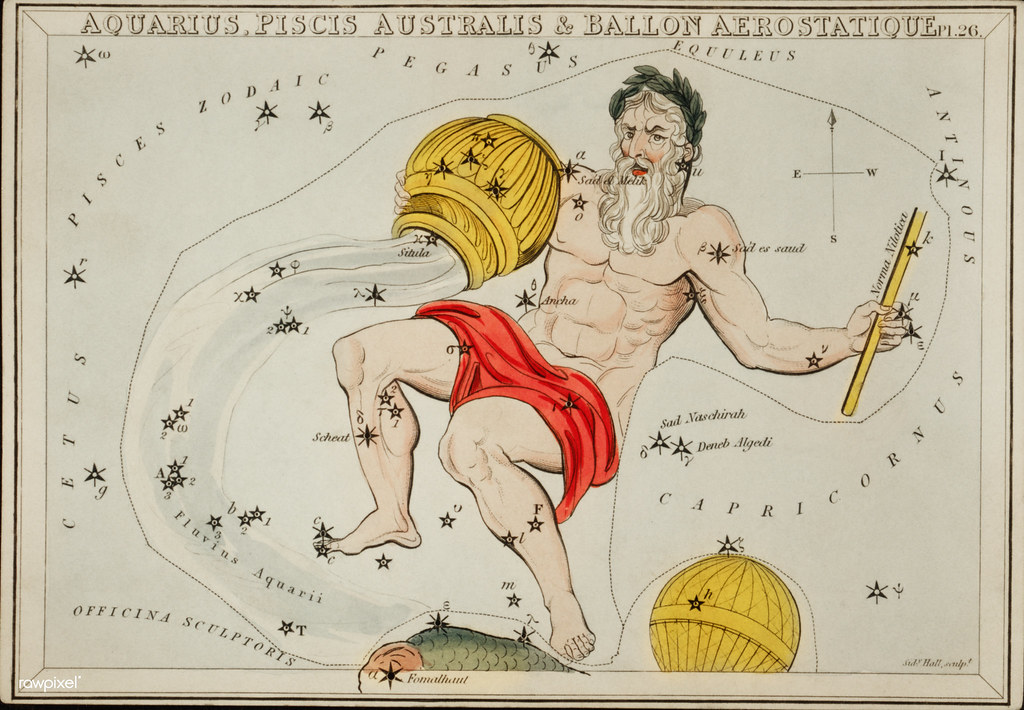
Aquarius constellation map courtesy of Openverse
Aquarius, “Water Bearer” – The Aquarius minor constellation is located in the southern hemisphere, and symbolizes “water bearer.” Aquarius is one of the twelve zodiac constellations, located on the celestial equator in the southern celestial hemisphere. Its name means “the water-bearer” in Latin, and its symbol represents water. Aquarius is found in a sky area called the Sea, sharing this space with other water-related constellations like Pisces, Eridanus, and Cetus. The Greek astronomer Ptolemy documented Aquarius in the 2nd century CE. Notable stars in Aquarius include Sadalsuud and Sadalmelik, and it is home to many stars with planets, such as TRAPPIST-1. Aquarius also contains significant deep sky objects, like the globular clusters Messier 2 and 72, and the Saturn and Helix Nebulae. The constellation features a distinct asterism called the Water Jar, made up of four stars, as well as Messier 73, which was reclassified as an asterism in 2002. Another asterism, the Lightning Bolt, includes the supergiants and forms a zig-zag pattern.

NGC 7009 ‘Saturn Nebula’ courtesy of Openverse
Key points regarding Aquarius:
- Meaning: The term “Aquarius” translates to “Water Bearer” in Greek. The constellation comprises 15 designated stars. The star names that have been sanctioned by the International Astronomical Union (IAU) include Albali (Epsilon Aquarii A), Ancha (Theta Aquarii), Bosona (HD 206610), Bunda (Xi Aquarii A), Lionrock (HD 212771), Márohu (WASP-6), Sadachbia (Gamma Aquarii Aa), Sadalmelik (Alpha Aquarii), Sadalsuud (Beta Aquarii), Safina (88 Aquarii), Shatabhisha (Lambda Aquarii), Situla (Kappa Aquarii A), Skat (Delta Aquarii A), Wouri (WASP-69), and Zembra (HATS-72). Aquarius is part of the zodiac family of constellations, which also includes Aries, Taurus, Gemini, Cancer, Leo, Virgo, Libra, Scorpius, Sagittarius, Capricornus, and Pisces. The constellation features three Messier objects: Messier 2 (NGC 7089), Messier 72 (NGC 6981), and Messier 73 (NGC 6994). Additionally, there are four meteor showers linked to Aquarius: the March Aquariids, Eta Aquariids, Delta Aquariids, and Iota Aquariids.
- Notable stars: The Aquarius constellation contains mostly dim stars, with two bright ones: Sadalsuud, a yellow supergiant 541.55 light-years away, and Sadalmelik, slightly fainter and located 690.8 light-years away. The constellation has notable stars with exoplanets, including TRAPPIST-1, a red dwarf found in 1999 that is 40.66 light-years from Earth and has seven potentially habitable exoplanets discovered in 2016. Other stars include Skat, Zeta Aquarii—a triple star system—and varieties of red dwarf systems like EZ Aquarii and LP 876-10.Several stars in Aquarius have historical names linked to fortune from Arabic. Albali (ε Aqr) is a binary star system 244 light-years away, while Sadachbia (γ Aqr) is a double star system 164 light-years away. Ancha (θ Aqr) is a yellow giant star, and Psi1 Aquarii (ψ1 Aqr) is a triple system with an exoplanet. R Aquarii, about 711 light-years away, is a symbiotic star system containing a red giant and a white dwarf.Other stars like Lionrock and Bosona host known exoplanets, while Gliese 876 and Gliese 849 are nearby red dwarfs with multiple planets. Márohu (WASP-6) is an older yellow dwarf with an inflated hot Jupiter, and Wouri (WASP-69) has a planet discovered in 2013. HATS-72 also has a super-aged star with a newly found planet. HD 215152 has four confirmed planets, potentially rocky, and WASP-47, like the Sun, has four planets including a gas giant.
- Other features: Aquarius contains many notable deep-sky objects that can be seen with small to medium telescopes. It features three Messier objects: Messier 2 and Messier 72, which are globular clusters, and Messier 73, an asterism. Messier 2 is large and located about 55,000 light-years away, while Messier 72 is around 54,570 light-years distant. Aquarius also has two planetary nebulae: the Saturn Nebula, 2,000 to 4,000 light-years away, and the Helix Nebula, 650 light-years away.Notable spiral galaxies include NGC 7606 and NGC 7723, as well as NGC 7727, which is 76 million light-years away and has two supermassive black holes. Its unusual features suggest it formed from a galaxy merger. The Atoms for Peace Galaxy, NGC 7252, is a peculiar galaxy resulting from a collision of galaxies. Other galaxies mentioned include NGC 7047, NGC 7069, NGC 7393, and NGC 7592, each with unique aspects.The Aquarius Stream is the closest stellar stream to Earth, formed about 700 million years ago. Abell 2597 is a galaxy cluster with a giant elliptical galaxy 1 billion light-years away. Several other galaxies and cosmic features, such as PGC 1228197 and RX J2129. 7+0005 BCG, are noted for their interesting characteristics and distances.
- Mythology: Aquarius is shown as a young man pouring water from an amphora into the mouth of the Southern Fish, linked to the star Fomalhaut. The stream of stars can be seen on clear nights. In the Early Bronze Age, Aquarius marked the winter solstice. Greek mythology connects Aquarius to Ganymede, a handsome youth taken by Zeus to serve as cupbearer to the gods. Another story links the constellation to Deucalion, who survived a great flood. In Babylonian myths, Aquarius is identified with the god Ea, depicted with an overflowing cup. In Egyptian mythology, it represents Hapi, the god of the Nile, associated with the river’s flooding and fertile soil.
- Visibility: Aquarius is the 10th largest constellation, covering 980 square degrees. It is classified among the 15 equatorial constellations. The majority of this constellation is situated in the fourth quadrant of the southern hemisphere (SQ4). The entire constellation can be observed from locations with latitudes ranging from +65° to -90°. The neighboring constellations include Aquila, Capricornus, Cetus, Delphinus, Equuleus, Pegasus, Pisces, Piscis Austrinus, and Sculptor. The name of the constellation, Aquarius, is pronounced /əˈkwɛəriəs/. In English, it is referred to as the Water-Bearer. The genitive form of Aquarius, which is used in the naming of stars, is Aquarii (pronunciation: /əˈkwɛəriaɪ/). The three-letter abbreviation, which was adopted by the International Astronomical Union (IAU) in 1922, is Aqr. Aquarius features two stars that shine brighter than magnitude 3.00 and seven stars that are situated within 10 parsecs (32.6 light years) of Earth. The brightest star within this constellation is Beta Aquarii, also known as Sadalsuud, which has an apparent magnitude of 2.87. The closest star to Earth is EZ Aquarii, a triple star system made up of three M-type dwarfs, located at a distance of 11.11 light years from our planet.
⁺‧₊☽◯☾₊‧⁺⋆⁺‧₊☽◯☾₊‧⁺⋆⁺‧₊☽◯☾₊‧⁺⋆⁺‧₊☽◯☾₊‧⁺⋆⁺‧₊☽◯☾₊‧⁺⋆⁺‧₊☽◯☾₊‧⁺⋆
Constellations:
| Constellations by Month | ||
| JANUARY [8] | FEBRUARY [7] | MARCH [7] |
| Taurus | Camelopardalis | Ursa Major |
| Orion | Auriga | Cancer |
| Lepus | Gemini | Canis Minor |
| Caelum | Monoceros | Pyxis |
| Reticulum | Canis Major | Vela |
| Dorado | Columba | Carina |
| Pictor | Puppis | Volans |
| Mensa | ||
| APRIL [8] | MAY [7] | JUNE [6] |
| Ursa Major | Canes Venatici | Ursa Minor |
| Leo Minor | Coma Berenices | Boötes |
| Leo | Virgo | Libra |
| Sextans | Corvus | Lupus |
| Crater | Centaurus | Circinus |
| Hydra | Crux | Apus |
| Antlia | Musca | |
| Chamaeleon | ||
| JULY [9] | AUGUST [9] | SEPTEMBER [6] |
| Draco | Lyra | Cygnus |
| Corona Borealis | Vulpecula | Delphinus |
| Hercules | Sagitta | Equuleus |
| Serpens | Aquila | Capricornus |
| Ophiuchus | Scutum | Microscopium |
| Scorpius | Sagittarius | Indus |
| Norma | Corona Australis | |
| Ara | Telescopium | |
| Triangulum Australe | Pavo | |
| OCTOBER [7] | NOVEMBER [8] | DECEMBER [6] |
| Cepheus | Cassiopeia | Perseus |
| Lacerta | Andromeda | Triangulum |
| Pegasus | Pisces | Aries |
| Aquarius | Cetus | Eridanus |
| Piscis Austrinus | Sculptor | Fornax |
| Grus | Phoenix | Horologium |
| Octans | Tucana | |
| Hydrus | ||

Sidney Hall’s (1831) astronomical chart illustration of the zodiacs Aquaris, Piscis Australis and Ballon Aerostatique. Original from Library of Congress. Digitally enhanced by rawpixel. courtesy of Openverse
Constellations of the Month:
October – Aquarius
Material may be shared for personal and educational use, Share with family and friends. The material cannot be used in an educational setting whereby a “book fee” is charged in or above tuition costs, and the material here is being used without paying a licensing fee.. AI must file an application for use of such material.
| You May Also Like. . . | |
 NASA 1997 Liftoff Special |
 NASA Mission Patch Party |
More on Versatileer:
![Bright Dark Rainbow 3.png]()
Happy Pride Day – 2022
06/19/2022![Hands Free Dog Leash-from Lifehandle]()
Hands-Free Dog Leash from LifeHandle – Review
12/06/2022![Mmm...Croutons! and..er.. some soup.jpg]()
Happy National Crouton Day – 2025
05/13/2025![The Birth of Death Blitz__BUTTON.jpg]()
Ends 06-14 – The Birth of Death by Joseph P. Macolino Book Blitz + $25 Amazon Gift Card + eBook Copy...
06/05/2023![#LIVE #SwitchOnSummer Celebration – The Buckingham Fountain - Chicago, IL]()
#LIVE #SwitchOnSummer Celebration – The Buckingham Fountain - Chicago, IL
05/22/2021





























Very nice