Constellations of the Month: October – Cepheus:
We start October with the first constellation of the month, Cepheus, “King Cepheus of Aethiopia.”

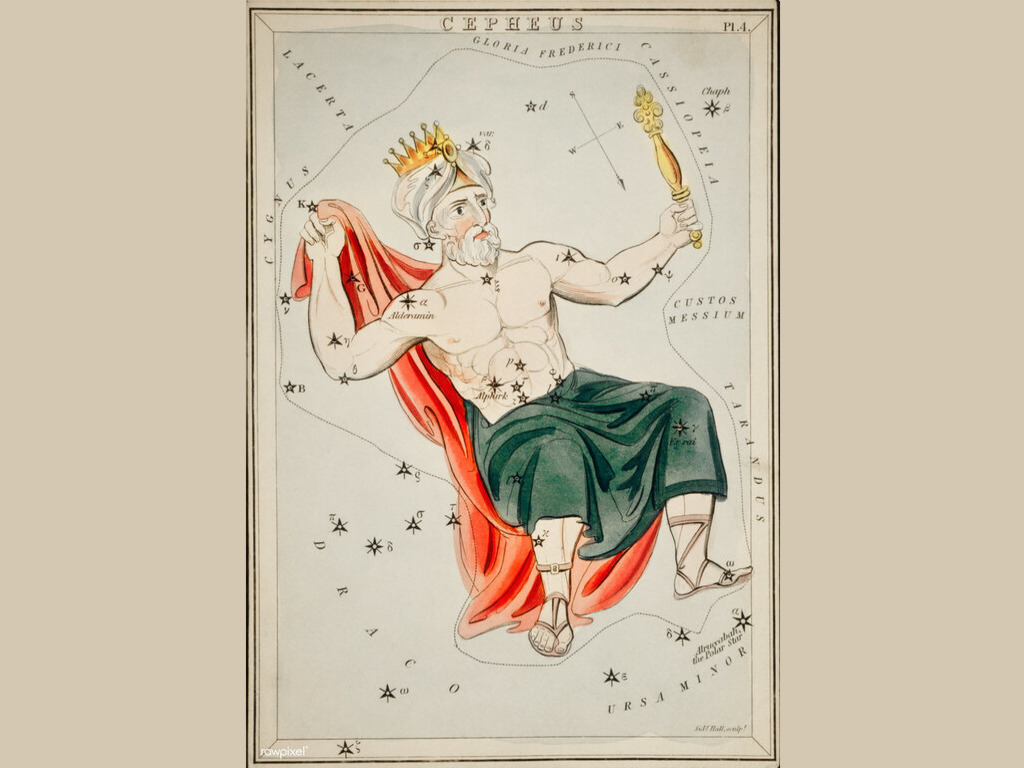
Cepheus constellation map courtesy of Openverse
Cepheus, “King Cepheus of Aethiopia” – The Cepheus constellation is located in the northern hemisphere, and symbolizes “the king of Aethiopia.” Cepheus derives its name from the legendary King Cepheus of Aethiopia, who was the spouse of Cassiopeia and the father of Andromeda, both of whom are depicted by adjacent constellations. Similar to many other constellations within the Perseus family, Cepheus was documented by the Greek astronomer Ptolemy during the 2nd century. Within this constellation, one can find VV Cephei and the Garnet Star (Mu Cephei), both of which are among the largest known stars in the Milky Way. Additionally, it contains several prominent deep sky objects, including the Bow-Tie Nebula, the Cave Nebula, the Wizard Nebula, the Iris Nebula, the Ghost Nebula, the Rosebud Nebula, the Flying Bat and Giant Squid nebulae, the Lion Nebula, the Seahorse Nebula, the Shark Nebula, and the Fireworks Galaxy.

NGC 7023 courtesy of Openverse
Key points regarding Cepheus:
- Meaning: The term “Cepheus” translates to “King Cepheus of Aethiopia” in Greek. The constellation Cepheus features a single star with confirmed planets and does not include any Messier objects. The most luminous star in this constellation is Alderamin, designated as Alpha Cephei. Additionally, there are no meteor showers linked to Cepheus. This constellation comprises five stars that have been officially named. The names of these stars, as recognized by the International Astronomical Union (IAU), are Alderamin, Alfirk, Errai, Garnet Star, and Kurhah.
- Notable stars: Alpha Cephei, or Alderamin, is the brightest star in its constellation, a white class A subgiant located about 49 light years away, with a quick rotation cycle of under 12 hours. It is visible in Europe, northern Asia, Canada, and most of North America. Beta Cephei, a triple star around 690 light years away, has an apparent magnitude of 3.15 to 3.21 and features the blue giant Alfirk A, changing brightness due to surface pulsations. Delta Cephei, about 891 light years distant, varies in brightness as a Cepheid variable star with a cycle of 5.36634 days. Gamma Cephei, an orange subgiant about 45 light years away, may become the northern pole star by 3000 AD. Zeta Cephei, about 730 light years from Earth, is an orange subgiant suspected of being binary. Eta Cephei, a K0 orange giant around 45 light years away, exhibits high proper motion. Mu Cephei, or Herschel’s Garnet Star, is a red supergiant 2,090 light years away, nearing supernova stage. VV Cephei is an eclipsing binary star at 2,400 light years, whereas V381 Cephei is a pulsating red supergiant 3,663 light years away. Lastly, Kruger 60 is a binary system of red dwarfs just 13.15 light years away.
- Other features: The Fireworks Galaxy, an intermediate spiral galaxy in Cepheus, is about 22 million light years away and has an apparent magnitude of 9.6. Discovered by William Herschel in 1798, it has observed nine supernovae in the last century. NGC 7380, known as the Wizard Nebula, is a young open star cluster discovered by Caroline Herschel in 1787, located approximately 7,000 light years from the solar system. NGC 7538 is an emission/reflection nebula, containing the largest known protostar, 9,100 light years away. NGC 188 is one of the oldest open clusters, about 5,400 light years distant. The Iris Nebula (NGC 7023) is a reflection nebula with a brightness of 6.8, around 1,300 light years away. The Rosebud Nebula is a young cluster with over 130 stars, located 3,300 light years away. NGC 7142 is an old open cluster, approximately 6,200 light years distant, with many young blue stars.
- Mythology: The constellation Cepheus represents the king of Ethiopia, who was placed in the sky by Zeus after his tragic end. Cepheus ruled an area that includes parts of modern-day Egypt, Israel, and Jordan. His wife, Cassiopeia, was vain and boasted of her beauty, angering the sea nymphs and Poseidon. He sent a sea monster, Cetus, to destroy their land. To save his kingdom, Cepheus consulted an oracle, which advised him to sacrifice his daughter, Andromeda, to the monster. Perseus rescued Andromeda and married her. During their wedding, Cepheus’ brother Phineus tried to claim Andromeda, leading to a fight where Perseus turned his enemies to stone, including Cepheus and Cassiopeia.
- Visibility: Cepheus is the 27th largest constellation, covering 588 square degrees. It is situated in the fourth quadrant of the northern hemisphere (NQ4) and is observable at latitudes ranging from +90° to -10°. The constellations that border it include Camelopardalis, Cassiopeia, Cygnus, Draco, Lacerta, and Ursa Minor. The name Cepheus is pronounced /ˈsiːfiəs/. In English, it is referred to as Cepheus or the King. The genitive form of Cepheus, which is utilized in the naming of stars, is Cephei (pronunciation: /ˈsiːfiaɪ/). The three-letter abbreviation, which was established by the International Astronomical Union (IAU) in 1922, is Cep. Cepheus is part of the Perseus family of constellations, which also includes Andromeda, Auriga, Cassiopeia, Cetus, Lacerta, Pegasus, Perseus, and Triangulum.
⁺‧₊☽◯☾₊‧⁺⋆⁺‧₊☽◯☾₊‧⁺⋆⁺‧₊☽◯☾₊‧⁺⋆⁺‧₊☽◯☾₊‧⁺⋆⁺‧₊☽◯☾₊‧⁺⋆⁺‧₊☽◯☾₊‧⁺⋆
Constellations:
| Constellations by Month | ||
| JANUARY [8] | FEBRUARY [7] | MARCH [7] |
| Taurus | Camelopardalis | Ursa Major |
| Orion | Auriga | Cancer |
| Lepus | Gemini | Canis Minor |
| Caelum | Monoceros | Pyxis |
| Reticulum | Canis Major | Vela |
| Dorado | Columba | Carina |
| Pictor | Puppis | Volans |
| Mensa | ||
| APRIL [8] | MAY [7] | JUNE [6] |
| Ursa Major | Canes Venatici | Ursa Minor |
| Leo Minor | Coma Berenices | Boötes |
| Leo | Virgo | Libra |
| Sextans | Corvus | Lupus |
| Crater | Centaurus | Circinus |
| Hydra | Crux | Apus |
| Antlia | Musca | |
| Chamaeleon | ||
| JULY [9] | AUGUST [9] | SEPTEMBER [6] |
| Draco | Lyra | Cygnus |
| Corona Borealis | Vulpecula | Delphinus |
| Hercules | Sagitta | Equuleus |
| Serpens | Aquila | Capricornus |
| Ophiuchus | Scutum | Microscopium |
| Scorpius | Sagittarius | Indus |
| Norma | Corona Australis | |
| Ara | Telescopium | |
| Triangulum Australe | Pavo | |
| OCTOBER [7] | NOVEMBER [8] | DECEMBER [6] |
| Cepheus | Cassiopeia | Perseus |
| Lacerta | Andromeda | Triangulum |
| Pegasus | Pisces | Aries |
| Aquarius | Cetus | Eridanus |
| Piscis Austrinus | Sculptor | Fornax |
| Grus | Phoenix | Horologium |
| Octans | Tucana | |
| Hydrus | ||

Sidney Hall’s (1831) astronomical chart illustration of the Cepheus. Original from Library of Congress. Digitally enhanced by rawpixel. courtesy of Openverse
Constellations of the Month:
October – Cepheus
Material may be shared for personal and educational use, Share with family and friends. The material cannot be used in an educational setting whereby a “book fee” is charged in or above tuition costs, and the material here is being used without paying a licensing fee.. AI must file an application for use of such material.
| You May Also Like. . . | |
 NASA 1997 Liftoff Special |
 NASA Mission Patch Party |