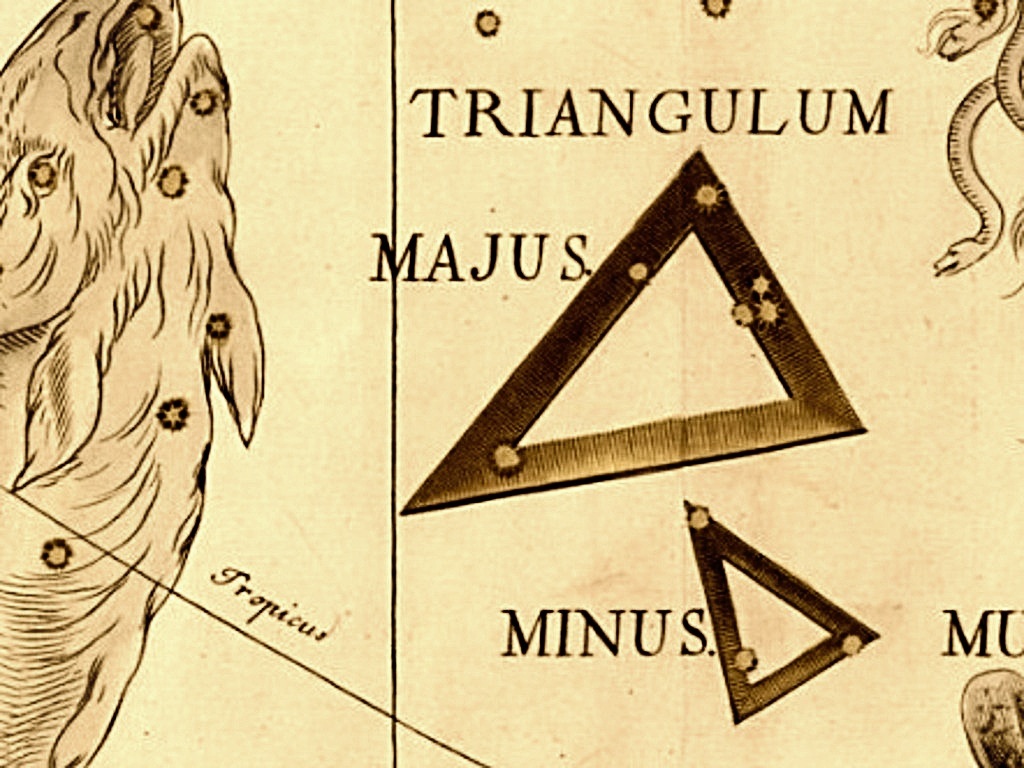
Constellations of the Month: July – Triangulum Australe:
We continue July with the last constellation of the month, Triangulum Australe, “The Southern Triangle.”

Triangulum Australe constellation map courtesy of Openverse
Triangulum Australe, “The Southern Triangle” – The constellation of Triangulum Australe is located in the southern hemisphere, and its symbolism translates to “the southern triangle” in Latin. The constellation has three most luminous stars within the constellation create an equilateral triangle. Triangulum Australe was established by the Dutch astronomer Petrus Plancius during the late 16th century, with its first representation appearing in 1603 in Johann Bayer’s Uranometria. This constellation is positioned too far south to be observed from Europe and the majority of the northern hemisphere; however, it never descends below the horizon south of the equator.

NGC 5979 courtesy of Openverse
Key points regarding Triangulum Australe:
- Meaning: The term “Triangulum Australe” translates to “The Southern Triangle” in Latin. The constellation Triangulum Australe features a single star that has a confirmed planet and does not include any Messier objects. The constellation’s brightest star is Atria, designated as Alpha Trianguli Australis, which has an apparent magnitude of 1.91. Additionally, there are no meteor showers linked to this constellation. Within Triangulum Australe, there exists one star that has been formally named. The name of this star, which has received approval from the International Astronomical Union (IAU), is Atria. The deep sky objects found in Triangulum Australe comprise the planetary nebulae NGC 5979 and Henize 2-138, the interacting galaxies ESO 69-6, the open cluster NGC 6025, the spiral galaxy NGC 5938, and the Jellyfish Galaxy (ESO 137-001), which is part of the Norma Cluster.
- Notable stars: Alpha Trianguli Australis is the brightest star in the Triangulum Australe constellation, with an apparent magnitude of 1.91 and located about 391 light years from Earth. It is an orange bright giant, approximately 48 million years old, with a mass around seven times that of the Sun and significantly greater luminosity. It is believed to be a binary star. Beta Trianguli Australis is the second brightest star in the constellation, with a visual magnitude of 2.85 and a distance of about 40.37 light years. It is a double star consisting of a yellow-white main sequence star and a faint companion. Gamma Trianguli Australis, the third brightest star, is a white main sequence dwarf with a magnitude of 2.87 and a distance of about 184 light years. It shows rapid rotation and has similar excess infrared emissions indicating a circumstellar disk. Other notable stars include Delta Trianguli Australis, a binary yellow supergiant, and Epsilon Trianguli Australis, a wide double star system. Zeta, Kappa, and Iota Trianguli Australis feature different stellar classifications and distances, while Theta is a yellow giant. X Trianguli Australis is a red carbon star, and HD 133683 is a bright giant. Finally, Eta Trianguli Australis, HD 147018, and EK Trianguli Australis have their unique characteristics, including planets and variable brightness.
- Other features: ESO 69-6 is a pair of galaxies that are colliding and merging, located about 600 million light years from the solar system. NGC 6025 is an open cluster with an apparent magnitude of 5.1, approximately 2,700 light years away and discovered by Nicolas Louis de Lacaille in 1751-1752. NGC 5938 is a spiral galaxy around 300 million light years from Earth, south of Epsilon Trianguli Australis. The Jellyfish Galaxy (ESO 137-001) is a barred spiral galaxy in the Norma Cluster, notable for its 260,000 light-year tail. NGC 5979 is a planetary nebula with an apparent magnitude of 12.3. Henize 2-138 is a smaller planetary nebula with a visual magnitude of 11.0.
- Mythology: Triangulum Australe is the smallest of the 12 constellations created by Dutch navigators in the late 16th century and has no associated myths. It first appeared in 1589 on a celestial globe by Petrus Plancius, where it was incorrectly labeled Triangulus Antarcticus. Johann Bayer named it Triangulum Australe in 1603. In 1756, Nicolas Louis de Lacaille referred to it as “le Triangle Austral ou le Niveau,” relating it to surveying tools. Johann Bode later called it Libella in 1801.
- Visibility: Triangulum Australe is the 83rd largest constellation, covering 110 square degrees. It is situated in the third quadrant of the southern hemisphere (SQ3) and is visible at latitudes ranging from +25° to -90°. The constellations that border it include Apus, Ara, Circinus, and Norma. The name Triangulum Australe is pronounced /traɪˈæŋɡjʊləm ɔːˈstræliː/. In English, it is referred to as the Southern Triangle. The genitive form used for star names is Trianguli Australis (pronunciation: /traɪˈæŋɡjʊlaɪ ɔːˈstrælɪs/). The three-letter abbreviation, which was established by the International Astronomical Union (IAU) in 1922, is TrA. Triangulum Australe is part of the Hercules family of constellations, which also includes Aquila, Ara, Centaurus, Corona Australis, Corvus, Crater, Crux, Cygnus, Hercules, Hydra, Lupus, Lyra, Ophiuchus, Sagitta, Scutum, Sextans, Serpens, and Vulpecula.
⁺‧₊☽◯☾₊‧⁺⋆⁺‧₊☽◯☾₊‧⁺⋆⁺‧₊☽◯☾₊‧⁺⋆⁺‧₊☽◯☾₊‧⁺⋆⁺‧₊☽◯☾₊‧⁺⋆⁺‧₊☽◯☾₊‧⁺⋆
Constellations:
| Constellations by Month | ||
| JANUARY [8] | FEBRUARY [7] | MARCH [7] |
| Taurus | Camelopardalis | Ursa Major |
| Orion | Auriga | Cancer |
| Lepus | Gemini | Canis Minor |
| Caelum | Monoceros | Pyxis |
| Reticulum | Canis Major | Vela |
| Dorado | Columba | Carina |
| Pictor | Puppis | Volans |
| Mensa | ||
| APRIL [8] | MAY [7] | JUNE [6] |
| Ursa Major | Canes Venatici | Ursa Minor |
| Leo Minor | Coma Berenices | Boötes |
| Leo | Virgo | Libra |
| Sextans | Corvus | Lupus |
| Crater | Centaurus | Circinus |
| Hydra | Crux | Apus |
| Antlia | Musca | |
| Chamaeleon | ||
| JULY [9] | AUGUST [9] | SEPTEMBER [6] |
| Draco | Lyra | Cygnus |
| Corona Borealis | Vulpecula | Delphinus |
| Hercules | Sagitta | Equuleus |
| Serpens | Aquila | Capricornus |
| Ophiuchus | Scutum | Microscopium |
| Scorpius | Sagittarius | Indus |
| Norma | Corona Australis | |
| Ara | Telescopium | |
| Triangulum Australe | Pavo | |
| OCTOBER [7] | NOVEMBER [8] | DECEMBER [6] |
| Cepheus | Cassiopeia | Perseus |
| Lacerta | Andromeda | Triangulum |
| Pegasus | Pisces | Aries |
| Aquarius | Cetus | Eridanus |
| Piscis Austrinus | Sculptor | Fornax |
| Grus | Phoenix | Horologium |
| Octans | Tucana | |
| Hydrus | ||
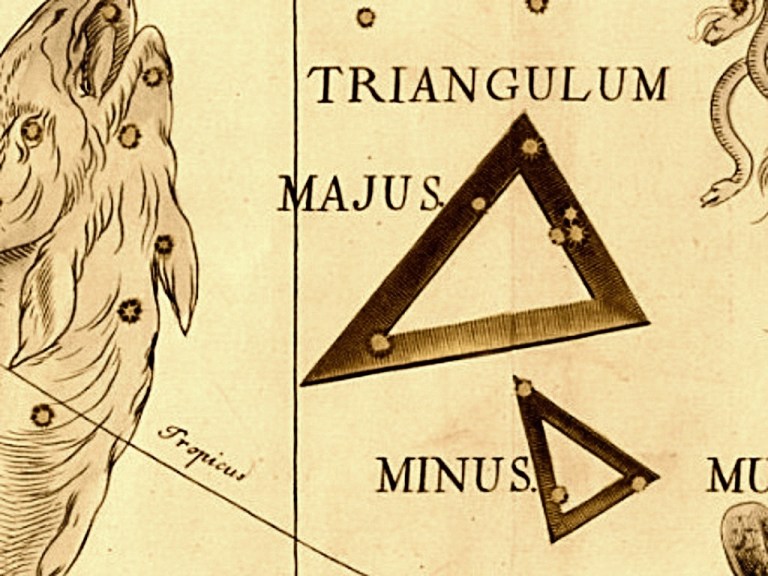
Triangulum Australe courtesy of Openverse
Constellations of the Month:
July – Triangulum Australe
Material may be shared for personal and educational use, Share with family and friends. The material cannot be used in an educational setting whereby a “book fee” is charged in or above tuition costs, and the material here is being used without paying a licensing fee.. AI must file an application for use of such material.
| You May Also Like. . . | |
 NASA 1997 Liftoff Special |
 NASA Mission Patch Party |
More on Versatileer:
![wp-1690579135083.jpg]()
Featured Photo: Flower of the Day – The Dancing Butterflies Peony
07/28/2023![20211013_213846.jpg]()
Featured Photos: The 13 Days of Halloween – Day 4: Scares on Sequoia
10/21/2021![honesty, forgiveness.jpg]()
Happy National Honesty Day – 2025
04/30/2025!['Give Me Your Sins'.jpg]()
Celebrate the Birth of Jesus! Merry Christmas '25
12/25/2025![INSTA_ScienceofAttraction.png]()
The Science of Attraction by Jay Hogan Cover Reveal – Release Date February 22nd
01/26/2024






























wonderful!
I am going to take more time to look up at the sky. The weather is changing. I am excited for the fall.