Constellations of the Month: May – Coma Berenices:
We continue May with the next constellation of the month, Coma Berenices, “Berenice’s Hair.”
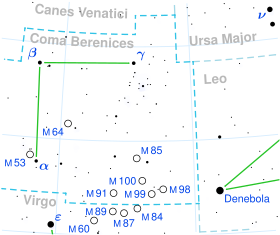
Coma Berenices constellation map courtesy of Openverse
Coma Berenices, “Berenice’s Hair” – The Coma Berenices constellation is located in the northern hemisphere, and symbolizes “the Berenice’s hair.” Coma Berenices, named after Queen Berenice II of Egypt. It marks the North Galactic Pole. Ptolemy viewed it as part of the Leo constellation until the 16th century when it became recognized as its own constellation, thanks to cartographer Caspar Vopel. Danish astronomer Tycho Brahe later included Coma Berenices in his 1602 star catalogue. Though small, it features notable deep sky objects like the Black Eye Galaxy and other galaxies in the Coma Cluster and the Virgo clusters’ northern part.

Hubble Sees ‘Island Universe’ in the Coma Cluster courtesy of Openverse
Key points regarding Coma Berenices:
- Meaning: The term “Coma Berenices” translates to “Berenice’s Hair” in Latin. The constellation Coma Berenices features two officially recognized stars. The names sanctioned by the International Astronomical Union (IAU) are Diadem (Alpha Comae Berenices A) and Phyllon Kissinou (23 Comae Berenices A).
- Notable stars: Diadem is the second brightest star in Coma Berenices, with a brightness of 4.32. It symbolizes the gem in Queen Berenice’s crown. The name comes from the Greek word for “band. ” Diadem is a binary star system, about 63 light years away, made of two stars near each other. Alpha Comae Berenices, also called Al Zafirah, means “the braid. ” Beta Comae Berenices is the brightest star in the constellation, despite being labeled beta, with a brightness of 4.26 and a distance of 29.78 light years. Gamma Comae Berenices is a giant star, about 170 light years away. FK Comae Berenices is a variable star that changes brightness over 2.4 days. 23 Comae Berenices is a binary system, around 310 light years away, and has a new name, Phyllon Kissinou, approved by the IAU.
- Other features: The Black Eye Galaxy (Messier 64) is a spiral galaxy about 24 million light years from Earth, also known as the Sleeping Beauty Galaxy. Its bright center and dark dust band give it the nickname Evil Eye. Its outer gas rotates opposite to its inner regions, possibly due to an ancient merger with a smaller galaxy. The Needle Galaxy, discovered by Sir William Herschel, is a famous edge-on spiral galaxy seen with small telescopes, located 42.7 million light years away. The Coma Star Cluster, with around 40 bright stars, lies about 280 light years from Earth. The Coma Cluster, 230-300 million light years away, includes about 1,000 large galaxies. The constellation Coma Berenices is home to the Virgo Cluster, about 60 million light years from Earth. Messier 53 is a globular cluster found northeast of Alpha Comae Berenices. Messier 100 is a prominent spiral galaxy in the Virgo Cluster, discovered in 1781. Other galaxies in the area include Messier 85, Messier 88, and Messier 91, along with NGC 4889, a supergiant elliptical galaxy in the Coma Cluster.
- Mythology: Coma Berenices is linked to Queen Berenice II of Egypt, who was married to Ptolemy III Euergetes. During the Third Syrian War, she feared for his life and promised Aphrodite she would cut her long, blonde hair if he returned safely. After Ptolemy came back, Berenice kept her vow and placed her hair in Aphrodite’s temple, but it vanished the next day. To calm the king’s anger, the astronomer Conon said the hair was turned into stars, now called Berenice’s Hair.
- Visibility: Coma Berenices is the 42nd largest constellation, covering 386 square degrees in the northern hemisphere. It can be viewed at latitudes from +90° to -70° and is near the constellations Boötes, Canes Venatici, Leo, Ursa Major, and Virgo. The name Coma Berenices means Berenice’s Hair in English and is pronounced /ˈkoʊmə bɛrəˈnaɪsiːz/. It belongs to the Ursa Major family and contains two stars with known planets, along with eight Messier objects. The brightest star is Beta Comae Berenices, and there is one meteor shower, the Coma Berenicids.
⁺‧₊☽◯☾₊‧⁺⋆⁺‧₊☽◯☾₊‧⁺⋆⁺‧₊☽◯☾₊‧⁺⋆⁺‧₊☽◯☾₊‧⁺⋆⁺‧₊☽◯☾₊‧⁺⋆⁺‧₊☽◯☾₊‧⁺⋆
Constellations:
| Constellations by Month | ||
| JANUARY [8] | FEBRUARY [7] | MARCH [7] |
| Taurus | Camelopardalis | Ursa Major |
| Orion | Auriga | Cancer |
| Lepus | Gemini | Canis Minor |
| Caelum | Monoceros | Pyxis |
| Reticulum | Canis Major | Vela |
| Dorado | Columba | Carina |
| Pictor | Puppis | Volans |
| Mensa | ||
| APRIL [8] | MAY [7] | JUNE [6] |
| Ursa Major | Canes Venatici | Ursa Minor |
| Leo Minor | Coma Berenices | Boötes |
| Leo | Virgo | Libra |
| Sextans | Corvus | Lupus |
| Crater | Centaurus | Circinus |
| Hydra | Crux | Apus |
| Antlia | Musca | |
| Chamaeleon | ||
| JULY [9] | AUGUST [9] | SEPTEMBER [6] |
| Draco | Lyra | Cygnus |
| Corona Borealis | Vulpecula | Delphinus |
| Hercules | Sagitta | Equuleus |
| Serpens | Aquila | Capricornus |
| Ophiuchus | Scutum | Microscopium |
| Scorpius | Sagittarius | Indus |
| Norma | Corona Australis | |
| Ara | Telescopium | |
| Triangulum Australe | Pavo | |
| OCTOBER [7] | NOVEMBER [8] | DECEMBER [6] |
| Cepheus | Cassiopeia | Perseus |
| Lacerta | Andromeda | Triangulum |
| Pegasus | Pisces | Aries |
| Aquarius | Cetus | Eridanus |
| Piscis Austrinus | Sculptor | Fornax |
| Grus | Phoenix | Horologium |
| Octans | Tucana | |
| Hydrus | ||

Coma Berenices courtesy of Openverse
Constellations of the Month:
May – Coma Berenices
Material may be shared for personal and educational use, Share with family and friends. The material cannot be used in an educational setting whereby a “book fee” is charged in or above tuition costs, and the material here is being used without paying a licensing fee.. AI must file an application for use of such material.
| You May Also Like. . . | |
 NASA 1997 Liftoff Special |
 NASA Mission Patch Party |
More on Versatileer:
![white and green cera.jpg]()
Happy Holy Day, Maundy Thursday – 2024
03/28/2024![20240825_00_30__two_cpac_2d0__Hone.jpg]()
From the Satellite...Pacific Hurricane Hone on .GIPHY & Video + 2024 Season Info
09/15/2024![Demon’s Discovery__Object Rosemary & Necklace.png]()
Ends 02-28 – The Demon’s Discovery by L. Alexander Book Blitz + $25 Amazon Gift Card & Signed Copy G...
02/20/2024![National Nebraska Day '25.jpg]()
Happy National Nebraska Day – 2025
04/05/2025![BCRF__Another Year & More.jpg]()
Another Year in the Battle for Breast Cancer Awareness – 2023
11/06/2023