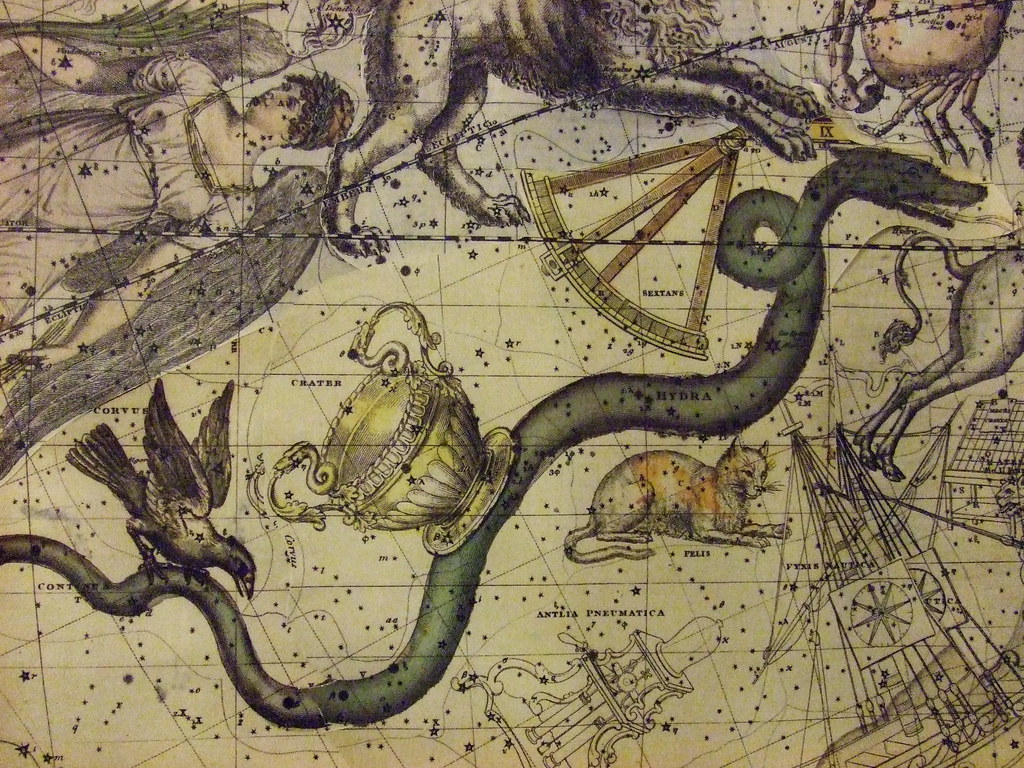
Constellations of the Month: April – Hydra:
We continue April with the next constellation of the month, Hydra, “The Water Snake.”
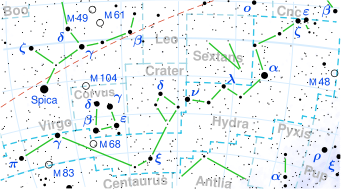
Hydra constellation map courtesy of Openverse
Hydra, “The Water Snake” – The Hydra constellation is a constellation in the southern sky and symbolizes “the water snake” in Latin. Hydra is one of the 15 equatorial constellations and has nine named stars approved by the International Astronomical Union: Alphard, Ashlesha, Felis, Filetdor, Lerna, Minchir, Solitaire, Ukdah, and Zhang. It includes three Messier objects: M48, M68, and M83. Hydra has 13 stars with known planets, and its brightest star is Alphard, with a magnitude of 1. 98. Two meteor showers, the Alpha Hydrids and Sigma Hydrids, are linked to this constellation.
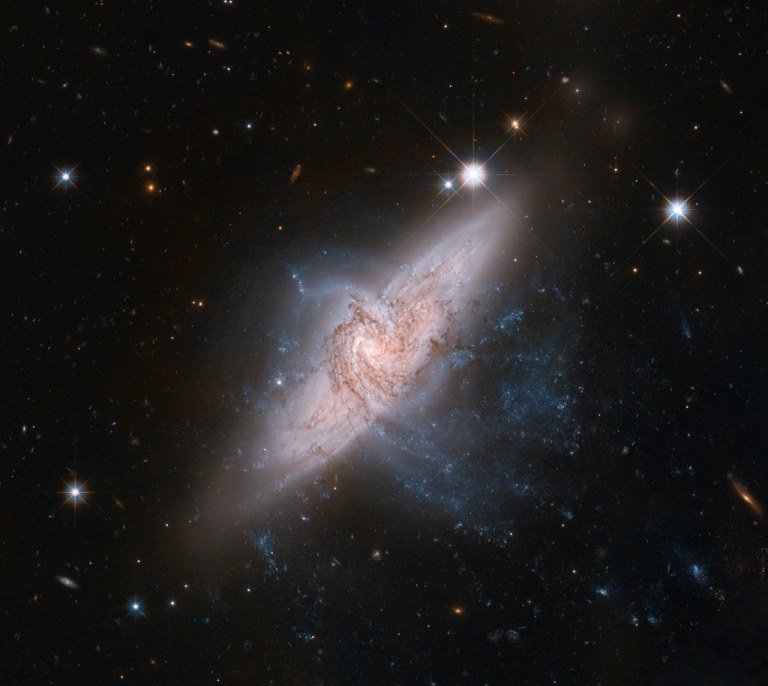
Zwei Galaxien – nicht auf Kollisionskurs, sondern weit voneinander entfernt courtesy of Openverse
Key points regarding Hydra:
- Meaning: The term “Hydra” translates to “The Water Snake.” Hydra is the largest constellation, with its head is south of Cancer, and its tail is between Centaurus and Libra. The constellation was first recorded by the Greek astronomer Ptolemy in the 2nd century and is linked to the Lernaean Hydra from Greek mythology. Notable deep sky objects in Hydra include Messier 48, Messier 68, the Southern Pinwheel Galaxy (Messier 83), the Hydra Cluster, and several other galaxies and nebulae.
- Notable stars: Alpha Hydrae is the brightest star in the Hydra constellation, with an apparent magnitude of 2.0 and a distance of about 177 light years from the Sun. It is classified as K3 II-III, a type between an orange giant and bright giant, with three solar masses and 50 times the solar radius. Its name, Alphard, means “the solitary one” in Arabic. Gamma Hydrae is the second brightest, with magnitude 2.993 and located 133.8 light years away. It is a yellow giant classified as G8 III and is 372 million years old. Zeta Hydrae ranks third in brightness, has a magnitude of 3.10, and is 167 light years away. It is an evolved giant star, approximately 400 million years old. Beta Hydrae is a binary star that is 370 light years away and has a combined magnitude of 4.276. Other notable stars include 27 Hydrae, a yellow giant 243.4 light years away; Sigma Hydrae, an orange giant at 353 light years; and R Hydrae, a variable red giant 410 light years away. The Epsilon Hydrae system consists of at least four stars and is about 129 light years away, while Nu Hydrae and Pi Hydrae are also significant stars in the constellation. Delta Hydrae is another binary star, located about 179 light years away.
- Other features: Messier 48 is an open star cluster located in Hydra, about 300 million years old and 1,500 light years away from Earth, with an apparent magnitude of 5.5. It was discovered by Charles Messier in 1771 and can be seen without binoculars under good conditions. Messier 68 is a globular cluster also in Hydra, discovered by Charles Messier in 1780. It has an apparent magnitude of 9.67 and is about 33,600 light years away from the solar system. The Hydra Cluster is a galaxy cluster that spans 10 million light years and includes 157 bright galaxies, including the elliptical galaxies NGC 3309 and NGC 3311. This cluster is 190.1 million light years distant and part of the larger Hydra-Centaurus Supercluster. Messier 83, known as the Southern Pinwheel Galaxy, is a barred spiral galaxy in Hydra, approximately 14.7 million light years from the Sun. It has a visual magnitude of 7.54 and was discovered by Nicolas Louis de Lacaille. Other notable objects include NGC 3242, a planetary nebula, and NGC 3109, a spiral or irregular galaxy interacting with Antlia Dwarf. There are several other galaxies and clusters mentioned with various distances and magnitudes.
- Mythology: The Hydra constellation comes from the Babylonian constellation MUL. DINGIR. MUŠ, which represented a serpent-like creature and is associated with the Greek Hydra. Hydra, in Greek mythology, is a large, multi-headed monster born from Typhon and Echidna. It has a brother named Ladon, who guards the Hesperides’ garden and is linked to the Draco constellation, while Heracles is honored by the Hercules constellation. Hydra had nine heads, one of which was immortal, while the constellation shows only the immortal head. The creature caused damage near Lerna, leading Heracles to use flaming arrows to smoke it out. During the battle, every head he crushed grew back two more. Heracles was briefly distracted by a crab, which became the Cancer constellation. With help from Iolaus, who burned the head stumps, Heracles eventually buried the immortal head. The myth also links Hydra to a story involving Apollo, a crow, and a cup, resulting in the eternal punishment of the crow (Corvus) and the creation of the water snake (Hydra) and the cup (Crater) as constellations.
- Visibility: Hydra is the largest constellation, covering 1303 square degrees in the night sky. It is located in the second quadrant of the southern hemisphere and can be seen at latitudes from +54° to -83°. Neighboring constellations include Antlia, Cancer, Canis Minor, and several others. The name Hydra is pronounced /ˈhaɪdrə/ and translates to Water Snake in English. Its genitive form for star names is Hydrae (/ˈhaɪdriː/), and the International Astronomical Union uses the abbreviation Hya. Hydra is part of the Hercules family of constellations.
⁺‧₊☽◯☾₊‧⁺⋆⁺‧₊☽◯☾₊‧⁺⋆⁺‧₊☽◯☾₊‧⁺⋆⁺‧₊☽◯☾₊‧⁺⋆⁺‧₊☽◯☾₊‧⁺⋆⁺‧₊☽◯☾₊‧⁺⋆
Constellations:
| Constellations by Month | ||
| JANUARY [8] | FEBRUARY [7] | MARCH [7] |
| Taurus | Camelopardalis | Leo Minor |
| Orion | Auriga | Cancer |
| Lepus | Gemini | Canis Minor |
| Caelum | Monoceros | Pyxis |
| Reticulum | Canis Major | Vela |
| Dorado | Columba | Carina |
| Pictor | Puppis | Volans |
| Mensa | ||
| APRIL [8] | MAY [7] | JUNE [6] |
| Ursa Major | Canes Venatici | Ursa Minor |
| Leo Minor | Coma Berenices | Boötes |
| Leo | Virgo | Libra |
| Sextans | Corvus | Lupus |
| Crater | Centaurus | Circinus |
| Hydra | Crux | Apus |
| Antlia | Musca | |
| Chamaeleon | ||
| JULY [9] | AUGUST [9] | SEPTEMBER [6] |
| Draco | Lyra | Cygnus |
| Corona Borealis | Vulpecula | Delphinus |
| Hercules | Sagitta | Equuleus |
| Serpens | Aquila | Capricornus |
| Ophiuchus | Scutum | Microscopium |
| Scorpius | Sagittarius | Indus |
| Norma | Corona Australis | |
| Ara | Telescopium | |
| Triangulum Australe | Pavo | |
| OCTOBER [7] | NOVEMBER [8] | DECEMBER [6] |
| Cepheus | Cassiopeia | Perseus |
| Lacerta | Andromeda | Triangulum |
| Pegasus | Pisces | Aries |
| Aquarius | Cetus | Eridanus |
| Piscis Austrinus | Sculptor | Fornax |
| Grus | Phoenix | Horologium |
| Octans | Tucana | |
| Hydrus | ||
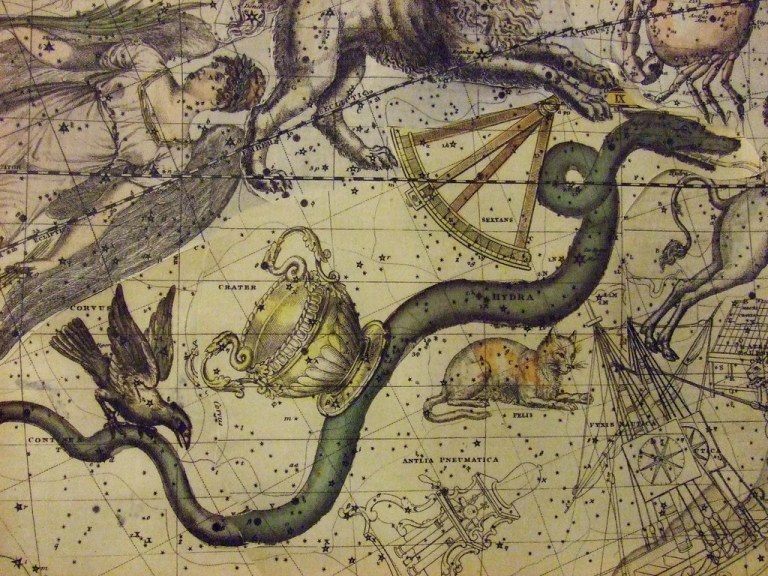
star collage (hydra) courtesy of Openverse
Constellations of the Month:
April – Hydra
Material may be shared for personal and educational use, Share with family and friends. The material cannot be used in an educational setting whereby a “book fee” is charged in or above tuition costs, and the material here is being used without paying a licensing fee.. AI must file an application for use of such material.
| You May Also Like. . . | |
 NASA 1997 Liftoff Special |
 NASA Mission Patch Party |