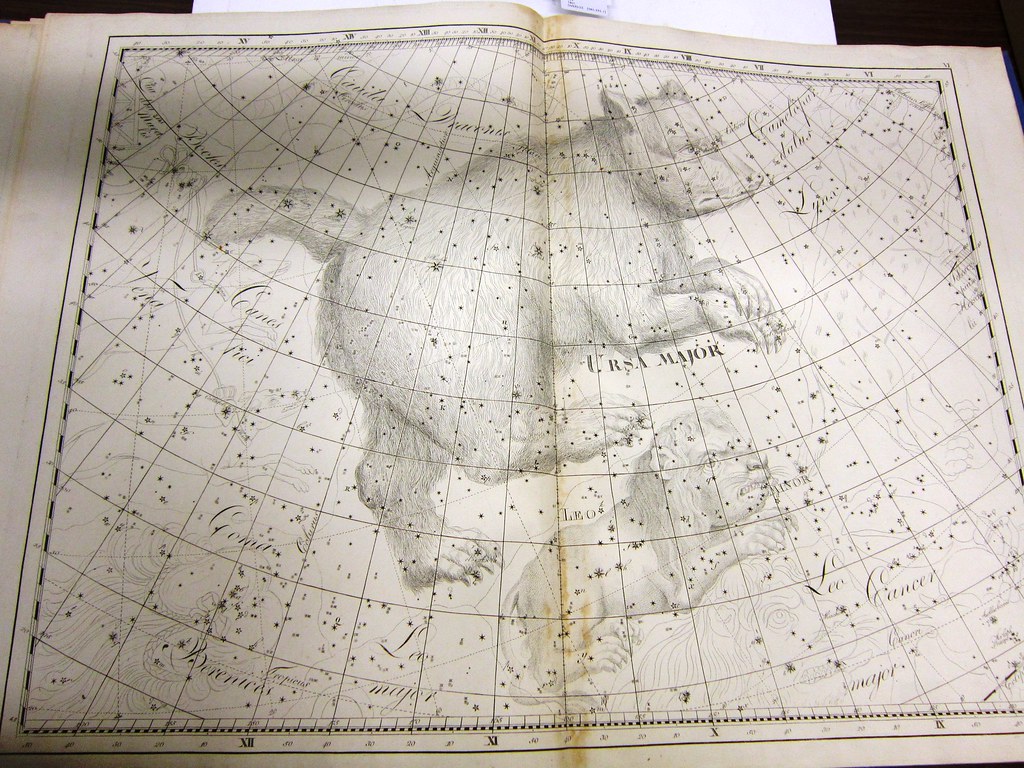
Constellations of the Month: April – Ursa Major:
We start April with the first constellation of the month, Ursa Major, “The Great Bear,” or “The Larger Bear.”
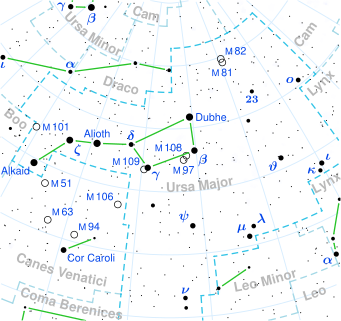
Ursa Major constellation map courtesy of Openverse
Ursa Major, “The Great Bear,” or “The Larger Bear” – The Ursa Major constellation (also the bright, western section referred to as “The Big Dipper”) is located in the northern hemisphere, and symbolizes “the great bear.” The smaller bear is Ursa Minor. Ursa Major is the largest northern constellation and the third largest in the sky. Its brightest stars create the Big Dipper asterism, a very recognizable shape, also called the Plough, and the “Saucepan”. Ursa Major is known in many cultures and has various myths. It was catalogued by the Greek astronomer Ptolemy in the 2nd century. In Greek mythology, it is linked to Callisto, a nymph turned into a bear by Hera. Ursa Major has notable stars and famous deep sky objects, including the Pinwheel Galaxy (M101), Bode’s Galaxy, the Cigar Galaxy, and the Owl Nebula. The Big Dipper is a recognizable pattern in Ursa Major, while Leo is a constellation associated with a lion.

A method to find Polaris at 5x the distance of Merak and Dubhe of Ursa Major courtesy of Openverse
The two bright stars of Dubhe and Merak, are called the pointer stars. To find Polaris, draw a line from Merak through Dubhe and extend it five times the distance between them. The Big Dipper serves as a legend to finding several of the northern hemisphere’s spring and summer constellations. The Big Dipper also is excellent to assisting finding the “Spring Triangle.” To find Regulus, the brightest star in Leo, extend a line from Megrez and Phecda below the bear. The handle section also points on an arc to two prominent constellations’ bright stars. “Arc to Arcturus, then spike to Spica” is the saying that allows you to follow the curve (arc) of the Big Dipper’s handle, extending it past the end. This will lead you to Arcturus, a bright yellow-orange star. Continue in a arc (spike) line from Arcturus, about the same distance, and you’ll find Spica, the brightest star in the Virgo constellation.

Constellation — Big Dipper courtesy of Openverse
Key points regarding Ursa Major:
- Meaning: The term “Ursa Major” translates to “The Great Bear,” or “The Larger Bear” in Latin. Ursa Major is a famous and important constellation found in many cultures, with a history that goes back to ancient times. It appears in works by Homer and the Bible and is commonly linked to a bear in legends worldwide.
- Notable stars: The Big Dipper is a well-known group of stars in the sky, important in various cultures. Alioth, the brightest star in Ursa Major, has an apparent magnitude of 1.76 and is about 81 light years away. Its name means “fat tail of a sheep” in Arabic, and it’s part of the Ursa Major Moving Group, discovered in 1869. Dubhe, the second brightest star, has an apparent magnitude of 1.79 and is 123 light years away. Its name translates to “the back of the Greater Bear” in Arabic. Unlike Alioth, Dubhe does not belong to the Ursa Major Moving Group. Merak, with a magnitude of 2. 37, is another member of this group and is 79.7 light years away, having a debris disk around it. Alkaid, also known as Elkeid, is a hot main sequence star and the third brightest in the constellation. It has a magnitude of 1.85 and is 101 light years distant. Gamma Ursae Majoris, known as Phecda, is around 83.2 light years away and is notable for its gas envelope. Megrez is the faintest star in the Big Dipper, being the least luminous and is 58.4 light years distant. Zeta Ursae Majoris, consisting of Mizar and Alcor, is a binary system with Mizar being known for its historical photography. W Ursae Majoris is a binary star system with varying brightness. Several other stars within Ursa Major include 47 Ursae Majoris, a sun-like star with an orbiting planet, and double stars like Nu and Xi Ursae Majoris. These have Arabic names related to “the leaps of the gazelle. ” The listing concludes with other stars, such as Groombridge 1830 and Lalande 21185, highlighting their distances and characteristics, revealing the variety and complexity of stars in Ursa Major.
- Other features: Messier 81 is a large, bright spiral galaxy located about 11. 8 million light years from Earth, making it popular among both beginner and professional astronomers. It has an apparent magnitude of 6. 94 and an apparent size of 26.9 x 14.1 arc minutes. A supernova, SN 1993J, was discovered here in March 1993. Discovered by Johann Elert Bode in 1774 and later catalogued by Charles Messier, Bode’s Galaxy is the largest in the M81 Group in Ursa Major. It is positioned around 10 degrees northwest of the star Dubhe and interacts with nearby galaxies Messier 82 and NGC 3077, leading to changes in gas structures and increased star formation. Messier 82, the Cigar Galaxy, is an edge-on starburst galaxy roughly 11.5 million light years away, with an apparent magnitude of 8.41. It forms stars in its core at a pace ten times faster than the Milky Way and was also discovered by Bode in 1774. Over the years, its star formation has surged due to gravitational interactions with Messier 81. The Owl Nebula is a planetary nebula located 2,600 light years away with an apparent magnitude of 9.9. Discovered by Pierre Méchain in 1781, it is believed to have formed about 8,000 years ago. The Pinwheel Galaxy, a grand design spiral galaxy around 20.9 million light years away, has an apparent magnitude of 7.86. It was discovered by Méchain in 1781, and a type Ia supernova, SN 2011fe, was seen there in 2011. Messier 108, a barred spiral galaxy also discovered by Méchain in 1781, appears nearly edge-on and is about 45,000 light years away. It contains 290 globular clusters and had a supernova, 1969B, in 1969. Messier 109, another barred spiral in Ursa Major, is 83.5 million light years away with an apparent magnitude of 10. 6. It was also discovered by Méchain. NGC 5474 is a peculiar dwarf galaxy interacting with M101. It has a visual magnitude of 11. 3 and is about 22 million light years distant. The Helix Galaxy is a lenticular polar ring galaxy located 48.2 million light years away, discovered by Wilhelm Tempel in 1882. Its apparent magnitude is 11.3.
- Mythology: In Greek mythology, Ursa Major is connected to the story of Callisto, a beautiful nymph who pledged to remain chaste to the goddess Artemis. Zeus fell in love with Callisto, and they had a son named Arcas. After discovering Callisto was pregnant, Artemis banished her. Hera, Zeus’ jealous wife, transformed Callisto into a bear in anger. Callisto lived as a bear for 15 years until Arcas unknowingly faced her in the forest and raised his spear in fear. To prevent a tragedy, Zeus intervened and sent them to the sky, turning Callisto into Ursa Major and Arcas into either Boötes or Ursa Minor. Another version of the myth claims Artemis turned Callisto into a bear to punish her. Eventually, both Callisto and Arcas sought refuge in Zeus’ temple, and he saved them by placing them in the heavens. Additionally, there is a different Greek myth involving Adrasteia, a nymph who cared for the young Zeus. Fearing a prophecy, Cronus swallowed all his children until Zeus was born. Rhea hid Zeus in Crete, where the nymphs nourished him. Zeus later overthrew Cronus. The Romans referred to Ursa Major as Septentrio, meaning “seven plough oxen. ” This constellation is seen differently across cultures, symbolizing various forms like a camel or a canoe. In Hindu mythology, it represents the Seven Sages. Native American legends describe it as a bear chased by warriors, while in American history, the Big Dipper helped those on the Underground Railroad find their way north.
- Visibility: Ursa Major is the third largest constellation, covering 1280 square degrees in the northern sky, visible between latitudes +90° and -30°. It is near the constellations Boötes, Camelopardalis, Canes Venatici, Coma Berenices, Draco, Leo, Leo Minor, and Lynx. Commonly known as the Great Bear, its name is pronounced /ˌɜːrsə ˈmeɪdʒər/, with the genitive form being Ursae Majoris. Ursa Major includes seven Messier objects and has 13 stars with confirmed planets. The International Astronomical Union’s abbreviation for Ursa Major is UMa.
⁺‧₊☽◯☾₊‧⁺⋆⁺‧₊☽◯☾₊‧⁺⋆⁺‧₊☽◯☾₊‧⁺⋆⁺‧₊☽◯☾₊‧⁺⋆⁺‧₊☽◯☾₊‧⁺⋆⁺‧₊☽◯☾₊‧⁺⋆
Constellations:
| Constellations by Month | ||
| JANUARY [8] | FEBRUARY [7] | MARCH [7] |
| Taurus | Camelopardalis | Ursa Major |
| Orion | Auriga | Cancer |
| Lepus | Gemini | Canis Minor |
| Caelum | Monoceros | Pyxis |
| Reticulum | Canis Major | Vela |
| Dorado | Columba | Carina |
| Pictor | Puppis | Volans |
| Mensa | ||
| APRIL [8] | MAY [7] | JUNE [6] |
| Ursa Major | Canes Venatici | Ursa Minor |
| Leo Minor | Coma Berenices | Boötes |
| Leo | Virgo | Libra |
| Sextans | Corvus | Lupus |
| Crater | Centaurus | Circinus |
| Hydra | Crux | Apus |
| Antlia | Musca | |
| Chamaeleon | ||
| JULY [9] | AUGUST [9] | SEPTEMBER [6] |
| Draco | Lyra | Cygnus |
| Corona Borealis | Vulpecula | Delphinus |
| Hercules | Sagitta | Equuleus |
| Serpens | Aquila | Capricornus |
| Ophiuchus | Scutum | Microscopium |
| Scorpius | Sagittarius | Indus |
| Norma | Corona Australis | |
| Ara | Telescopium | |
| Triangulum Australe | Pavo | |
| OCTOBER [7] | NOVEMBER [8] | DECEMBER [6] |
| Cepheus | Cassiopeia | Perseus |
| Lacerta | Andromeda | Triangulum |
| Pegasus | Pisces | Aries |
| Aquarius | Cetus | Eridanus |
| Piscis Austrinus | Sculptor | Fornax |
| Grus | Phoenix | Horologium |
| Octans | Tucana | |
| Hydrus | ||
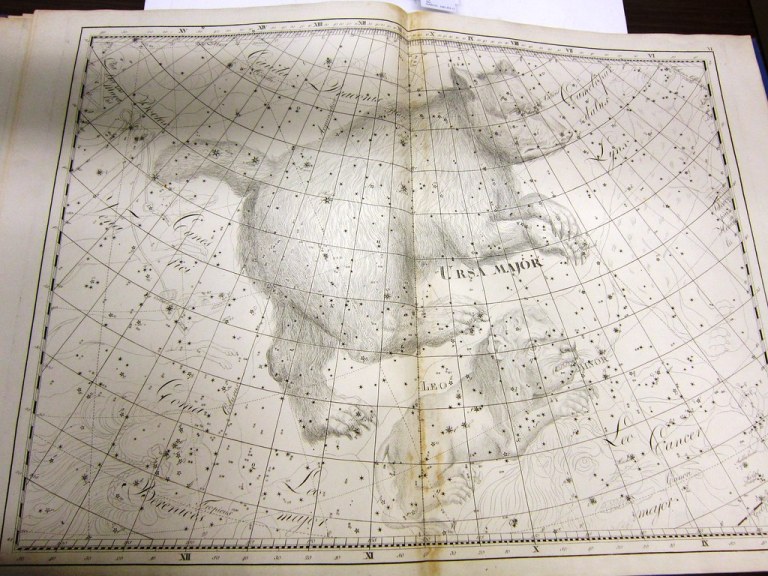
[Ursa Major, Leo] courtesy of Openverse
Constellations of the Month:
April – Ursa Major
Material may be shared for personal and educational use, Share with family and friends. The material cannot be used in an educational setting whereby a “book fee” is charged in or above tuition costs, and the material here is being used without paying a licensing fee.. AI must file an application for use of such material.
| You May Also Like. . . | |
 NASA 1997 Liftoff Special |
 NASA Mission Patch Party |
More on Versatileer:
![aerial photography of concrete roads.jpg]()
National Broadcast Traffic Professional's Day – 2024
11/04/2024![Jack playing cards.jpg]()
Happy National Card Playing Day – 2025
12/29/2025![roasted turkey.jpg]()
Happy Thanksgiving Day – 2024
11/28/2024![Copycat Olive Garden Breadsticks-1]()
Copycat Olive Garden Breadsticks On Your Table!
06/08/2022![20221214_172934.jpg]()
Featured Photo + Video: The 12 Days of Christmas – Day 6: Yuletide #1 on Lamon Avenue, Oak Forest
12/20/2022