Constellations of the Month: February – Puppis:
We continue February with the last constellation of the month, Puppis, “The Stern of the Ship Argo.”
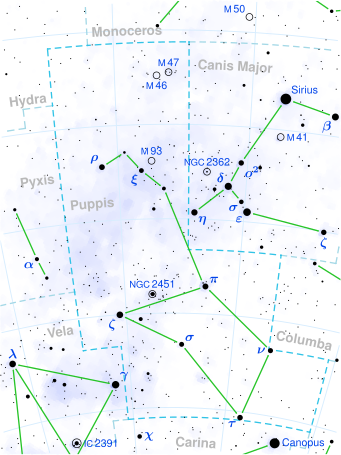
Puppis constellation map courtesy of Openverse
Puppis, “The Stern of the Ship Argo” – Puppis constellation is in the southern hemisphere and represents the stern of the ship Argo, which Jason and the Argonauts used to find the Golden Fleece. It was once part of the larger constellation Argo Navis but was divided into smaller constellations: Carina, Vela, and Puppis. Argo Navis was first listed by the Greek astronomer Claudius Ptolemy in the 2nd century CE and was split by the French astronomer Nicolas Louis de Lacaille in 1752. Puppis contains notable deep sky objects, including three Messier objects, the planetary nebulae NGC 2438 and NGC 2440, and the star-forming region NGC 2467.

Messier 47’s Jewels courtesy of Openverse
Key points regarding Puppis:
- Meaning: The term “Puppis” translates to “The Stern of the Ship Argo” in Latin.
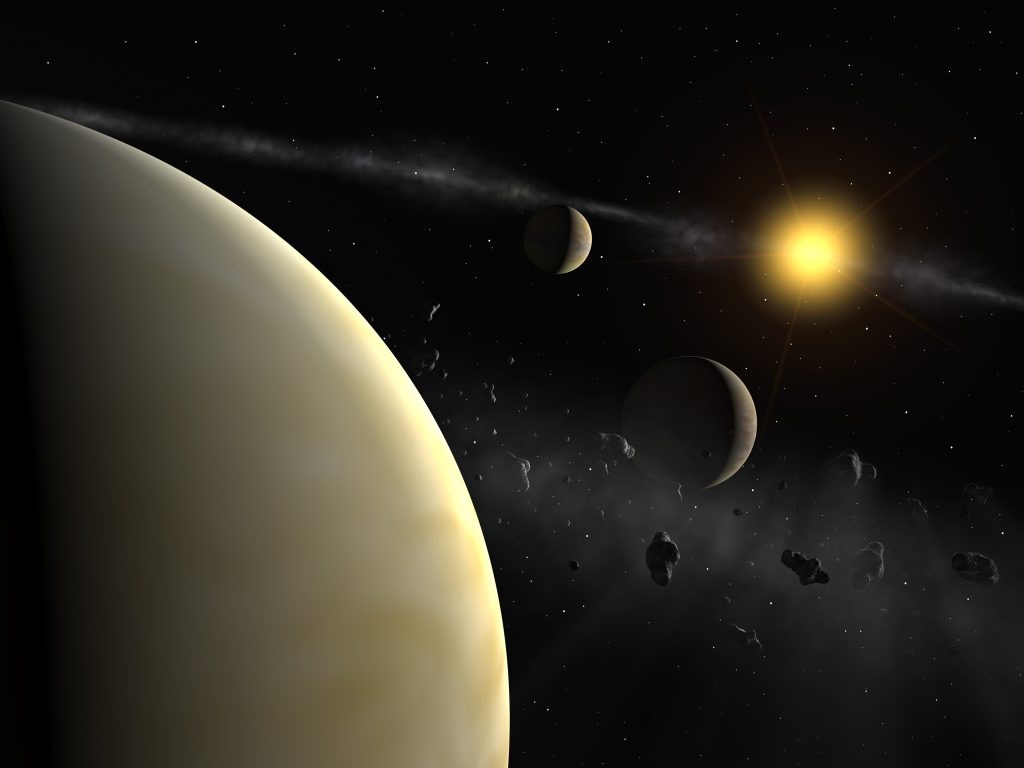
- Notable stars: Zeta Puppis is the brightest star in its constellation, classified as an O4If blue supergiant. It is very hot, with a surface temperature of 42,000 K, and is about 1,090 light years from Earth. Zeta Puppis has an apparent magnitude of 2.21, making it the 62nd brightest star in the sky. It is 22.5 times more massive than the Sun and 550,000 times more luminous. The stellar wind from Zeta Puppis is very strong, causing it to lose significant mass annually. The star is known as Naos, meaning “ship,” and Suhail Hadar, meaning “the roaring bright one,” with the name Naos officially recognized by the International Astronomical Union (IAU). Pi Puppis is the second brightest star in the constellation, with an apparent magnitude of 2.733 and located about 810 light years from Earth. It is a double star, featuring an orange supergiant and a companion star. The orange supergiant has a radius about 290 times that of the Sun and is a semi-regular variable star, with brightness changes between magnitudes 2.70 and 2.85. Pi Puppis is part of the Collinder 135 open cluster. Rho Puppis, the third brightest in Puppis, is a yellow-white bright giant. It has a visual magnitude of 2. 78 and is roughly 63. 5 light years away. Classified as a Delta Scuti type variable star, its brightness varies periodically. Rho Puppis is about 2 billion years old, has a mass 1. 85 times the Sun, and is 22 times more luminous. Tau Puppis is a spectroscopic binary star system located about 182 light years away, with an apparent magnitude of 2. 95. The main component is an orange giant approximately 27 times bigger than the Sun. Nu Puppis, a blue-white giant star with an apparent magnitude of 3.173, is about 370 light years distant and has a remarkable rotational speed. Sigma Puppis is another binary star system that is a Beta Lyrae type variable. Xi Puppis is a yellow supergiant, c Puppis is an orange giant in a cluster, and several other stars like HD 64440 and 3 Puppis have notable distances and classifications. The section also covers various stars’ characteristics, distances, and configurations, including multiple star systems and notable variables. HD 69830 hosts planets and a debris disk, contributing to the rich diversity of stars outlined in Puppis.
- Other features: Messier 46 is an open cluster with a brightness of 6.1 and is about 5,500 light years from Earth. Discovered by Charles Messier in 1771, it is estimated to be around 300 million years old. The cluster seems to include the planetary nebula NGC 2438, but they are likely unrelated and just appear along the same line. Messier 47 is another open cluster located about a degree west of Messier 46. It has about 50 stars, the brightest of which is magnitude 5.7. Giovanni Batista Hodierna discovered it around 1654, and Messier cataloged it on February 19, 1771. Messier specified its location in relation to the star 2 Puppis, but no cluster is found there. It might match NGC 2422’s position. M47 has a brightness of 4.2 and is approximately 1,600 light years away, with an age of about 78 million years. Messier 93 is an open cluster with a brightness of 6.0, located about 3,600 light years from Earth. Discovered by Charles Messier in 1782, it has a radius of about 10 light years and an age of around 100 million years. NGC 2451, discovered by Giovanni Batista Hodierna in 1654, consists of two clusters: NGC 2451 A and NGC 2451 B, at distances of 197 and 358 parsecs. NGC 2451 has a visual magnitude of 2. 8 and is 850 light years away, containing about 40 stars, with the brightest being a yellow giant. NGC 2477, near NGC 2451, has a brightness of 5. 8 and is about 3,600 light years away, containing around 300 stars and believed to be about 700 million years old. Collinder 135 consists of four visible stars, with Pi Puppis as the main star. It has a brightness of 2.1 and is around 840 light years away. NGC 2438 is a planetary nebula with a magnitude of 10. 8, located about 2,900 light years from Earth. Its central star is a hot white dwarf, discovered by William Herschel in 1786. NGC 2467 is a star-forming region in Puppis, not a distinct cluster but several groups along the same line. HD 64315 is a prominent star in this region. NGC 2509 is an open cluster with a brightness of 9.3. NGC 2439 is located about 12,570 light years from Earth, has a brightness of 6.9, and is about 10 million years old. NGC 2440, a planetary nebula with a magnitude of 9.4, is approximately 4,000 light years from Earth. Its central star is a hot white dwarf with a surface temperature of 200,000 kelvins. NGC 2298 is a globular cluster with a brightness of 9.3, discovered by James Dunlop on May 8, 1826, and is about 30,000 light years away. NGC 2546 is another open cluster discovered by Lacaille between 1751 and 1752, with a brightness of 6.3 and located about 3,300 light years away.
- Mythology: Puppis is one of the three constellations that comprised the ancient Greek constellation Argo Navis, symbolizing the vessel on which Jason and the Argonauts embarked in their quest for the Golden Fleece. In the 18th century, the French astronomer Nicolas Louis de Lacaille restructured this constellation into three smaller ones: Carina, Puppis, and Vela. Among these, Puppis is the most extensive. Neither Puppis nor Vela possesses stars designated as Alpha and Beta, as these designations were assigned to the constellation Carina.
- Visibility: Puppis is the 20th largest constellation, covering 673 square degrees. It is located in the southern hemisphere and can be seen at latitudes from +40° to -90°. It is bordered by the constellations Carina, Canis Major, Columba, Hydra, Monoceros, Pictor, Pyxis, and Vela. The name Puppis is pronounced /ˈpʌpɪs/ and means “the Stern” in English. Its abbreviation is Pup. Puppis is part of the Heavenly Waters group of constellations. It has three Messier objects and six stars with confirmed planets, with Naos being the brightest. Three meteor showers are linked to Puppis, and it has seven named stars recognized by the IAU.
⁺‧₊☽◯☾₊‧⁺⋆⁺‧₊☽◯☾₊‧⁺⋆⁺‧₊☽◯☾₊‧⁺⋆⁺‧₊☽◯☾₊‧⁺⋆⁺‧₊☽◯☾₊‧⁺⋆⁺‧₊☽◯☾₊‧⁺⋆
Constellations:
| Constellations by Month | ||
| JANUARY [8] | FEBRUARY [7] | MARCH [7] |
| Taurus | Camelopardalis | Lynx |
| Orion | Auriga | Cancer |
| Lepus | Gemini | Canis Minor |
| Caelum | Monoceros | Pyxis |
| Reticulum | Canis Major | Vela |
| Dorado | Columba | Carina |
| Pictor | Puppis | Volans |
| Mensa | ||
| APRIL [8] | MAY [7] | JUNE [6] |
| Ursa Major | Canes Venatici | Ursa Minor |
| Leo Minor | Coma Berenices | Boötes |
| Leo | Virgo | Libra |
| Sextans | Corvus | Lupus |
| Crater | Centaurus | Circinus |
| Hydra | Crux | Apus |
| Antlia | Musca | |
| Chamaeleon | ||
| JULY [9] | AUGUST [9] | SEPTEMBER [6] |
| Draco | Lyra | Cygnus |
| Corona Borealis | Vulpecula | Delphinus |
| Hercules | Sagitta | Equuleus |
| Serpens | Aquila | Capricornus |
| Ophiuchus | Scutum | Microscopium |
| Scorpius | Sagittarius | Indus |
| Norma | Corona Australis | |
| Ara | Telescopium | |
| Triangulum Australe | Pavo | |
| OCTOBER [7] | NOVEMBER [8] | DECEMBER [6] |
| Cepheus | Cassiopeia | Perseus |
| Lacerta | Andromeda | Triangulum |
| Pegasus | Pisces | Aries |
| Aquarius | Cetus | Eridanus |
| Piscis Austrinus | Sculptor | Fornax |
| Grus | Phoenix | Horologium |
| Octans | Tucana | |
| Hydrus | ||
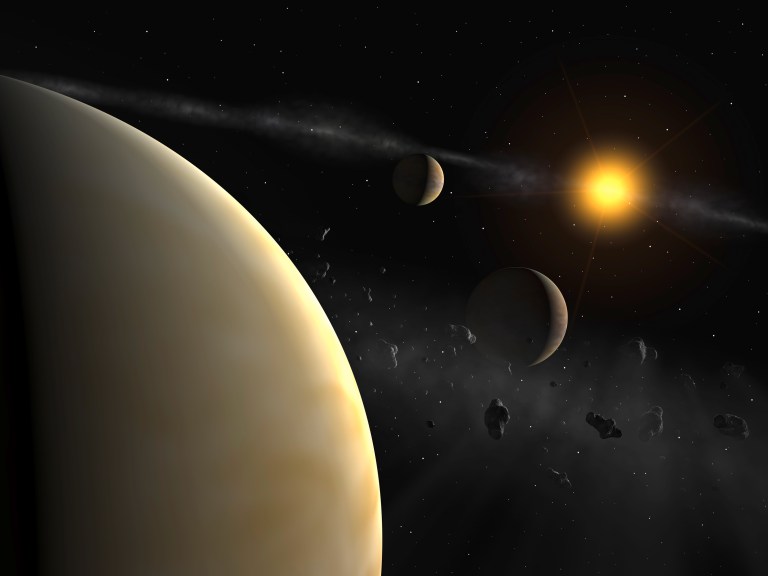
File:Planetary System Around HD 69830 courtesy of Openverse
Constellations of the Month:
February – Puppis
Material may be shared for personal and educational use, Share with family and friends. The material cannot be used in an educational setting whereby a “book fee” is charged in or above tuition costs, and the material here is being used without paying a licensing fee.. AI must file an application for use of such material.
| You May Also Like. . . | |
 NASA 1997 Liftoff Special |
 NASA Mission Patch Party |
More on Versatileer:
![Teacher Tuesday - March 2024.png]()
Ends 04-01 – Teacher Tuesday - March 26th
03/26/2024![Risk® The 1980s Edition_Boggle® Jr._Monopoly® Scrabble®.jpg]()
Boggle® Jr., Monopoly® Scrabble® & Risk® The 1980s Edition from Winning Moves Games – Review
07/22/2023![INSTA_TheFallThatSavedUs.png]()
The Fall That Saved Us by Tamara Jerée Cover Reveal – Release Date Coming September 5th
07/23/2023![Pi Day-01.jpg]()
Happy National Pi Day – 2025
03/14/2025![How Well Do You Know Your Husband.jpeg]()
Ends 12-04 – How Well Do You Know Your Husband? by M.Q. Webb Book Blitz + $25 Amazon Gift Card Givea...
11/24/2024






























awesome! thanks for sharing!