Constellations of the Month: February – Gemini:
We continue February with the next constellation of the month, Gemini, “The Twins.”
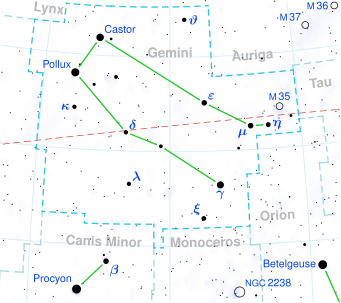
Gemini constellation map courtesy of Openverse
Gemini, “The Twins” – The Gemini constellation is located in the northern hemisphere, NS Its Latin name translates to “the twins.” This constellation symbolizes the twins Castor and Pollux (also referred to as Polydeuces), who were known as the Dioscuri in ancient Greek mythology. Gemini is particularly recognized for its two prominent stars, Castor and Pollux, as well as the neutron star Geminga. Gemini is a zodiac constellation that was first documented by the Greek astronomer Ptolemy during the 2nd century. The symbol associated with this constellation is ♊. Gemini ranks as the 30th largest constellation, covering an expanse of 514 square degrees. It is situated in the second quadrant of the northern hemisphere (NQ2) and is observable at latitudes ranging from +90° to -60°. The constellations that border Gemini include Auriga, Cancer, Canis Minor, Lynx, Monoceros, Orion, and Taurus.
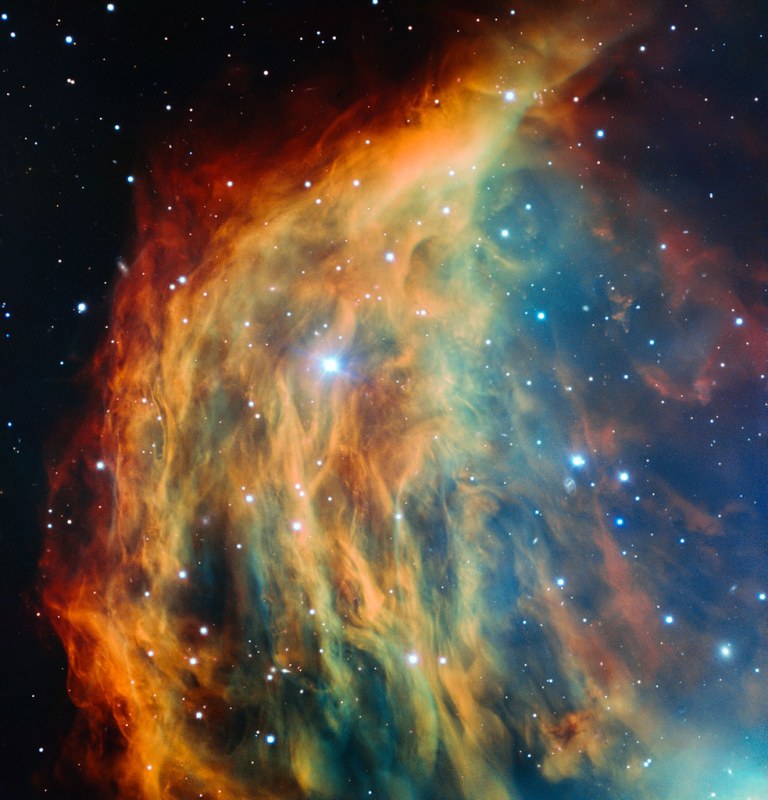
ESO’s Very Large Telescope images the Medusa Nebula courtesy of Openverse
Key points regarding Gemini:
- Meaning: The term “Gemini” translates to “The Twins” in Latin.
- Notable stars: The brightest star is Pollux. Gemini is associated with the Geminids and Rho Geminids meteor showers. There are ten named stars in Gemini, recognized by the IAU.Castor is the second brightest star in Gemini and is part of a complex four-star system. Its components are separated by 6” and exhibit a visual magnitude of 1.58. Castor is 51 light years from the Sun and has a faint companion star forming a sextuple star system. Pollux, the brightest star in Gemini, is an evolved orange giant 33.78 light years away, known to have a planet, Pollux b. Alhena, a white subgiant star, is visible to the naked eye and 109 light years from Earth. Epsilon Geminorum is a supergiant star, located about 840 light years away, and very luminous. Mu Geminorum is a red giant exhibiting variations in brightness. Eta Geminorum is a multiple star about 350 light years distant, while Xi Geminorum is a yellow-white subgiant 58. 7 light years away. Delta Geminorum is a triple star system, Kappa and Lambda Geminorum are variable stars, and U Geminorum is a binary star known for its dramatic outbursts.
- Other features: Gemini contains the star cluster Messier 35 and seven stars with known planets. Messier 35 is an open star cluster in Gemini, covering an area as large as the full Moon, with an apparent magnitude of 5.30, located about 2,800 light years away. It was discovered in 1745. NGC 2158, another open cluster in the same constellation, has an apparent magnitude of 8. 6 and is approximately 11,000 light years distant, thought to be around a billion years old. The Eskimo Nebula is a double-shell planetary nebula found by William Herschel in 1787, with an apparent magnitude of 10.1 and a distance of at least 2,870 light years. IC 443, known as the Jellyfish Nebula, is a supernova remnant about 5,000 light years from Earth, created by a Type II supernova. The Medusa Nebula, discovered in 1955, spans over four light years and is about 1,500 light years distant. Geminga, a neutron star in Gemini from a supernova 300,000 years ago, has an apparent magnitude of 25.5 and is approximately 815 light years away. NGC 2129 is a young open cluster, around 10 million years old, situated about 7,200 light years from the Sun. NGC 2371-2 is a dual lobed planetary nebula discovered by William Herschel with an apparent magnitude of 13, located approximately 4,400 light years away. NGC 2355 is an older open cluster, about a billion years old, with a visual magnitude of 9.7 and located around 5,400 light years distant.
- Mythology: The Gemini constellation represents the twins Castor and Polydeuces from Greek mythology, also known as the Dioscuri or “sons of Zeus. ” Polydeuces is considered Zeus’ son, while Castor is the son of King Tyndareus of Sparta. Their mother, Queen Leda, was visited by Zeus in the form of a swan, leading to the birth of Polydeuces and Helen, while Castor and Clytemnestra were born later. The twins were close; Castor was skilled in horse riding and fencing, and Polydeuces excelled in boxing. They helped the Argonauts by defeating Amycus in a boxing match. As patrons of sailors, they were believed to save shipwrecked sailors and were given two white horses by Poseidon. In a conflict over two women, Castor was killed, leading Polydeuces to ask Zeus for shared immortality, resulting in them becoming the constellation Gemini, where their brightest stars mark their heads.
- Visibility: The constellation Gemini is pronounced /ˈdʒɛmɪnaɪ/ and means “the Twins” in English. Its genitive form is Geminorum, pronounced /ˌdʒɛmɪˈnɒrəm/. The abbreviation for Gemini is Gem, established by the International Astronomical Union (IAU) in 1922. Gemini contains the star cluster Messier 35 and seven stars with known planets. The brightest star is Pollux. Gemini is associated with the Geminids and Rho Geminids meteor showers. There are ten named stars in Gemini, recognized by the IAU.
⁺‧₊☽◯☾₊‧⁺⋆⁺‧₊☽◯☾₊‧⁺⋆⁺‧₊☽◯☾₊‧⁺⋆⁺‧₊☽◯☾₊‧⁺⋆⁺‧₊☽◯☾₊‧⁺⋆⁺‧₊☽◯☾₊‧⁺⋆
Constellations:
| Constellations by Month | ||
| JANUARY [8] | FEBRUARY [7] | MARCH [7] |
| Taurus | Camelopardalis | Lynx |
| Orion | Auriga | Cancer |
| Lepus | Gemini | Canis Minor |
| Caelum | Monoceros | Pyxis |
| Reticulum | Canis Major | Vela |
| Dorado | Columba | Carina |
| Pictor | Puppis | Volans |
| Mensa | ||
| APRIL [8] | MAY [7] | JUNE [6] |
| Ursa Major | Canes Venatici | Ursa Minor |
| Leo Minor | Coma Berenices | Boötes |
| Leo | Virgo | Libra |
| Sextans | Corvus | Lupus |
| Crater | Centaurus | Circinus |
| Hydra | Crux | Apus |
| Antlia | Musca | |
| Chamaeleon | ||
| JULY [9] | AUGUST [9] | SEPTEMBER [6] |
| Draco | Lyra | Cygnus |
| Corona Borealis | Vulpecula | Delphinus |
| Hercules | Sagitta | Equuleus |
| Serpens | Aquila | Capricornus |
| Ophiuchus | Scutum | Microscopium |
| Scorpius | Sagittarius | Indus |
| Norma | Corona Australis | |
| Ara | Telescopium | |
| Triangulum Australe | Pavo | |
| OCTOBER [7] | NOVEMBER [8] | DECEMBER [6] |
| Cepheus | Cassiopeia | Perseus |
| Lacerta | Andromeda | Triangulum |
| Pegasus | Pisces | Aries |
| Aquarius | Cetus | Eridanus |
| Piscis Austrinus | Sculptor | Fornax |
| Grus | Phoenix | Horologium |
| Octans | Tucana | |
| Hydrus | ||

Sidney Hall’s (1831) astronomical chart illustration of the zodiac Gemini. Original from Library of Congress. Digitally enhanced by rawpixel courtesy of Openverse
Constellations of the Month:
February – Gemini
Material may be shared for personal and educational use, Share with family and friends. The material cannot be used in an educational setting whereby a “book fee” is charged in or above tuition costs, and the material here is being used without paying a licensing fee.. AI must file an application for use of such material.
| You May Also Like. . . | |
 NASA 1997 Liftoff Special |
 NASA Mission Patch Party |
More on Versatileer:
![Featured Photo #1: Magic of St. Valentine in 2023 – Cupid on 158th Street]()
Featured Photo #1: Magic of St. Valentine in 2023 – Cupid on 158th Street
02/15/2023![A Festivus For the Rest of Us.jpg]()
Happy Festivus – 2024
12/23/2024![caramel corn.jpg]()
Happy National Caramel Popcorn Day – 2024
04/06/2024![SMGN-2022MothersdayGiftGuide-smallerpostversionNATGEOBOOKS-Giveaway.png]()
Ends 5- 8 – Nat Geo Kids ‘FOR THE BIRDS’ Book Bundle Giveaway!
04/09/2022![TMF__BUTTON.jpg]()
Ends 10-11 – Diary of an Artist in Love by The Muse Frequency Book Blitz + $25 Amazon Gift Card Give...
10/04/2023