Constellations of the Month: December – Triangulum:
We continue December with the next constellation of the month, Triangulum, “The Triangle.”
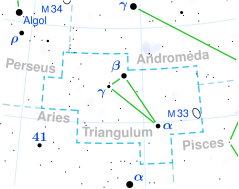
Triangulum constellation map courtesy of Openverse
Triangulum, “The Triangle” – The Triangulum constellation is located in the northern hemisphere, and symbolizes “the triangle.” Triangulum is classified as one of the Greek constellations. It was initially catalogued by the Greek astronomer Ptolemy during the 2nd century. This constellation does not contain any stars of first magnitude. The three most luminous stars within the constellation outline the form of a long, slender triangle. Additionally, the constellation hosts the Triangulum Galaxy (Messier 33), recognized as one of the closest and most prominent galaxies visible in the night sky.

NGC 604 courtesy of Openverse
Key points regarding Triangulum:
- Meaning: The term “Triangulum” translates to “The Triangle” in Latin. The constellation Triangulum features a single star with a confirmed planet and includes one Messier object, specifically Messier 33 (M33, NGC 598), known as the Triangulum Galaxy. The constellation’s brightest star is Beta Trianguli, which has an apparent magnitude of 3.00. Notably, there are no meteor showers linked to this constellation. Triangulum is home to six named stars. The names of the stars that have received official approval from the International Astronomical Union (IAU) include Alaybasan (Beta Trianguli A), Apdu (Gamma Trianguli), Horna (HAT-P-38), Mothallah (Alpha Trianguli A), Deltoton (Delta Trianguli A), and Triminus (Iota Trianguli Aa).
- Notable stars: Beta Trianguli is the brightest star in the Triangulum constellation, with an apparent magnitude of 3.00 and a distance of about 127 light years from Earth. It is a white giant star, classified as a spectroscopic binary with a dust ring around it. Alpha Trianguli, also known as Mothallah, is the second brightest star and is approximately 63.3 light years away, with a magnitude of 3.42. It is a close binary star system that orbits every 1.736 days and has a combined classification between F5III and F6IV. The star is rapidly rotating and appears ellipsoidal. Gamma Trianguli is the third brightest star with a magnitude of 4.01 and is located around 112.3 light years from Earth. It is a white main sequence star that is much larger and brighter than the Sun and has a debris disk, emitting infrared radiation. Delta Trianguli is a spectroscopic binary with a visual magnitude of 4.865, around 35.2 light years away. It consists of a yellow dwarf and an orange dwarf that orbit closely. Iota Trianguli is a quadruple star system approximately 305 light years distant, with complex arrangements of different stellar types and variations in luminosity. Epsilon Trianguli is a binary with a white dwarf and a secondary star, situated about 390 light years away, and is suspected to belong to the Ursa Major Moving Group. HD 13189 is a distant orange giant with an evolved status, while HD 9446 is a yellow dwarf with two discovered planets orbiting it.
- Other features: The Triangulum Galaxy, also known as Messier 33, is a spiral galaxy located between 2,380 and 3,070 light years from Earth. It is part of the Local Group and is the third-largest member after the Milky Way and Andromeda. The galaxy has about 50,000 light years in diameter and contains around 40 billion stars. It is home to the largest known stellar mass black hole, M33 X-7. Notable features include NGC 604, the brightest H II region, and various other galaxies like NGC 925, NGC 672, and IC 1727, which interact and exhibit peculiar structures due to their gravitational pull. The Triangulum Galaxy might have been first discovered by Giovanni Batista Hodierna.
- Mythology: The Greeks referred to the constellation as Deltoton. This ancient constellation was named due to its shape, which resembled the capital Greek letter delta. Eratosthenes noted that the constellation symbolized the delta of the Nile River, while Hyginus mentioned that some individuals perceived it as the island of Sicily. The name of the constellation is preserved in the formal designation of Delta Trianguli (Deltoton), which was sanctioned by the International Astronomical Union in 2025. Sicilia was among the initial names attributed to the constellation, as Ceres, the patron goddess of the island, was said to have implored Jupiter to position the island in the heavens. The Babylonians identified Triangulum and the star Gamma Andromedae within the Andromeda constellation as a constellation known as MUL.Apin, or the Plough. In 1687, the Polish astronomer Johannes Hevelius introduced a smaller triangle, Triangulum Minus, composed of three stars situated near Triangulum; however, this division quickly fell out of favor.
- Visibility: Triangulum is the 78th largest constellation, covering an area of 132 square degrees. It is located in the first quadrant of the northern hemisphere (NQ1) and is visible at latitudes ranging from +90° to -60°. The constellations that border it include Andromeda, Aries, Perseus, and Pisces. The name of the constellation, Triangulum, is pronounced /traɪˈæŋɡjʊləm/. In English, it is referred to as the Triangle. The genitive form of Triangulum, which is used in the naming of stars, is Trianguli (pronunciation: /traɪˈæŋɡjʊlaɪ/). The three-letter abbreviation, which was established by the International Astronomical Union (IAU) in 1922, is Tri. Triangulum is part of the Perseus family of constellations, which also includes Andromeda, Auriga, Cassiopeia, Cepheus, Cetus, Lacerta, Pegasus, and Perseus.
⁺‧₊☽◯☾₊‧⁺⋆⁺‧₊☽◯☾₊‧⁺⋆⁺‧₊☽◯☾₊‧⁺⋆⁺‧₊☽◯☾₊‧⁺⋆⁺‧₊☽◯☾₊‧⁺⋆⁺‧₊☽◯☾₊‧⁺⋆
Constellations:
| Constellations by Month | ||
| JANUARY [8] | FEBRUARY [7] | MARCH [7] |
| Taurus | Camelopardalis | Ursa Major |
| Orion | Auriga | Cancer |
| Lepus | Gemini | Canis Minor |
| Caelum | Monoceros | Pyxis |
| Reticulum | Canis Major | Vela |
| Dorado | Columba | Carina |
| Pictor | Puppis | Volans |
| Mensa | ||
| APRIL [8] | MAY [7] | JUNE [6] |
| Ursa Major | Canes Venatici | Ursa Minor |
| Leo Minor | Coma Berenices | Boötes |
| Leo | Virgo | Libra |
| Sextans | Corvus | Lupus |
| Crater | Centaurus | Circinus |
| Hydra | Crux | Apus |
| Antlia | Musca | |
| Chamaeleon | ||
| JULY [9] | AUGUST [9] | SEPTEMBER [6] |
| Draco | Lyra | Cygnus |
| Corona Borealis | Vulpecula | Delphinus |
| Hercules | Sagitta | Equuleus |
| Serpens | Aquila | Capricornus |
| Ophiuchus | Scutum | Microscopium |
| Scorpius | Sagittarius | Indus |
| Norma | Corona Australis | |
| Ara | Telescopium | |
| Triangulum Australe | Pavo | |
| OCTOBER [7] | NOVEMBER [8] | DECEMBER [6] |
| Cepheus | Cassiopeia | Perseus |
| Lacerta | Andromeda | Triangulum |
| Pegasus | Pisces | Aries |
| Aquarius | Cetus | Eridanus |
| Piscis Austrinus | Sculptor | Fornax |
| Grus | Phoenix | Horologium |
| Octans | Tucana | |
| Hydrus | ||
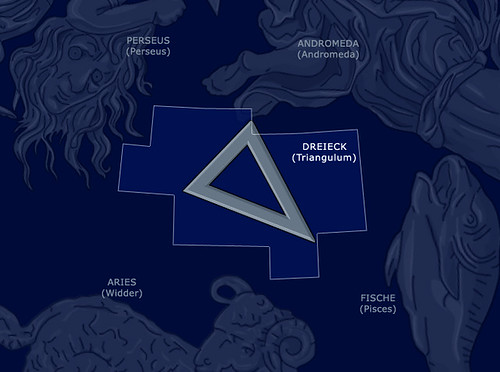
triangulum courtesy of Openverse
Constellations of the Month:
December – Triangulum
Material may be shared for personal and educational use, Share with family and friends. The material cannot be used in an educational setting whereby a “book fee” is charged in or above tuition costs, and the material here is being used without paying a licensing fee.. AI must file an application for use of such material.
| You May Also Like. . . | |
 NASA 1997 Liftoff Special |
 NASA Mission Patch Party |
More on Versatileer:
![Chocolate cake.jpg]()
Happy National Chocolate Cake Day – 2026
01/29/2026![43985896_698564110523511_7432128399064638325_n-625x625px.jpg]()
Book Review: They Can Never Know by Sheri Meshal
11/04/2018![Featured Photo: Architecture, Part 2 – Vintage Architecture – Victorian Stick-Style Home in Oak Lawn...]()
Featured Photo: Architecture, Part 2 – Vintage Architecture – Victorian Stick-Style Home in Oak Lawn...
04/13/2021![The numbers 2026 and 2025 on dice.jpg]()
Happy 2026! Hope For The Whole Year & 2025 Revisited
12/31/2025![1385882_1408441126052507_125289092_n_.jpg]()
Featured Photo: Sunsets & Sunrises – Sunset Near Woodridge, Illinois
02/10/2024































this is a constellation i had not heard of before!
I am excited for the new moon on the 19th and the equinox on the 21st,
lovely- thanks for sharing