Constellations of the Month: November – Tucana:
We continue November with the next constellation of the month, Tucana, “The Toucan.”
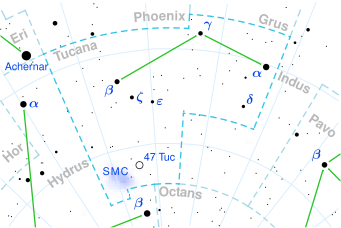
Tucana constellation map courtesy of Openverse
Tucana, “The Toucan” – The Tucana constellation is located in the southern hemisphere, symbolizing a toucan, a bird native to tropical and sub-tropical areas. This constellation was established by the Dutch astronomer Petrus Plancius, based on the observations made by Dutch sailors Frederick de Houtman and Pieter Dirkszoon Keyser during the late 16th century. It was first illustrated in a celestial atlas in 1603, within Johann Bayer’s Uranometria. Within this constellation, one can find the Tucana Dwarf galaxy, the Small Magellanic Cloud, the globular cluster 47 Tucanae, along with several other significant deep sky objects.
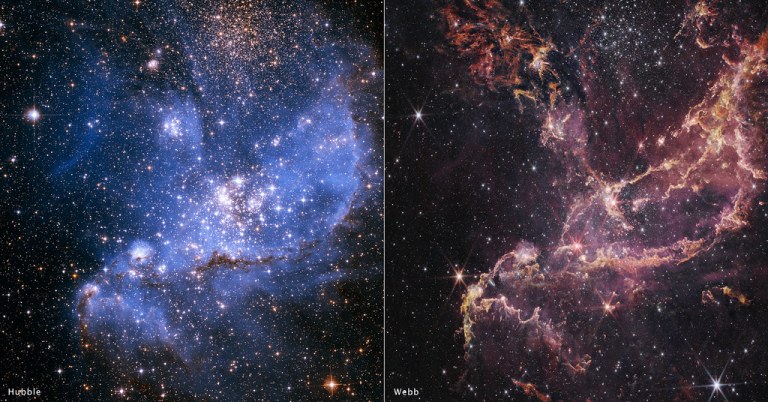
NGC 346: Hubble and Webb Observations courtesy of Openverse
Key points regarding Tucana:
- Meaning: The term “Tucana” translates to “The Toucan.” Tucana comprises three stars that have known planets, but it does not contain any Messier objects. The most luminous star in this constellation is Alpha Tucanae, which has an apparent magnitude of 2.86. Additionally, there are no meteor showers linked to this constellation. Tucana features three stars that have been officially named. The names recognized by the International Astronomical Union (IAU) include Danfeng, Emiw, Lang-Exster, and Poerava.
- Notable stars: Alpha Tucanae is the brightest star in Tucana, located about 184 light years from the Sun. It is a spectroscopic binary and is 2.5 to 3 times the mass of the Sun. In 2024, it was named Lang-Exster. Gamma Tucanae is the second brightest star, a yellow-white giant 75.3 light years away. Zeta Tucanae is a yellow-white dwarf, 28.01 light years distant. Kappa Tucanae is a multiple star system 66.6 light years away, while Beta Tucanae includes a group of six stars around 140 light years from the Sun. Epsilon Tucanae is a blue-white subgiant about 374 light years away. Delta Tucanae is a binary star system located 267 light years away, with a primary blue-white dwarf and a companion star. Nu Tucanae is a variable red giant, 273 light years from Earth, showing brightness changes. Iota Tucanae is a semi-regular variable yellow giant, 279 light years away. HD 219077 and HD 4308 are yellow dwarfs, each having confirmed planets. HD 221287, an F7V dwarf, has a Jupiter-like planet, while HD 215497 hosts two smaller planets. HD 5980, in the Small Magellanic Cloud, is a complex system of luminous Wolf-Rayet stars and a blue supergiant.
- Other features: The Tucana Dwarf is a dwarf spheroidal galaxy with an apparent magnitude of 15.7, located about 3.2 million light years from Earth. Discovered in 1990 by R. J. Lavery, it contains only old stars and has no neighboring galaxies or star formation activity. The Small Magellanic Cloud, classified as either a dwarf irregular or a Magellanic type dwarf spiral galaxy, is a companion to the Milky Way and part of the Local Group. It has a magnitude of 2.7 and lies approximately 197,000 light years away. It features several hundred million stars and a central bar structure, possibly due to past interactions with the Milky Way. NGC 346, an open star cluster in the Small Magellanic Cloud, includes the bright star HD 5980. NGC 104, discovered by Nicolas Louis de Lacaille in 1751, is a massive globular cluster in the Milky Way. Other mentioned objects include NGC 406, a spiral galaxy, and NGC 362 and NGC 265, both open clusters in the Small Magellanic Cloud located at various distances.
- Mythology: Tucana is not linked to any myths. The name of the constellation is derived from Latin, meaning “the toucan,” which refers to a South American bird known for its large bill. The constellation was first illustrated by the Dutch astronomer and cartographer Petrus Plancius on a celestial globe in 1598, who assigned it the name Tucana. Johann Bayer retained this name in his 1603 atlas; however, Frederick de Houtman referred to the constellation as Den Indiaenschen Exster, op Indies Lang ghenaemt, which translates to “the Indian magpie, named Lang in the Indies,” in his catalogue published in the same year. It is likely that de Houtman was referring to the hornbill, another bird indigenous to the East Indies and Malaysia. Ultimately, the name Tucana prevailed.
- Visibility: Tucana is the 48th largest constellation, covering 295 square degrees. It is located in the first quadrant of the southern hemisphere (SQ1) and can be observed at latitudes ranging from +25° to -90°. The constellations that border it include Eridanus, Grus, Hydrus, Indus, Octans, and Phoenix. The name of the constellation, Tucana, is pronounced /tjuːˈkeɪnə/. In English, it is referred to as the Toucan. The genitive form of Tucana, which is used in the naming of stars, is Tucanae (pronunciation: /tjuːˈkeɪniː/). The three-letter abbreviation, which was established by the International Astronomical Union (IAU) in 1922, is Tuc. Tucana is part of the Johann Bayer family of constellations, which also includes Apus, Chamaeleon, Dorado, Grus, Hydrus, Indus, Musca, Pavo, Phoenix, and Volans.
⁺‧₊☽◯☾₊‧⁺⋆⁺‧₊☽◯☾₊‧⁺⋆⁺‧₊☽◯☾₊‧⁺⋆⁺‧₊☽◯☾₊‧⁺⋆⁺‧₊☽◯☾₊‧⁺⋆⁺‧₊☽◯☾₊‧⁺⋆
Constellations:
| Constellations by Month | ||
| JANUARY [8] | FEBRUARY [7] | MARCH [7] |
| Taurus | Camelopardalis | Ursa Major |
| Orion | Auriga | Cancer |
| Lepus | Gemini | Canis Minor |
| Caelum | Monoceros | Pyxis |
| Reticulum | Canis Major | Vela |
| Dorado | Columba | Carina |
| Pictor | Puppis | Volans |
| Mensa | ||
| APRIL [8] | MAY [7] | JUNE [6] |
| Ursa Major | Canes Venatici | Ursa Minor |
| Leo Minor | Coma Berenices | Boötes |
| Leo | Virgo | Libra |
| Sextans | Corvus | Lupus |
| Crater | Centaurus | Circinus |
| Hydra | Crux | Apus |
| Antlia | Musca | |
| Chamaeleon | ||
| JULY [9] | AUGUST [9] | SEPTEMBER [6] |
| Draco | Lyra | Cygnus |
| Corona Borealis | Vulpecula | Delphinus |
| Hercules | Sagitta | Equuleus |
| Serpens | Aquila | Capricornus |
| Ophiuchus | Scutum | Microscopium |
| Scorpius | Sagittarius | Indus |
| Norma | Corona Australis | |
| Ara | Telescopium | |
| Triangulum Australe | Pavo | |
| OCTOBER [7] | NOVEMBER [8] | DECEMBER [6] |
| Cepheus | Cassiopeia | Perseus |
| Lacerta | Andromeda | Triangulum |
| Pegasus | Pisces | Aries |
| Aquarius | Cetus | Eridanus |
| Piscis Austrinus | Sculptor | Fornax |
| Grus | Phoenix | Horologium |
| Octans | Tucana | |
| Hydrus | ||

Tucana courtesy of Openverse
Constellations of the Month:
November – Tucana
Material may be shared for personal and educational use, Share with family and friends. The material cannot be used in an educational setting whereby a “book fee” is charged in or above tuition costs, and the material here is being used without paying a licensing fee.. AI must file an application for use of such material.
| You May Also Like. . . | |
 NASA 1997 Liftoff Special |
 NASA Mission Patch Party |
More on Versatileer:
![wp-17027517334724280888980279212264.jpg]()
Featured Photo + Video: The 25 Days of Christmas – Day 16: Yuletide on Olcott Avenue, Tinley Park
12/16/2023![Update on Again Tropical Storm Elsa – Passing Over the Florida-Georgia Line]()
Update on Again Tropical Storm Elsa – Passing Over the Florida-Georgia Line
07/07/2021![Crayola.jpg]()
Happy National Crayon Day – 2025
03/31/2025![US Flag & 2022 B&W Olympic Flag Gold Background__BUTTON.jpg]()
Winter Olympics Recap & Winners – 2022
02/23/2022![green leaf plant in white pot.jpg]()
Happy National Houseplant Appreciation Day – 2025
01/11/2025