Constellations of the Month: November – Sculptor:
We continue November with the next constellation of the month, Sculptor, “The Sculptor.”

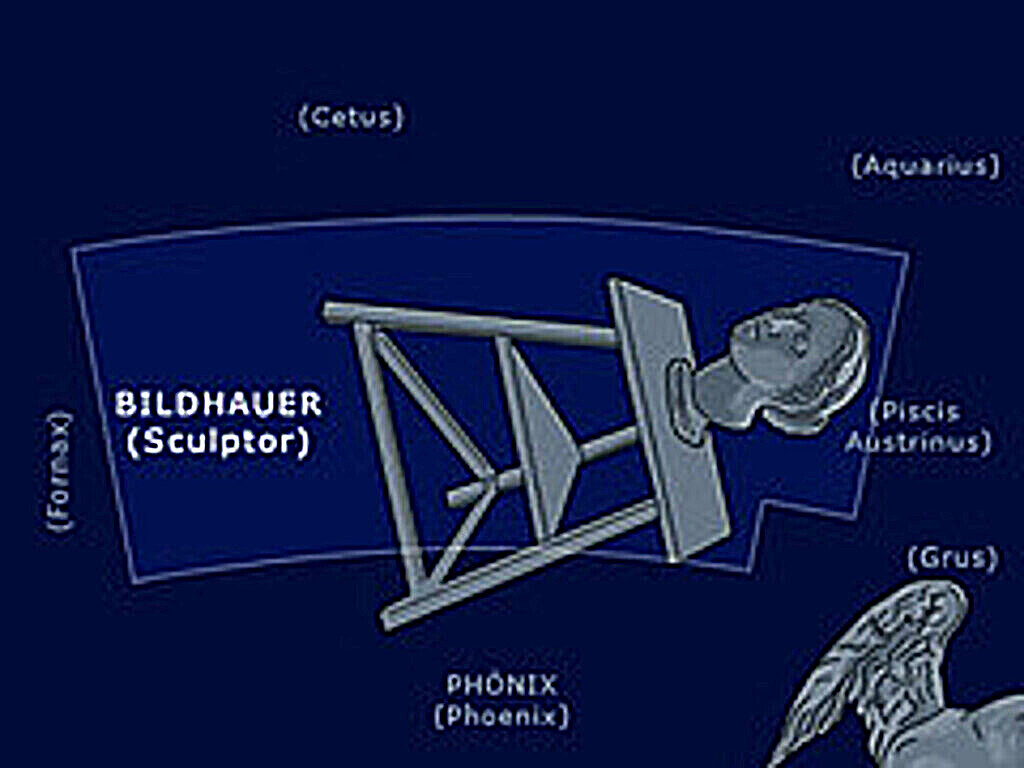
Sculptor constellation map courtesy of Openverse
Sculptor, “The Sculptor” – The Sculptor constellation is located in the southern hemisphere, symbolizing a sculptor, and positioned to the south of Aquarius and Cetus. This constellation was among those introduced in the southern hemisphere by the French astronomer Nicolas Louis de Lacaille during the 18th century. Lacaille initially referred to it as Apparatus Sculptoris, which translates to “the sculptor’s studio,” but the name was subsequently abbreviated to Sculptor. Sculptor is considered a relatively faint constellation, as it does not feature any stars that exceed third magnitude in brightness. It encompasses the south galactic pole and hosts several notable deep sky objects, such as the Cartwheel Galaxy, the Sculptor Galaxy (NGC 253), the String of Pearls Galaxy (NGC 55), the Sculptor Pinwheel Galaxy (NGC 300), and the Sculptor Dwarf.

A spiral galaxy’s brights and darks courtesy of Openverse
Key points regarding Sculptor:
- Meaning: The term “Sculptor” translates to “The Sculptor” in all western languages. Sculptor does not feature any stars that are brighter than magnitude 3.00 and includes two stars situated within 10 parsecs (32.6 light years) from Earth. The most luminous star in this constellation is Alpha Sculptoris, which has an apparent magnitude of 4.30. The closest star is Gliese 1 (spectral class M1.5V), positioned at a distance of 14.22 light years from our planet. Within the constellation, there are two stars that have been formally named. The names that have received approval from the International Astronomical Union (IAU) are Cocibolca (HD 4208) and Uúba (LTT 9779). Sculptor is part of the Lacaille family of constellations, which also includes Antlia, Caelum, Circinus, Fornax, Horologium, Mensa, Microscopium, Norma, Octans, Pictor, Reticulum, and Telescopium. The constellation is home to six stars that are known to have exoplanets: HD 4208 (spectral class G7V), HD 4113 (G5V), HD 9578 (G1V), WASP-8 (G6), WASP-29 (K4V), and WASP-45 (K2V). Notably, Sculptor does not contain any Messier objects and is not linked to any meteor showers.
- Notable stars: Alpha Sculptoris is the brightest star in the Sculptor constellation, located about 780 light years away with a magnitude of 4.30. It’s a blue-white giant star that is much brighter than the Sun and has a high surface temperature. Beta Sculptoris is the second brightest star, a blue-white subgiant about 178 light years away. Gamma Sculptoris is the third brightest and is an orange giant star around 179 light years distant. Delta Sculptoris is a triple star system, and Eta Sculptoris is a red giant star that varies in brightness. Other stars mentioned include Zeta, Iota, Epsilon, Kappa, and Lambda Sculptoris, as well as various yellow dwarf stars like HD 4208 and HD 4113, each with confirmed planets. R Sculptoris is a notable red giant with a spiral structure.
- Other features: The Sculptor Group is a collection of galaxies near the south galactic pole in the Sculptor constellation, about 12.7 million light years from the Milky Way. Key members include the Sculptor Galaxy (NGC 253), known for its intense star formation and visibility through binoculars, the Cartwheel Galaxy, which transformed after colliding with another galaxy, and the Sculptor Dwarf, a satellite of the Milky Way. Other notable galaxies are NGC 55 and NGC 300, both close to the Local Group. Abell 2744, or Pandora’s Cluster, is a giant cluster of galaxies located much farther away. Write an email. NGC 300 is a galaxy located about 6.07 million light years from the Sun, featuring an X-ray source believed to be a black hole binary system. NGC 288 is a globular cluster 28,700 light years away, visible with binoculars. Blanco 1 is an open cluster 850 light years distant, containing around 300 stars. Other galaxies mentioned include NGC 24, NGC 10, and NGC 613, along with various deep sky objects in the Sculptor constellation.
- Mythology: Sculptor constellation is not associated with any myths. It is one of the southern constellations introduced by Nicolas Louis de Lacaille in 1751-1752. On his planisphere of 1756, Lacaille named the constellation l’Atelier du Sculpteur, which is French for “the sculptor’s studio.” The constellation was depicted as a carved head lying on a tripod table, next to a sculptor’s mallet and two chisels. The name was Latinized to Apparatus Sculptoris on Lacaille’s 1763 planisphere and in 1844 the English astronomer John Herschel proposed shortening the name to Sculptor. His suggestion was adopted by Francis Baily in his British Association Catalogue of 1845, and the constellation has been known as Sculptor ever since.
- Visibility: Sculptor is the 36th largest constellation, covering 475 square degrees. It is situated in the first quadrant of the southern hemisphere (SQ1) and is observable at latitudes ranging from +50° to -90°. The constellations that border Sculptor include Aquarius, Cetus, Fornax, Grus, Phoenix, and Piscis Austrinus. The name Sculptor is pronounced /ˈskʌlptər/. In English, this constellation is referred to as the Sculptor. The genitive form of Sculptor, which is utilized in the naming of stars, is Sculptoris (pronunciation: /skəlpˈtɒrɪs/). The three-letter abbreviation, which was established by the International Astronomical Union (IAU) in 1922, is Scl.
⁺‧₊☽◯☾₊‧⁺⋆⁺‧₊☽◯☾₊‧⁺⋆⁺‧₊☽◯☾₊‧⁺⋆⁺‧₊☽◯☾₊‧⁺⋆⁺‧₊☽◯☾₊‧⁺⋆⁺‧₊☽◯☾₊‧⁺⋆
Constellations:
| Constellations by Month | ||
| JANUARY [8] | FEBRUARY [7] | MARCH [7] |
| Taurus | Camelopardalis | Ursa Major |
| Orion | Auriga | Cancer |
| Lepus | Gemini | Canis Minor |
| Caelum | Monoceros | Pyxis |
| Reticulum | Canis Major | Vela |
| Dorado | Columba | Carina |
| Pictor | Puppis | Volans |
| Mensa | ||
| APRIL [8] | MAY [7] | JUNE [6] |
| Ursa Major | Canes Venatici | Ursa Minor |
| Leo Minor | Coma Berenices | Boötes |
| Leo | Virgo | Libra |
| Sextans | Corvus | Lupus |
| Crater | Centaurus | Circinus |
| Hydra | Crux | Apus |
| Antlia | Musca | |
| Chamaeleon | ||
| JULY [9] | AUGUST [9] | SEPTEMBER [6] |
| Draco | Lyra | Cygnus |
| Corona Borealis | Vulpecula | Delphinus |
| Hercules | Sagitta | Equuleus |
| Serpens | Aquila | Capricornus |
| Ophiuchus | Scutum | Microscopium |
| Scorpius | Sagittarius | Indus |
| Norma | Corona Australis | |
| Ara | Telescopium | |
| Triangulum Australe | Pavo | |
| OCTOBER [7] | NOVEMBER [8] | DECEMBER [6] |
| Cepheus | Cassiopeia | Perseus |
| Lacerta | Andromeda | Triangulum |
| Pegasus | Pisces | Aries |
| Aquarius | Cetus | Eridanus |
| Piscis Austrinus | Sculptor | Fornax |
| Grus | Phoenix | Horologium |
| Octans | Tucana | |
| Hydrus | ||

Sculptor courtesy of Openverse
Constellations of the Month:
November – Sculptor
Material may be shared for personal and educational use, Share with family and friends. The material cannot be used in an educational setting whereby a “book fee” is charged in or above tuition costs, and the material here is being used without paying a licensing fee.. AI must file an application for use of such material.
| You May Also Like. . . | |
 NASA 1997 Liftoff Special |
 NASA Mission Patch Party |
More on Versatileer:
![20220607_135357-1024x768.jpg]()
Featured Photo: Flower of the Day – Bouquet of the Week – 7-17-2022
07/17/2022![DC: Ye Olde Yule Log.jpg]()
Happy Yule Day – 2025
12/21/2025![We The people text.jpg]()
Happy Bill Of Rights Day – 2025
12/21/2025![pink-pencil-on-open-bible-page-and-pink-272337 bible_1646267076.jpeg John-Mark Smith at Pexels]()
Happy Ash Wednesday: Lent Begins Today – 2022
03/02/2022![INSTA_AHollywoopdEnding.png]()
Ends 08-16 – A Hollywood Ending by Melanie Summers Book Blitz + $100 Amazon Gift Card & Signed Copy ...
08/10/2023