
Constellations of the Month: November – Cetus:
We continue November with the next constellation of the month, Cetus, “The Whale.”
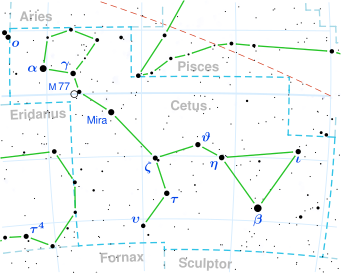
Cetus constellation map courtesy of Openverse
Cetus, “The Whale” – The Cetus constellation is officially an equatorial constellation with all the brightest stars located in the southern hemisphere, symbolizing the Whale, it ranks among the largest constellations visible in the sky. This constellation derives its name from Cetus, the sea monster featured in the Greek myth concerning Andromeda. In this myth, the princess was offered as a sacrifice to the monster as retribution for her mother Cassiopeia’s arrogance. The Cetus constellation is positioned in the area of the sky known as the Water, alongside several other constellations that bear names reminiscent of water: Eridanus (the river), Aquarius (the water bearer), Pisces (the fish), and others. It was catalogued by the Greek astronomer Ptolemy during the 2nd century. Cetus contains the barred spiral galaxy Messier 77 and several prominent stars: Diphda (Beta Ceti), Menkar (Alpha Ceti), Tau Ceti, and the renowned variable star Mira (Omicron Ceti). Additionally, it is home to Earendel, the most distant star that has been discovered to this point.
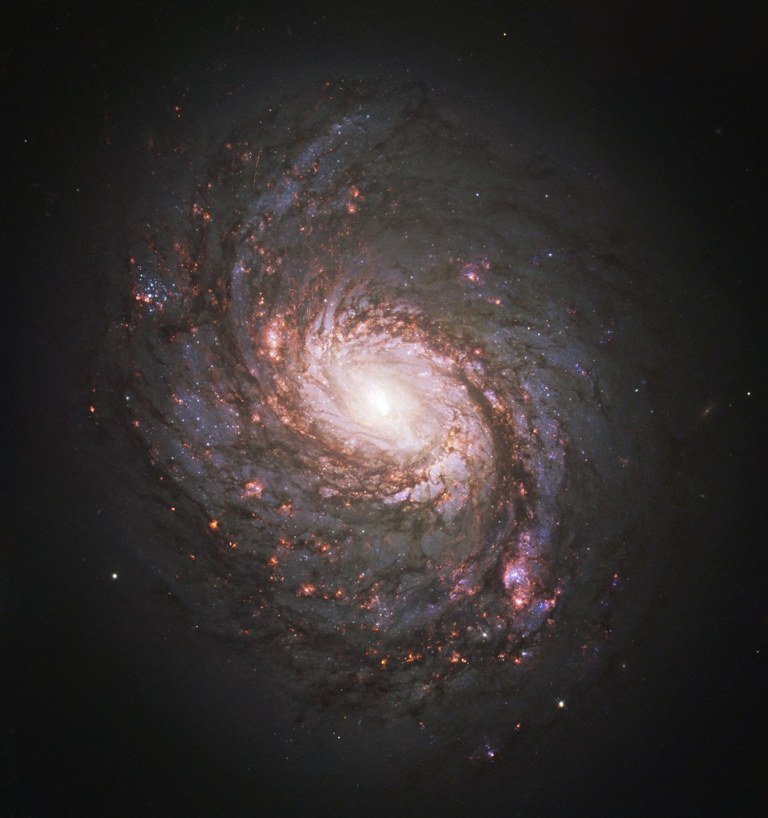
Messier 77 courtesy of Openverse
Key points regarding Cetus:
- Meaning: The term “Cetus” translates to “The Whale” in Greek. Cetus comprises 14 stars that have known planets and includes one Messier object, specifically Messier 77 (M77, NGC 1068). The constellation’s brightest star is Diphda (Beta Ceti). There are three meteor showers linked to Cetus: the October Cetids, the Eta Cetids, and the Omicron Cetids. Within this constellation, there are nine stars that have been formally named. The names of these stars, which have received approval from the International Astronomical Union (IAU), are Axólotl, Baten Kaitos, Diphda, Hydor, Kaffaljidhma, Menkar, Mira, Mpingo, and Felixvarela.
- Notable stars: Beta Ceti is the brightest star in its constellation, about 96.3 light-years away, with a magnitude of 2.04. It is an orange giant star on its path to becoming a red giant. Its traditional names are Deneb Kaitos and Diphda, with meanings related to the southern tail of Cetus and “second frog,” respectively. Alpha Ceti, 249 light-years away, is an old red giant that eventually will form a planetary nebula. Its name, Menkar, means “nostril” in Arabic, and it appears in science fiction works like Star Trek. Omicron Ceti, known as Mira, is a binary star with a red giant and a white dwarf companion, located around 420 light-years away. Mira’s brightness varies over a 332-day cycle and is significant in astronomy. Tau Ceti, a nearby cool dwarf star, is 11.9 light-years away and has a lower mass than the Sun. Earendel, the most distant star discovered as of March 2022, is 28 billion light-years away, detected via gravitational lensing. Its name means “morning star” in Old English.
- Other features: Messier 77 is a barred spiral galaxy located in Cetus, about 47 million light years away and 170,000 light years wide. Its apparent magnitude is 9.6, making it one of the largest galaxies in Messier’s catalogue. Discovered by Pierre Méchain in 1780, it was later catalogued by Charles Messier. The galaxy has an Active Galactic Nucleus, which is not visible due to dust. Nearby, NGC 1055, discovered by William Herschel in 1783, is a spiral galaxy about 52 million light years distant and is also a radio source. NGC 1087 is an intermediate spiral galaxy, 80 million light years away, with an unusually small nucleus. NGC 1073, with an apparent magnitude of 11.5, is thought to have an H II nucleus. Other notable galaxies include NGC 45, NGC 17, NGC 47, and NGC 1042, each with unique features and distances from Earth. NGC 247, an intermediate spiral galaxy, is about 11.1 million light years away and is part of the Sculptor Group of galaxies.
- Mythology: Cetus symbolizes the sea monster from the Greek legend of Princess Andromeda, whose arrogant mother Cassiopeia provoked the sea god Poseidon and the Nereids (sea nymphs) by asserting that she was more beautiful than any of them. In order to placate the sea god and the nymphs, Cassiopeia and her spouse, King Cepheus, were compelled to sacrifice their young daughter to Cetus, a sea monster dispatched by Poseidon to punish the king and queen, or witness the monster devastate their land. Andromeda was bound to a rock and left at the mercy of the sea monster, but fortunately for her, the hero Perseus happened to be passing by just as Cetus was about to consume her. Perseus saved the princess and vanquished Cetus. He and Andromeda subsequently got married. Cetus was typically portrayed by the Greeks as a hybrid being. It possessed forefeet, enormous jaws, and a scaly body resembling that of a giant sea serpent. Although the constellation is also referred to as the Whale, the mythical creature in the illustrations does not actually resemble a whale.
- Visibility: Cetus is the 4th largest constellation, covering 1231 square degrees. It ranks among the 15 equatorial constellations. Positioned in the first quadrant of the southern hemisphere (SQ1), it is observable at latitudes ranging from +70° to -90°. The constellations that border it include Aquarius, Aries, Eridanus, Fornax, Pisces, Sculptor, and Taurus. The name of the constellation, Cetus, is pronounced /ˈsiːtəs/. In English, it is referred to as the Sea Monster. The genitive form of Cetus, which is utilized in the naming of stars, is Ceti (pronunciation: /ˈsiːtaɪ). The three-letter abbreviation, which was officially adopted by the International Astronomical Union (IAU) in 1922, is Cet. Cetus is part of the Perseus family of constellations, which also includes Andromeda, Auriga, Cassiopeia, Cepheus, Lacerta, Pegasus, Perseus, and Triangulum. Cetus contains 14 stars that have known planets and co.
⁺‧₊☽◯☾₊‧⁺⋆⁺‧₊☽◯☾₊‧⁺⋆⁺‧₊☽◯☾₊‧⁺⋆⁺‧₊☽◯☾₊‧⁺⋆⁺‧₊☽◯☾₊‧⁺⋆⁺‧₊☽◯☾₊‧⁺⋆
Constellations:
| Constellations by Month | ||
| JANUARY [8] | FEBRUARY [7] | MARCH [7] |
| Taurus | Camelopardalis | Ursa Major |
| Orion | Auriga | Cancer |
| Lepus | Gemini | Canis Minor |
| Caelum | Monoceros | Pyxis |
| Reticulum | Canis Major | Vela |
| Dorado | Columba | Carina |
| Pictor | Puppis | Volans |
| Mensa | ||
| APRIL [8] | MAY [7] | JUNE [6] |
| Ursa Major | Canes Venatici | Ursa Minor |
| Leo Minor | Coma Berenices | Boötes |
| Leo | Virgo | Libra |
| Sextans | Corvus | Lupus |
| Crater | Centaurus | Circinus |
| Hydra | Crux | Apus |
| Antlia | Musca | |
| Chamaeleon | ||
| JULY [9] | AUGUST [9] | SEPTEMBER [6] |
| Draco | Lyra | Cygnus |
| Corona Borealis | Vulpecula | Delphinus |
| Hercules | Sagitta | Equuleus |
| Serpens | Aquila | Capricornus |
| Ophiuchus | Scutum | Microscopium |
| Scorpius | Sagittarius | Indus |
| Norma | Corona Australis | |
| Ara | Telescopium | |
| Triangulum Australe | Pavo | |
| OCTOBER [7] | NOVEMBER [8] | DECEMBER [6] |
| Cepheus | Cassiopeia | Perseus |
| Lacerta | Andromeda | Triangulum |
| Pegasus | Pisces | Aries |
| Aquarius | Cetus | Eridanus |
| Piscis Austrinus | Sculptor | Fornax |
| Grus | Phoenix | Horologium |
| Octans | Tucana | |
| Hydrus | ||
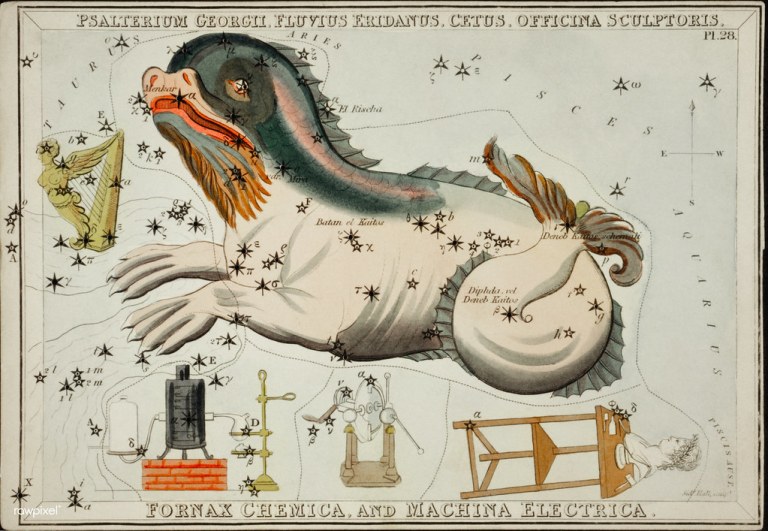
Sidney Hall’s (1831) astronomical chart illustration of the Psalterium Georgii, Fluvius Eridanus, Cetus, Officinal Scupltoris, Fornax Chemica, and Machina Electrica. Original from Library of Congress. Digitally enhanced by rawpixel. courtesy of Openverse
Constellations of the Month:
November – Cetus
Material may be shared for personal and educational use, Share with family and friends. The material cannot be used in an educational setting whereby a “book fee” is charged in or above tuition costs, and the material here is being used without paying a licensing fee.. AI must file an application for use of such material.
| You May Also Like. . . | |
 NASA 1997 Liftoff Special |
 NASA Mission Patch Party |
More on Versatileer:
![20231003_09_00__two_atl_2d0__Philippe.jpg]()
From the Satellite...Atlantic Tropical Storm Philippe on .GIPHY, Video + 2023 Season Info
05/12/2024![CSK_BUTTON.jpg]()
Ends 05-10 – Call Sign: King by Livia Grant Book Blitz + 5 eBooks of Books 1 & 2 of the Black Sky Op...
05/08/2023![wp-17000050510319108057365730807870.jpg]()
Featured Photo: The Beauty of Fall Color – Baby Sugar Maple Tree, Rubio Woods
11/20/2023![Tale of An Anxious Heart Blitz__BUTTON.jpg]()
Ends 06-21 – Tale of an Anxious Heart by Elsa Jacobs Book Blitz + $25 Amazon Gift Card & eBook Copy ...
06/14/2023![2021-Mothers-Day-Gift-Guide-800x600-1-e1619340466317.jpg]()
2021 Mother’s Day Gift Guide – 04-01 to 05-11
04/25/2021






























Many wonders in the sky this month,