
Constellations of the Month: November – Pisces:
We continue November with the next constellation of the month, Pisces, “The Fish.”

Pisces constellation map courtesy of Openverse
Pisces, “The Fish” – The Pisces constellation is officially an equatorial constellation with all the brightest stars located in the northern hemisphere, symbolizing “the fish” (in plural form) in Latin. Pisces ranks among the largest constellations visible in the sky. It is classified as one of the zodiac constellations and was first documented by the Greek astronomer Ptolemy during the 2nd century. Its symbol is ♓. Pisces is positioned between the Aries constellation to the east and Aquarius to the west. In Roman mythology, the two celestial fish symbolize Venus and Cupid, who transformed into fish to evade the monster Typhon. The Vernal equinox, which marks the point where the Sun crosses into the northern hemisphere across the equator each year, is currently found in Pisces.
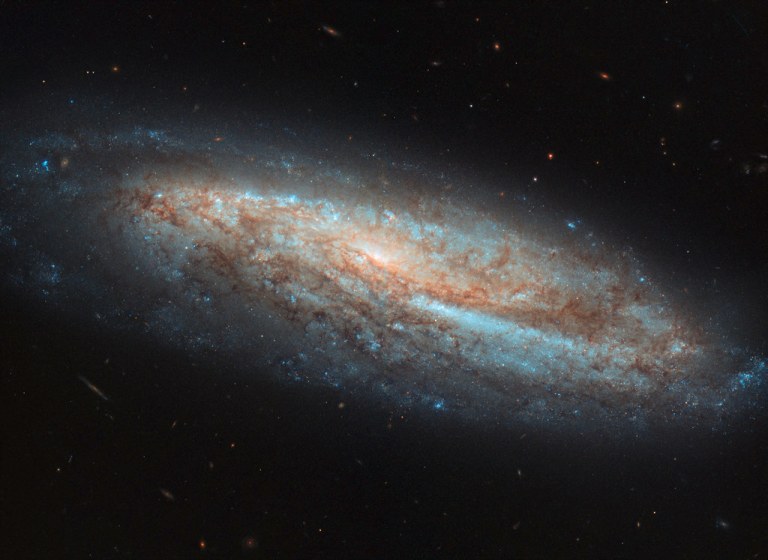
Barred Spiral Galaxy NGC 7541 courtesy of Openverse
Key points regarding Pisces:
- Meaning: The term “Pisces” translates to “The Fish” in Greek. In his work Firmamentum Sobiescianum published in 1690, the astronomer Johannes Hevelius categorized Pisces into four distinct subdivisions: the North Fish (Piscis Boreus), the North Cord (Linum Boreum), the South Cord (Linum Austrinum), and the South Fish (Piscis Austrinus).
- Notable stars: Eta Piscium, also known as Alpherg, is the brightest star in Pisces, about 350 light years away. It is a yellow giant, 457 times more luminous than the Sun, with a mass of 3.78 solar masses and an effective temperature of 4,937 K. Gamma Piscium is the second brightest star in Pisces, roughly 138 light years away, and ten times the size of the Sun. Other notable stars include Omega Piscium, Iota Piscium, Omicron Piscium, Alpha Piscium, Epsilon Piscium, Theta Piscium, and Delta Piscium, each with unique characteristics and distances from Earth. Nu Piscium is an orange giant star, about 370 light years away, with a classification of K3IIIb. Beta Piscium is a blue-white main sequence star known as Fumalsamakah, located roughly 492 light years from the Sun. Van Maanen’s Star is a white dwarf, about 14.1 light years away, and discovered in 1917. 19 Piscium is a variable carbon star, while 107 Piscium and 96 G. Piscium are orange dwarfs, each around 24 light years distant. 54 Piscium has a confirmed planet and a brown dwarf companion, while 6 G. Piscium is a yellow subgiant with two known planets.
- Other features: The Pisces constellation features several intriguing deep sky objects, including the face-on grand design spiral galaxy Messier 74 (NGC 628), the Pisces Dwarf galaxy, the double radio galaxy 3C 31, and the colliding galaxy pair Arp 284. Messier 74 is a spiral galaxy located about 30 million light years from the Sun, known for its clear spiral arms and low brightness, making it hard to observe. Discovered by Pierre Méchain, it features two supernovae and a suspected black hole with a mass of 10,000 Suns. M74 is part of the M74 Group of galaxies. Other galaxies mentioned include CL 0024+1654, a cluster of galaxies, NGC 7541 and NGC 7537, both spiral galaxies; the Bullseye Galaxy, known for its unique nine-ring structure; and 3C 31, an active double radio galaxy. The Pisces Dwarf is a small, irregular galaxy, while Arp 284 and NGC 7714 are pairs of interacting galaxies. NGC 474 and NGC 520 are also notable galaxies with unique features. Lastly, NGC 60 has unusually distorted spiral arms.
- Mythology: The Pisces constellation has origins in Babylonian culture, where it is seen as two fish connected by a cord. This constellation is linked to a Roman myth involving Venus and Cupid, who turned into fish to escape the monster Typhon. The star Alpha Piscium, also called Alrescha, represents the knot of the cord. In Greek mythology, after the gods defeated the Titans, Gaia had a terrifying son named Typhon, who threatened the gods. Pan transformed into a goat-fish to escape and jumped into the river Euphrates. The constellation Capricornus represents this creature. Meanwhile, Aphrodite and Eros called for help from the water nymphs and jumped into the river. Different versions of the story describe how two fishes helped them or how they were transformed into fish themselves.
- Visibility: Pisces is the 14th largest constellation, covering 889 square degrees, and is located in the northern hemisphere, visible between latitudes +90° and -65°. It is one of the 15 equatorial constellations and is bordered by Andromeda, Aquarius, Aries, Cetus, Pegasus, and Triangulum. The constellation name is pronounced /ˈpaɪsiːz/, means “the Fishes,” and is abbreviated as Psc by the International Astronomical Union. Pisces belongs to the zodiac group, which includes several other constellations. It has one Messier object, the spiral galaxy M74, and features ten stars with known planets. The brightest star is Alpherg (Eta Piscium), and there is one associated meteor shower, the Piscids. Pisces has nine named stars.
⁺‧₊☽◯☾₊‧⁺⋆⁺‧₊☽◯☾₊‧⁺⋆⁺‧₊☽◯☾₊‧⁺⋆⁺‧₊☽◯☾₊‧⁺⋆⁺‧₊☽◯☾₊‧⁺⋆⁺‧₊☽◯☾₊‧⁺⋆
Constellations:
| Constellations by Month | ||
| JANUARY [8] | FEBRUARY [7] | MARCH [7] |
| Taurus | Camelopardalis | Ursa Major |
| Orion | Auriga | Cancer |
| Lepus | Gemini | Canis Minor |
| Caelum | Monoceros | Pyxis |
| Reticulum | Canis Major | Vela |
| Dorado | Columba | Carina |
| Pictor | Puppis | Volans |
| Mensa | ||
| APRIL [8] | MAY [7] | JUNE [6] |
| Ursa Major | Canes Venatici | Ursa Minor |
| Leo Minor | Coma Berenices | Boötes |
| Leo | Virgo | Libra |
| Sextans | Corvus | Lupus |
| Crater | Centaurus | Circinus |
| Hydra | Crux | Apus |
| Antlia | Musca | |
| Chamaeleon | ||
| JULY [9] | AUGUST [9] | SEPTEMBER [6] |
| Draco | Lyra | Cygnus |
| Corona Borealis | Vulpecula | Delphinus |
| Hercules | Sagitta | Equuleus |
| Serpens | Aquila | Capricornus |
| Ophiuchus | Scutum | Microscopium |
| Scorpius | Sagittarius | Indus |
| Norma | Corona Australis | |
| Ara | Telescopium | |
| Triangulum Australe | Pavo | |
| OCTOBER [7] | NOVEMBER [8] | DECEMBER [6] |
| Cepheus | Cassiopeia | Perseus |
| Lacerta | Andromeda | Triangulum |
| Pegasus | Pisces | Aries |
| Aquarius | Cetus | Eridanus |
| Piscis Austrinus | Sculptor | Fornax |
| Grus | Phoenix | Horologium |
| Octans | Tucana | |
| Hydrus | ||

Sidney Hall’s (1831) astronomical chart illustration of the Pisces. Original from Library of Congress. Digitally enhanced by rawpixel. courtesy of Openverse
Constellations of the Month:
November – Pisces
Material may be shared for personal and educational use, Share with family and friends. The material cannot be used in an educational setting whereby a “book fee” is charged in or above tuition costs, and the material here is being used without paying a licensing fee.. AI must file an application for use of such material.
| You May Also Like. . . | |
 NASA 1997 Liftoff Special |
 NASA Mission Patch Party |
More on Versatileer:
![Teacher Tuesday - May 2024.png]()
Ends 05-13 – Teacher Tuesday - May 7th
05/07/2024![Happy National Ice Cream Sunday '22_Lunapic.png]()
Happy National Ice Cream Sunday – 2022
07/17/2022![blue-tape-measuring-on-clear-glass-square-weighing-scale-53404 diet_1703649364.jpeg Pixabay at Pexels]()
Some Simple Weight Loss Tips.
12/26/2023![20211103_081343.jpg]()
Featured Photo: The Beauty of Fall Color – The Oak Wilt Tree
11/23/2022![Belle review Post (1).jpg]()
Ends 09-25 – In the Midst of Shadows by Nicola Italia Audio Book Blitz + $20 Amazon Gift Card Giveaw...
09/16/2024






























I almost thought they were parakeets from far way!
Thank you for sharing