
Constellations of the Month: September – Delphinus:
We continue September with the next constellation of the month, Delphinus, “The Dolphin.”
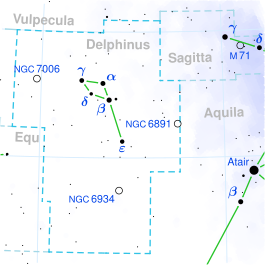
Delphinus constellation map courtesy of Openverse
Delphinus, “The Dolphin” – The Delphinus constellation is located in the northern hemisphere (area with no bright stars in the southern hemisphere), and symbolizes “the dolphin.” Delphinus is a constellation with five stars that have known planets, but it contains no Messier objects. The brightest star is Rotanev (Beta Delphini) with an apparent magnitude of 3.617, and there are no meteor showers related to it. The International Astronomical Union has approved five star names: Aldulfin (Epsilon Delphini), Musica (18 Delphini), Rotanev (Beta Delphini A), Shama (HAT-P-23), and Sualocin (Alpha Delphini Aa). Delphinus is recognizable because its brightest stars form a shape that looks like a dolphin, including a diamond-shaped asterism known as Job’s Coffin. It is located between the bright star Altair in Aquila and the Great Square of Pegasus. Aldulfin can be located by extending a line from Vega through Albireo.

Planetary Nebula NGC 6891 courtesy of Openverse
Key points regarding Delphinus:
- Meaning: The term “Delphinus” translates to “The Dolphin” in Latin. In Greek mythology, this constellation symbolizes the dolphin dispatched by the sea deity Poseidon to locate Amphitrite, the Nereid he wished to wed. Additionally, it is linked to the tale of Arion, the Greek poet and musician whose life was rescued by dolphins while at sea. Delphinus ranks among the smallest constellations visible in the night sky. It is classified as one of the Greek constellations, initially catalogued by the Greek astronomer Ptolemy of Alexandria during the 2nd century CE. Delphinus is distinguished by the diamond-shaped arrangement created by its most luminous stars, referred to as Job’s Coffin, which delineates the form of the celestial Dolphin. This constellation hosts several fascinating deep-sky objects, including the globular clusters NGC 6934 and NGC 7006, as well as the planetary nebulae NGC 6891 and NGC 6905 (known as the Blue Flash Nebula).
- Notable stars: Beta Delphini, the brightest star in Delphinus, is 101 light years away and has an apparent magnitude of 3.617. Its traditional name, Rotanev, means “hunter. ” It is a binary star system with two white stars and a 26.66-year orbit. Alpha Delphini, the second brightest, has a magnitude of 3.777 and is 254 light years distant, consisting of a pair and five fainter stars. Epsilon Delphini is a blue-white giant, 330 light years away, with brightness varying slightly. Gamma Delphini is a binary system at 101 light years, potentially hosting a planet. Delta Delphini is a spectroscopic binary with pulsating stars. Rho Aquilae is a white dwarf at 150 light years, and Musica is a yellow giant with an exoplanet. Shama is an orange star with a confirmed planet, named Perwana.
- Other features: NGC 6934 is a large globular cluster near Epsilon Delphini, located 52,000 light years from Earth with a visual magnitude of 8.83, discovered by William Herschel in 1785. NGC 6891 is a small planetary nebula near Rho Aquilae, measuring 0.33′ by 0.3′ and at a distance of 7,200 light years, discovered by Ralph Copeland in 1884. NGC 6905 is another small, bluish planetary nebula, with an apparent magnitude of 10.9, located 7,500 light years away, also discovered by William Herschel in 1784. NGC 7006, a globular cluster at about 137,000 light years in the Milky Way’s halo, has a visual magnitude of 10.6 and occupies 2.8′ in the sky. Additionally, NGC 7003 is a spiral galaxy, approximately 222 million light years away, with a visual magnitude of 13.76 and an estimated diameter of 80,800 light years, known for hosting a supernova observed in 2011.
- Mythology: There are two myths about the constellation Delphinus. In the first, the dolphin represents Poseidon’s messenger. When Poseidon wanted to marry the nymph Amphitrite, he sent a dolphin to find her. The dolphin comforted her and brought her to Poseidon, who later honored the dolphin by placing it in the stars. In the second myth, Apollo put the dolphin in the sky for saving Arion, a famous poet and musician. After performing, Arion faced danger from sailors who wanted his money. He sang one last song, attracting dolphins. He jumped into the sea, and one dolphin saved him and took him back to Greece. Delphinus is also called Job’s Coffin because of its box-like shape.
- Visibility: Delphinus is the 69th largest constellation, covering 189 square degrees. It is situated in the fourth quadrant of the northern hemisphere (NQ4) and is observable at latitudes ranging from +90° to -70°. The constellations that border it include Aquarius, Aquila, Equuleus, Pegasus, Sagitta, and Vulpecula. The name Delphinus is pronounced /dɛlˈfaɪnəs/. In English, this constellation is referred to as the Dolphin. The genitive form of Delphinus, which is utilized in the naming of stars, is Delphini, pronounced /dɛlˈfaɪnaɪ/. The three-letter abbreviation, which was established by the International Astronomical Union (IAU) in 1922, is Del. Delphinus is part of the Heavenly Waters family of constellations, which also includes Carina, Columba, Equuleus, Eridanus, Piscis Austrinus, Puppis, Pyxis, and Vela.
⁺‧₊☽◯☾₊‧⁺⋆⁺‧₊☽◯☾₊‧⁺⋆⁺‧₊☽◯☾₊‧⁺⋆⁺‧₊☽◯☾₊‧⁺⋆⁺‧₊☽◯☾₊‧⁺⋆⁺‧₊☽◯☾₊‧⁺⋆
Constellations:
| Constellations by Month | ||
| JANUARY [8] | FEBRUARY [7] | MARCH [7] |
| Taurus | Camelopardalis | Ursa Major |
| Orion | Auriga | Cancer |
| Lepus | Gemini | Canis Minor |
| Caelum | Monoceros | Pyxis |
| Reticulum | Canis Major | Vela |
| Dorado | Columba | Carina |
| Pictor | Puppis | Volans |
| Mensa | ||
| APRIL [8] | MAY [7] | JUNE [6] |
| Ursa Major | Canes Venatici | Ursa Minor |
| Leo Minor | Coma Berenices | Boötes |
| Leo | Virgo | Libra |
| Sextans | Corvus | Lupus |
| Crater | Centaurus | Circinus |
| Hydra | Crux | Apus |
| Antlia | Musca | |
| Chamaeleon | ||
| JULY [9] | AUGUST [9] | SEPTEMBER [6] |
| Draco | Lyra | Cygnus |
| Corona Borealis | Vulpecula | Delphinus |
| Hercules | Sagitta | Equuleus |
| Serpens | Aquila | Capricornus |
| Ophiuchus | Scutum | Microscopium |
| Scorpius | Sagittarius | Indus |
| Norma | Corona Australis | |
| Ara | Telescopium | |
| Triangulum Australe | Pavo | |
| OCTOBER [7] | NOVEMBER [8] | DECEMBER [6] |
| Cepheus | Cassiopeia | Perseus |
| Lacerta | Andromeda | Triangulum |
| Pegasus | Pisces | Aries |
| Aquarius | Cetus | Eridanus |
| Piscis Austrinus | Sculptor | Fornax |
| Grus | Phoenix | Horologium |
| Octans | Tucana | |
| Hydrus | ||
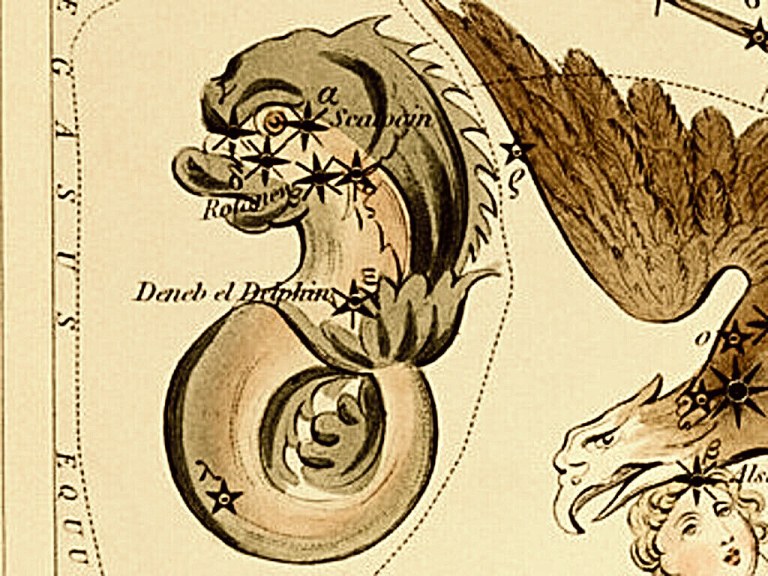
Sidney Hall’s (1831) astronomical chart illustration of the Delphinus, Sagitta, Aquila, and the Antinous. Original from Library of Congress. Digitally enhanced by rawpixel. courtesy of Openverse
Constellations of the Month:
September – Delphinus
Material may be shared for personal and educational use, Share with family and friends. The material cannot be used in an educational setting whereby a “book fee” is charged in or above tuition costs, and the material here is being used without paying a licensing fee.. AI must file an application for use of such material.
| You May Also Like. . . | |
 NASA 1997 Liftoff Special |
 NASA Mission Patch Party |
More on Versatileer:
![suzuki-samurai-doing-off-road-5913420 flood_1653369509.jpeg Robin Ramos at Pexels]()
The Danger of Floods – Spring & Summer Weather Series + Resources For Recovery
05/24/2022![Sunforest Mix Sunflowers.jpg]()
Featured Photo: Flower of the Day – Sunforest Mix Sunflowers
11/18/2021![2022 New Year Freebies.png]()
Happy Holiday Season + Calendar Freebies & Deals – 2021 into 2022
01/02/2022![Fall Colors at Lake Sabrina in the Eatsern Sierra.jpg]()
Welcome to the Fall Season – 2025
09/22/2025![wp-17329077399035112122171803714220.jpg]()
Featured Photo: Christmas Flower of the Day '24 – Bouquet #4
12/13/2024
































Thanks for the information on Delphinus. I enjoy learning about the constellations.