Constellations of the Month: August – Pavo:
We continue August with the last constellation of the month, Pavo, “The Peacock.”

Pavo constellation map courtesy of Openverse
Pavo, “The Peacock” – The Pavo constellation is located in the southern hemisphere, and symbolizes “the peacock.” Pavo is part of the Johann Bayer family of constellations, which includes Apus, Chamaeleon, Dorado, Grus, Hydrus, Indus, Musca, Phoenix, Tucana, and Volans. The constellation Pavo features five stars that have confirmed planets and does not include any Messier objects. The most luminous star in this constellation is Peacock, designated as Alpha Pavonis, which has an apparent magnitude of 1.94. Additionally, there is one meteor shower linked to this constellation: the Delta Pavonids. Within Pavo, there is one star that has been given a name. The name recognized by the International Astronomical Union (IAU) for this star is Peacock.

Spiral Galaxy NGC 6782 courtesy of Openverse
Key points regarding Pavo:
- Meaning: The term “Pavo” translates to “The Peacock” in Latin. Pavo was brought to light by the Dutch astronomer Petrus Plancius, based on the observations made by Dutch navigators Frederick de Houtman and Pieter Dirkszoon Keyser during the late 16th century. Pavo was first illustrated in 1598 on Plancius’ globe and made its debut in a star atlas in 1603, within Johann Bayer’s Uranometria. In Australia, a section of this constellation is referred to as “the Saucepan” and serves as a navigational aid for locating the south. Pavo is distinguished by its prominent star Peacock, the nearby solar analog Delta Pavonis, the interacting galaxies NGC 6872 (known as the Condor Galaxy) and IC 4970, along with several other deep-sky objects.
- Notable stars: Alpha Pavonis is the brightest star in the Pavo constellation, located about 179 light years from Earth. It has an apparent magnitude of 1.94 and is a blue-white subgiant star classified as B2 IV. This star is a spectroscopic binary with an orbital period of 11.753 days, although the companion star’s classification remains unknown. In the late 1930s, Her Majesty’s Nautical Almanac Office named it Peacock when creating the Air Almanac for the Royal Air Force. Beta Pavonis is the second brightest star in Pavo, about 137 light years away, with a visual magnitude of 3.42. It is an A5IV subgiant, 58 times more luminous than the Sun. Delta Pavonis, only 19.92 light years from the Sun, has an apparent magnitude of 3.56 and is a G8 IV subgiant, slightly less massive than the Sun. Gamma Pavonis, a main sequence F9 V star, has a magnitude of 4.22 and is 30.21 light years distant. Phi-2 Pavonis is a yellow-white dwarf star, and HD 181433 is between a red giant and a subgiant, with extrasolar planets discovered orbiting it.
- Other features: NGC 6752 is a globular cluster and the third brightest of its kind in the night sky, located about 13,000 light years away, with an apparent magnitude of 5.4. NGC 6872, or the Condor Galaxy, and IC 4970 are two interacting galaxies in Pavo, at a distance of about 220 million light years. NGC 6872 is a large barred spiral galaxy with a disrupted spiral arm containing many young blue stars, influenced by the nearby IC 4970. NGC 6744 is an intermediate spiral galaxy, similar to the Milky Way, located around 31 million light years away, and has at least one satellite galaxy. IC 4687, IC 4689, and IC 4686 are a triplet of merging galaxies, about 250 million light years away, showcasing starburst regions. NGC 6782, another barred spiral galaxy, is approximately 183 million light years distant.
- Mythology: The constellation is thought to symbolize the Java green peacock, which Dutch explorers de Houtman and Keyser likely saw on their journey to the East Indies. In Greek mythology, the peacock is a sacred bird of the goddess Hera, who rode in a chariot pulled by them. There is a myth about the peacock’s tail having eyes. When Zeus fell for Io, a nymph, he transformed her into a cow to hide her from Hera. Hera, suspicious, assigned the giant Argus, known for his hundred eyes, to watch over Io. Zeus sent Hermes, disguised as a shepherd, to rescue Io by lulling Argus to sleep with stories and music. After defeating Argus, Hera honored him by placing his eyes on the peacock’s tail.
- Visibility: Pavo is the 44th largest constellation, covering 378 square degrees. It is situated in the fourth quadrant of the southern hemisphere (SQ4) and is observable at latitudes ranging from +30° to -90°. The constellations that border Pavo include Apus, Ara, Indus, Octans, and Telescopium. The name of the constellation, Pavo, is pronounced /ˈpeɪvoʊ/. In English, it is referred to as the Peacock. The genitive form of Pavo, which is utilized in the naming of stars, is Pavonis (pronunciation: /pəˈvoʊnɪs/). The three-letter abbreviation, which was officially adopted by the International Astronomical Union (IAU) in 1922, is Pav.
⁺‧₊☽◯☾₊‧⁺⋆⁺‧₊☽◯☾₊‧⁺⋆⁺‧₊☽◯☾₊‧⁺⋆⁺‧₊☽◯☾₊‧⁺⋆⁺‧₊☽◯☾₊‧⁺⋆⁺‧₊☽◯☾₊‧⁺⋆
Constellations:
| Constellations by Month | ||
| JANUARY [8] | FEBRUARY [7] | MARCH [7] |
| Taurus | Camelopardalis | Ursa Major |
| Orion | Auriga | Cancer |
| Lepus | Gemini | Canis Minor |
| Caelum | Monoceros | Pyxis |
| Reticulum | Canis Major | Vela |
| Dorado | Columba | Carina |
| Pictor | Puppis | Volans |
| Mensa | ||
| APRIL [8] | MAY [7] | JUNE [6] |
| Ursa Major | Canes Venatici | Ursa Minor |
| Leo Minor | Coma Berenices | Boötes |
| Leo | Virgo | Libra |
| Sextans | Corvus | Lupus |
| Crater | Centaurus | Circinus |
| Hydra | Crux | Apus |
| Antlia | Musca | |
| Chamaeleon | ||
| JULY [9] | AUGUST [9] | SEPTEMBER [6] |
| Draco | Lyra | Cygnus |
| Corona Borealis | Vulpecula | Delphinus |
| Hercules | Sagitta | Equuleus |
| Serpens | Aquila | Capricornus |
| Ophiuchus | Scutum | Microscopium |
| Scorpius | Sagittarius | Indus |
| Norma | Corona Australis | |
| Ara | Telescopium | |
| Triangulum Australe | Pavo | |
| OCTOBER [7] | NOVEMBER [8] | DECEMBER [6] |
| Cepheus | Cassiopeia | Perseus |
| Lacerta | Andromeda | Triangulum |
| Pegasus | Pisces | Aries |
| Aquarius | Cetus | Eridanus |
| Piscis Austrinus | Sculptor | Fornax |
| Grus | Phoenix | Horologium |
| Octans | Tucana | |
| Hydrus | ||
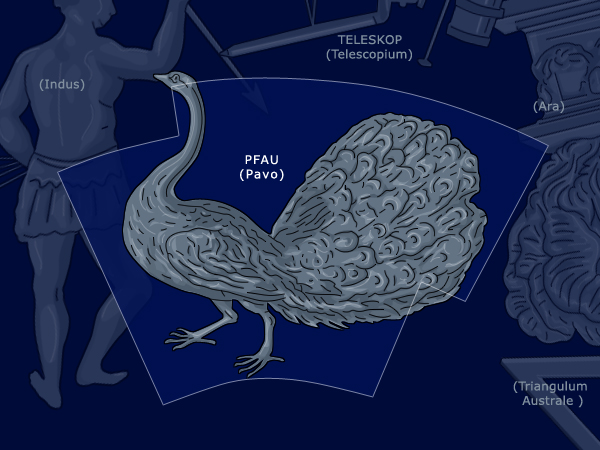
Pavo courtesy of Openverse
Constellations of the Month:
August – Pavo
Material may be shared for personal and educational use, Share with family and friends. The material cannot be used in an educational setting whereby a “book fee” is charged in or above tuition costs, and the material here is being used without paying a licensing fee.. AI must file an application for use of such material.
| You May Also Like. . . | |
 NASA 1997 Liftoff Special |
 NASA Mission Patch Party |
More on Versatileer:
![20220511_165801.jpg]()
Featured Photo: Flower of the Day – The Doubleflower Chinese Crabapple Tree
09/04/2022![World Day Against Cyber Censorship '24.jpg]()
World Day Against Cyber Censorship – 2024
03/12/2024![wp-16977803386055351821408034411715.jpg]()
Featured Photo: The Beauty of Fall Color – Freeman's Maple Tree in Midlothian
10/20/2023![pexels-photo-211122.jpeg]()
April Fool's is No Joke for my Website - A New Beginning
04/01/2019![wp-17200286450311973498424570309807.jpg]()
Featured Photo: Flower of the Day – Whitestar Morning Glory
07/23/2024