Constellations of the Month: August – Sagittarius:
We continue August with the next constellation of the month, Sagittarius, “The Archer.”
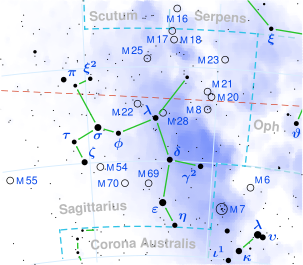
Sagittarius constellation map courtesy of Openverse
Sagittarius, “The Archer” – The Sagittarius constellation is located in the southern hemisphere, and symbolizes “the archer.” Sagittarius is part of the zodiac, represented by an archer, typically shown as a centaur with a bow and arrow. Its symbol is ♐, and it is linked to Crotus, a satyr who was with the Muses. As one of the largest southern constellations, Sagittarius is easy to locate on the Milky Way (the galactic center), with its brightest stars forming the asterism called the Teapot. Catalogued by Greek astronomer Ptolemy in the 2nd century, it includes notable features like the Arches Cluster, the Pistol Star, and over 15 Messier objects, such as the Lagoon Nebula and Trifid Nebula. Some of the brightest stars in Sagittarius create a shape called the Teapot. Sigma and Tau Sagittarii are the handle, while Delta, Epsilon, Zeta, and Phi Sagittarii form the body. Lambda Sagittarii is the lid, and Gamma-2 Sagittarii is the spout. The Terebellum is a shape made by four stars: Omega, 59, 60, and 62 Sagittarii, located close to each other. Each star is a different type with varying distances from Earth, and they are not bound by gravity.

NGC 6445 PanSv courtesy of Openverse
Key points regarding Sagittarius:
- Meaning: The term “Sagittarius” translates to “The Archer” in Latin. Sagittarius has 17 named stars, which have names approved by the International Astronomical Union. These stars include Ainalrami, Albaldah, Alnasl, and others. Sagittarius also has 32 stars with confirmed planets. Notably, the star OGLE-2006-BLG-109L has two exoplanets resembling Jupiter and Saturn, discovered in 2008. Two of the most distant exoplanets, SWEEPS-04 and SWEEPS-11, orbit distant stars over 27,000 light years away. Other stars like HD 169830 and HD 190647 also have known exoplanets discovered in 2000 and 2007, respectively. Additionally, a transiting planet was found orbiting the star OGLE-TR-10 in 2002. Sagittarius belongs to the Zodiac family of constellations, alongside Aries, Taurus, and others. The constellation contains 15 Messier objects, including the Lagoon Nebula and the Trifid Nebula. There are no meteor showers linked to Sagittarius.
- Notable stars: Epsilon Sagittarii is a binary star about 143 light years away, classified as a blue class B giant, with a brightness 375 times that of the Sun. Kaus Australis, the brightest star in Sagittarius, also has a faint companion and marks the base of the archer’s bow. Sigma Sagittarii, known as Nunki, is the second brightest star in Sagittarius, located 228 light years away, and has a brightness 3,300 times greater than the Sun. It is a hydrogen-fusing dwarf star that spins very fast and has had its light occasionally blocked by the Moon or planets. Delta Sagittarii is a multiple star system 306 light years away with a brightness 1,180 times that of the Sun. Its traditional name means “the middle bow.” Lambda Sagittarii, or Kaus Borealis, is an orange giant, 77.3 light years from Earth, in the final stages of life, fusing helium. Alpha Sagittarii, also known as Rukbat, is a blue dwarf star located 170 light years away with a brightness of 3.97. Beta Sagittarii consists of two nearby systems, Beta-1 and Beta-2, also known as Arkab. Zeta Sagittarii, a binary star, is 89.1 light years from Earth. Other stars mentioned include Pi Sagittarii, Gamma Sagittarii, and Tau Sagittarii, among others. Ross 154 is a red dwarf star, and V4641 Sagittarii is a microquasar discovered in 1999. LBV 1806-20 is a luminous variable star, and SGR 1806-20 is a magnetar that emits gamma rays. These stars contribute to the rich diversity and mystery of the constellation Sagittarius.
- Other features: Sagittarius A is a radio source at the center of the Milky Way, consisting of Sagittarius A East, Sagittarius A West, and a candidate for the supermassive black hole. Sagittarius A East is about 25 light years wide, while Sagittarius A West, known as Minispiral, contains fast-moving gas clouds. Sagittarius B2 is a large molecular cloud situated 390 light years from the center. The Lagoon Nebula, notable for star formation, is 4,100 light years away. Other significant objects include the Omega Nebula, Trifid Nebula, and different star clusters, like Messier 18, Messier 21, the Sagittarius Cluster, and Messier 23, which vary in characteristics and distances from Earth. The Small Sagittarius Star Cloud is densely packed with stars visible through binoculars. Messier 25, an open cluster, is about 2,000 light years from Earth. Messier 28 is a globular cluster with pulsating stars, at a distance of 18,000 to 19,000 light years, while Messier 54 is about 87,400 light years away. Several other globular clusters, including Messier 69, Messier 70, and Messier 75, are also located near the Galactic center. The Sagittarius Dwarf Elliptical Galaxy, 65,000 light years away, will merge with the Milky Way in the future. Various notable clusters and nebulae exist in the area, such as the Arches Cluster, Quintuplet Cluster, and NGC 6522, which is over 12 billion years old. Terzan 5 is another noteworthy globular cluster with multiple generations of stars and a high density of star formation. The Red Spider Nebula is also mentioned, along with numerous other clusters discovered by astronomers over the years.
- Mythology: The constellation Sagittarius has 17 named stars, which have names approved by the International Astronomical Union. These stars include Ainalrami, Albaldah, Alnasl, and others. Sagittarius also has 32 stars with confirmed planets. Notably, the star OGLE-2006-BLG-109L has two exoplanets resembling Jupiter and Saturn, discovered in 2008. Two of the most distant exoplanets, SWEEPS-04 and SWEEPS-11, orbit distant stars over 27,000 light years away. Other stars like HD 169830 and HD 190647 also have known exoplanets discovered in 2000 and 2007, respectively. Additionally, a transiting planet was found orbiting the star OGLE-TR-10 in 2002. Sagittarius belongs to the Zodiac family of constellations, alongside Aries, Taurus, and others. The constellation contains 15 Messier objects, including the Lagoon Nebula and the Trifid Nebula. There are no meteor showers linked to Sagittarius.
- Visibility: Sagittarius is the 84th largest constellation, covering 867 square degrees in the southern hemisphere. It can be seen at latitudes from +55° to -90° and is bordered by several constellations including Aquila and Scorpius. Sagittarius means “the Archer” in English, and its genitive form is Sagittarii, with the abbreviation Sgr designated by the International Astronomical Union in 1922. The constellation has seven stars brighter than magnitude 3.00, with Kaus Australis as the brightest star, and Ross 154 is the closest star at 9.69 light years away.
⁺‧₊☽◯☾₊‧⁺⋆⁺‧₊☽◯☾₊‧⁺⋆⁺‧₊☽◯☾₊‧⁺⋆⁺‧₊☽◯☾₊‧⁺⋆⁺‧₊☽◯☾₊‧⁺⋆⁺‧₊☽◯☾₊‧⁺⋆
Constellations:
| Constellations by Month | ||
| JANUARY [8] | FEBRUARY [7] | MARCH [7] |
| Taurus | Camelopardalis | Ursa Major |
| Orion | Auriga | Cancer |
| Lepus | Gemini | Canis Minor |
| Caelum | Monoceros | Pyxis |
| Reticulum | Canis Major | Vela |
| Dorado | Columba | Carina |
| Pictor | Puppis | Volans |
| Mensa | ||
| APRIL [8] | MAY [7] | JUNE [6] |
| Ursa Major | Canes Venatici | Ursa Minor |
| Leo Minor | Coma Berenices | Boötes |
| Leo | Virgo | Libra |
| Sextans | Corvus | Lupus |
| Crater | Centaurus | Circinus |
| Hydra | Crux | Apus |
| Antlia | Musca | |
| Chamaeleon | ||
| JULY [9] | AUGUST [9] | SEPTEMBER [6] |
| Draco | Lyra | Cygnus |
| Corona Borealis | Vulpecula | Delphinus |
| Hercules | Sagitta | Equuleus |
| Serpens | Aquila | Capricornus |
| Ophiuchus | Scutum | Microscopium |
| Scorpius | Sagittarius | Indus |
| Norma | Corona Australis | |
| Ara | Telescopium | |
| Triangulum Australe | Pavo | |
| OCTOBER [7] | NOVEMBER [8] | DECEMBER [6] |
| Cepheus | Cassiopeia | Perseus |
| Lacerta | Andromeda | Triangulum |
| Pegasus | Pisces | Aries |
| Aquarius | Cetus | Eridanus |
| Piscis Austrinus | Sculptor | Fornax |
| Grus | Phoenix | Horologium |
| Octans | Tucana | |
| Hydrus | ||
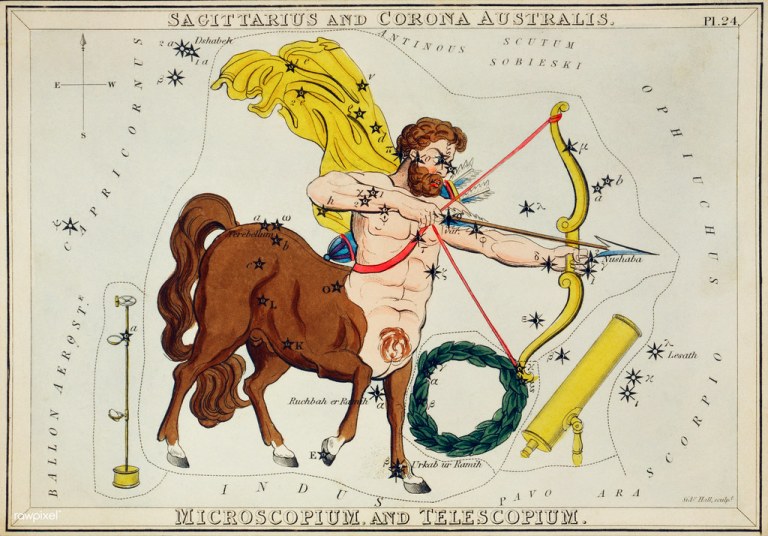
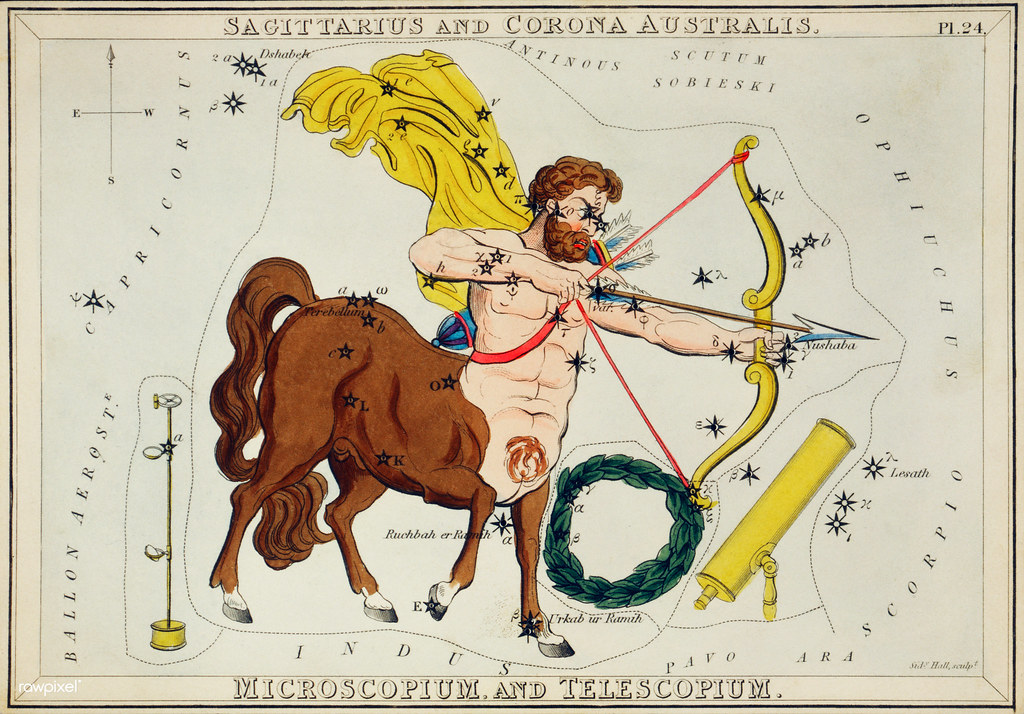
Sidney Hall’s (?-1831) astronomical chart illustration of Sagittarius and Corona Australis, Microscopium and Telescopium. The centaur Sagittarius with bow and arrow, telescope and microscope forming the constellation. Original from Library of Congress courtesy of Openverse
Constellations of the Month:
August – Sagittarius
Material may be shared for personal and educational use, Share with family and friends. The material cannot be used in an educational setting whereby a “book fee” is charged in or above tuition costs, and the material here is being used without paying a licensing fee.. AI must file an application for use of such material.
| You May Also Like. . . | |
 NASA 1997 Liftoff Special |
 NASA Mission Patch Party |
More on Versatileer:
![Teacher Tuesday - May 2024.png]()
Ends 06-03 – Teacher Tuesday - May 28th
05/28/2024![Chicago Marching Band Competition-June 1983_COLLAGE__Bagpipe Day '24.jpg]()
International Bagpipe Day - 2024 + Photos of the Chicago Marching Band Competition – June 1983
03/11/2024![INSTA_ColdRide.png]()
The Cold Ride by Anya Summers Cover Reveal – Release Date Coming September 19th
08/25/2023![A Montana Feud__26.jpg]()
Ends 10-02 – A Montana Feud by Jim Overstreet Book Blitz + $25 Amazon Gift Card Giveaway
09/22/2024![INSTA_IntheTimeofSpirits.png]()
Ends 08-14 – In the Time of Spirits by Beth Ford Book Blitz + $25 Amazon Gift Card Giveaway
08/07/2024





























Thank you for sharing