Constellations of the Month: July – Ara:
We continue July with the next constellation of the month, Ara, “The Altar.”
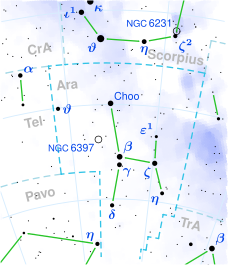
Ara constellation map courtesy of Openverse
Ara, “The Altar” – The constellation of Ara is located in the southern hemisphere, and its symbolism translates to “the altar” in Latin. The constellation symbolizes the altar utilized by Zeus and other Greek deities to pledge their allegiance before confronting Cronus and the Titans. In another Greek legend, Ara signifies the altar of King Lycaon from Arcadia. Ara was among the 48 Greek constellations cataloged by the astronomer Claudius Ptolemy in the 2nd century. It is positioned just south of Scorpius, beneath the tail of the scorpion. The constellation features several prominent deep sky objects: the Stingray Nebula, the open clusters Westerlund 1 (Ara Cluster) and NGC 6193, the globular clusters NGC 6397, NGC 6352, and NGC 6362, the barred spiral galaxy NGC 6300, the planetary nebula NGC 6326, and the pre-planetary Water Lily Nebula.

Hubble’s Holiday Nebula “Ornament” courtesy of Openverse
Key points regarding Ara:
- Meaning: The term “Ara” translates to “The Altar” in Latin. The constellation Ara is home to Gliese 674 is the closest star in the constellation Ara, located 14.849 light-years away from Earth. Ara has two stars brighter than magnitude 3.00 and three stars within 10 parsecs of Earth. The brightest star in this constellation is Beta Arae, with a magnitude of 2.84, and Alpha Arae sometimes varies in brightness from 2.76 to 2.90. Ara has no meteor showers or Messier objects, and it contains two officially named stars: Cervantes (Mu Arae) and Inquill (HD 156411). The best time to observe Ara is in July at around 9 pm.
- Notable stars: Beta Arae is an orange K-type bright giant star located about 603 light years away, and it has an apparent magnitude of 2.84, making it the brightest in the Ara constellation. Alpha Arae is the second brightest, a variable Be star with an apparent magnitude that changes between 2.76 and 2.90, located around 240 light years from Earth. It rotates quickly and is surrounded by a disk of ejected material. Gamma Arae is a blue-white B-type supergiant, distant about 1140 light years, with a visual companion star. Zeta Arae, another orange K-type giant, is approximately 574 light years away. Mu Arae is a G-type star with four known planets, about 50 light years distant. Epsilon Arae is a binary star system, consisting of two stars of differing distances and magnitudes.
- Other features: NGC 6193 is a large open cluster with 27 stars, mostly binaries, located 4,300 light years from Earth, and about 3 million years old. It illuminates the nearby NGC 6188 nebula. NGC 6379 is a bright globular cluster containing about 400,000 stars, discovered in the 18th century, and is one of the nearest to Earth at 7,200 light years away. The Stingray Nebula is the youngest known planetary nebula, 18,000 light years from Earth, with a central white dwarf. NGC 6362 is an ancient globular cluster, roughly 13.57 billion years old, and 24,800 light years distant. NGC 6326 is an irregular planetary nebula, 11,000 light years away, while NGC 6300 is a Seyfert galaxy at 50.9 million light years. The Ara Cluster, discovered in 1961, is a massive young cluster housing rare high-mass stars. Other deep sky objects in Ara include various galaxies and clusters.
- Mythology: There are myths about the constellation Ara. One myth tells how it represents the altar where Zeus and other gods vowed to defeat Cronus, a Titan who had overthrown his father, Uranus. To stop a prophecy predicting his downfall, Cronus swallowed his children. When Zeus was born, his mother hid him and gave Cronus a stone to swallow instead. Zeus later freed his siblings, and after a decade of war, they triumphed over Cronus and the Titans. Another story involves Lycaon, who tested Zeus by serving him a meal of a dismembered child. Furious, Zeus turned Lycaon into a wolf and punished his sons with lightning. In this version, the child sacrificed was Arcas, the son of Zeus and Lycaon’s daughter Callisto.
- Visibility: Ara is the 74th largest constellation, covering 237 square degrees in the southern hemisphere. It can be seen from latitudes +25° to -90°. Neighboring constellations include Apus, Corona Australis, and Scorpius. Ara is pronounced /ˈɛərə/ and means Altar in English. It has seven stars with known exoplanets, including Cervantes, which has four planets, and Gliese 676, which has three confirmed planets. Other stars with exoplanets are HD 156411, HD 152079, and HD 154672.
⁺‧₊☽◯☾₊‧⁺⋆⁺‧₊☽◯☾₊‧⁺⋆⁺‧₊☽◯☾₊‧⁺⋆⁺‧₊☽◯☾₊‧⁺⋆⁺‧₊☽◯☾₊‧⁺⋆⁺‧₊☽◯☾₊‧⁺⋆
Constellations:
| Constellations by Month | ||
| JANUARY [8] | FEBRUARY [7] | MARCH [7] |
| Taurus | Camelopardalis | Ursa Major |
| Orion | Auriga | Cancer |
| Lepus | Gemini | Canis Minor |
| Caelum | Monoceros | Pyxis |
| Reticulum | Canis Major | Vela |
| Dorado | Columba | Carina |
| Pictor | Puppis | Volans |
| Mensa | ||
| APRIL [8] | MAY [7] | JUNE [6] |
| Ursa Major | Canes Venatici | Ursa Minor |
| Leo Minor | Coma Berenices | Boötes |
| Leo | Virgo | Libra |
| Sextans | Corvus | Lupus |
| Crater | Centaurus | Circinus |
| Hydra | Crux | Apus |
| Antlia | Musca | |
| Chamaeleon | ||
| JULY [9] | AUGUST [9] | SEPTEMBER [6] |
| Draco | Lyra | Cygnus |
| Corona Borealis | Vulpecula | Delphinus |
| Hercules | Sagitta | Equuleus |
| Serpens | Aquila | Capricornus |
| Ophiuchus | Scutum | Microscopium |
| Scorpius | Sagittarius | Indus |
| Norma | Corona Australis | |
| Ara | Telescopium | |
| Triangulum Australe | Pavo | |
| OCTOBER [7] | NOVEMBER [8] | DECEMBER [6] |
| Cepheus | Cassiopeia | Perseus |
| Lacerta | Andromeda | Triangulum |
| Pegasus | Pisces | Aries |
| Aquarius | Cetus | Eridanus |
| Piscis Austrinus | Sculptor | Fornax |
| Grus | Phoenix | Horologium |
| Octans | Tucana | |
| Hydrus | ||
![[Ara].jpg](https://versatileer.com/wp-content/uploads/2025/07/Ara-768x576.jpg)
[Ara] courtesy of Openverse
Constellations of the Month:
July – Ara
Material may be shared for personal and educational use, Share with family and friends. The material cannot be used in an educational setting whereby a “book fee” is charged in or above tuition costs, and the material here is being used without paying a licensing fee.. AI must file an application for use of such material.
| You May Also Like. . . | |
 NASA 1997 Liftoff Special |
 NASA Mission Patch Party |
More on Versatileer:
![bright-close-up-color-colorful-221247 Exercise_1701065639.jpeg Pixabay at Pexels]()
Plan Exercise By Goal.
11/27/2023![Day 252: Metric System.jpg]()
Happy National Metric Day – 2025
10/18/2025![drill-press-and-clamp-with-timber-in-workroom-5974026 press_1683656890.jpeg Ono Kosuki at Pexels]()
Happy National Skilled Trades Day – 2023
05/09/2023![TooGoodToBeTruePromo2.jpg]()
Ends 07-30 – Too Good to Be True by A.S. Kelly Book Blitz + $25 Amazon Gift Card Giveaway
07/22/2025![World Trade Center Lights .. New York City ...9/11/08/jpg]()
Never Forget 9/11! Remembrance Day for Friends and Families – 23 Years Later
09/11/2024