Constellations of the Month: July – Scorpius:
We continue July with the next constellation of the month, Scorpius, “The Scorpion.”

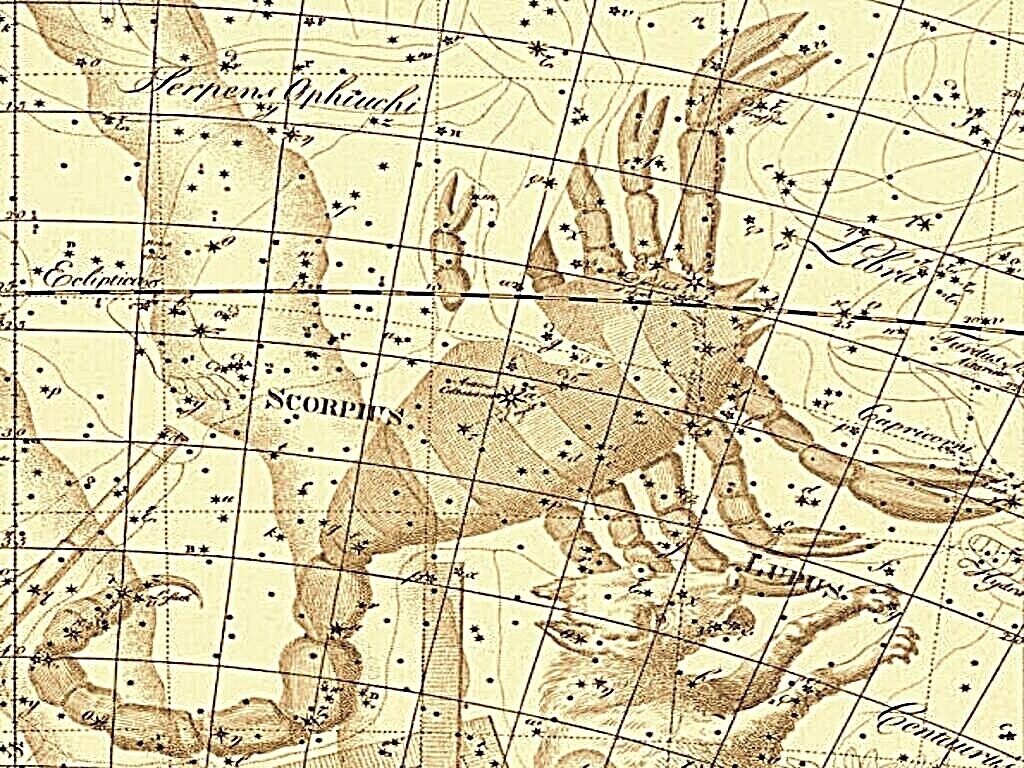
Scorpius constellation map courtesy of Openverse
Scorpius, “The Scorpion” – The constellation of Scorpius (not “Scorpio”) is located in the southern hemisphere, and symbolizes “the scorpion.” The constellation is linked to the tale of Orion in Greek mythology. Scorpius is classified as one of the zodiac constellations and was first documented by the Greek astronomer Ptolemy during the 2nd century. Its symbol is ♏. Scorpius predates Greek civilization and is recognized as one of the most ancient constellations known to humanity. Approximately 5,000 years ago, the Sumerians referred to it as GIR-TAB, meaning “the scorpion.” This constellation is relatively easy to locate in the night sky due to its position near the center of the Milky Way. It features several prominent stars and deep-sky objects, including the luminous stars Antares and Shaula, the Butterfly Cluster (Messier 6), the Ptolemy Cluster (Messier 7), the Cat’s Paw Nebula (NGC 6334), the Butterfly Nebula (NGC 6302), the Cotton Candy Nebula, the Blue Horsehead Nebula (IC 4592), and the War and Peace Nebula (NGC 6357).
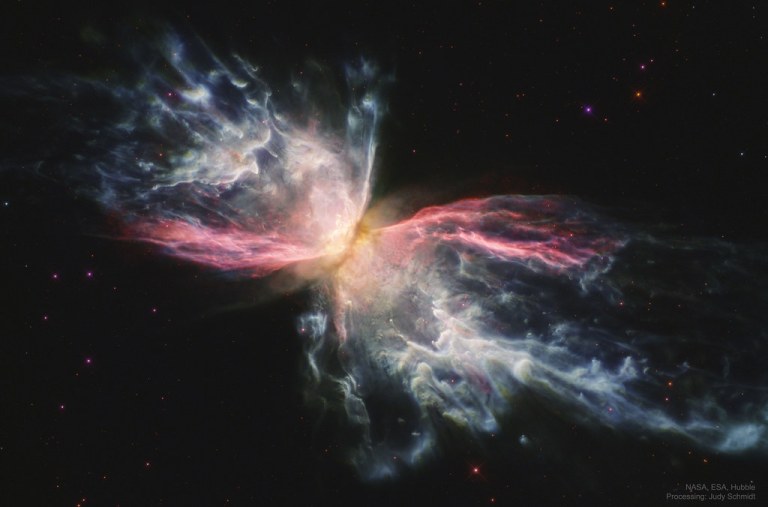
Iron in the Butterfly Nebula courtesy of Openverse
Key points regarding Scorpius:
- Meaning: The term “Scorpius” translates to “The Scorpion” in Greek. The constellation Scorpius comprises 18 designated stars. The names of these stars, which have been sanctioned by the International Astronomical Union (IAU), include Acrab, Alniyat, Antares, Dìwö, Dschubba, Fang, Fuyue, Iklil, Jabbah, Larawag, Lesath, Paikauhale, Pipirima, Rapeto, Sargas, Sharjah, Shaula, and Xamidimura. Within Scorpius, there are four Messier objects: Messier 4 (M4, NGC 6121), Messier 6 (M6, NGC 6405, known as the Butterfly Cluster), Messier 7 (M7, NGC 6475, also called the Ptolemy Cluster), and Messier 80 (NGC 6093). Additionally, the constellation features 13 stars that have known planets. The most luminous star in Scorpius is Antares, Alpha Scorpii, which has an apparent magnitude of 0.96. Antares is also recognized as one of the brightest stars visible in the night sky. Furthermore, there are two meteor showers linked to this constellation: the Alpha Scorpiids and the Omega Scorpiids.
- Notable stars: Antares (the 15th brightest star) is a red supergiant star located about 550 light years from the Sun in the Scorpius constellation, making it the brightest star in that constellation and the 16th brightest in the night sky. It shines 10,000 times brighter than the Sun, has a visual magnitude of 0.96, and is around 12 million years old, with a radius 883 times larger than the Sun. Antares varies in brightness and has a companion star called Antares B, which is 529 astronomical units away. Its name means “rival of Mars” in Greek, due to its red color. Shaula, the second brightest star in Scorpius, is about 700 light years away and consists of three stars. Its name means “the raised (tail)” in Arabic. Beta Scorpii, known as Acrab, is another multiple star system that appears as a binary star. Delta Scorpii, around 444 light years away, has a visual magnitude of 2.307 and a companion star. Theta Scorpii is a yellow giant star 300 light years from the Sun, while Epsilon Scorpii is a giant star 63.7 light years away. Kappa Scorpii is a binary system with an orbital period of 196 days. Pi Scorpii is a triple star system about 590 light years away, with its brightest stars showing brightness changes. Nu Scorpii, 437 light years from Earth, has two groups of stars. G Scorpii, an orange giant star, is located 125.8 light years away. Eta Scorpii is an evolving subgiant star located 73.5 light years away. Rho Scorpii is a binary system roughly 409 light years from Earth. Zeta Scorpii consists of two stars at different distances. Mu Scorpii has two systems, while 18 Scorpii is a solar analog that may host life. Gliese 667 is a triple star system with confirmed exoplanets. HD 159868 is a yellow dwarf with gas giant planets. Wray 17-96 is a luminous blue variable (LBV) with an absolute magnitude of -10.9 (almost the brightest), equivalent to 1.8 million solar units, but only an apparent magnitude of 17.8 and is located roughly 15,000 light years away.
- Other features: Messier 4 is a globular cluster in the constellation Scorpius, located about 7,200 light years away. It has an apparent magnitude of 5.9 and is approximately 12.2 billion years old. The cluster spans around 75 light years across and was first discovered in 1746 by Philippe Loys de Chéseaux, later included in Messier’s catalog in 1764. It is easy to locate in the sky, as it is 1.3 degrees west of Antares. Messier 6, known as the Butterfly Cluster, was discovered by Giovanni Batista Hodierna in 1654. It has an apparent magnitude of 4.2 and is about 1,600 light years away. Messier 7, or the Ptolemy Cluster, is an open star cluster near Scorpius’ stinger, first recorded by Ptolemy in 130 AD, with an apparent magnitude of 3.3 and a distance of about 980 light years. Messier 80 is another globular cluster, discovered in 1781, located 32,600 light years away with an apparent magnitude of 7.87. The Cat’s Paw Nebula is a large star-forming region discovered in 1837. NGC 6072 and NGC 6281 are other notable nebulae and star clusters in Scorpius, with distances around 1,611 light years. The Butterfly Nebula features a very hot central star. Finally, the Lobster Nebula is a young star region containing many protostars, including the previously thought most massive star, Pismis 24-1.
- Mythology: In Greek mythology, the constellation Scorpius is associated with the scorpion that stung Orion, the legendary hunter. These two constellations are positioned opposite each other in the sky, with Orion depicted as fleeing from the scorpion as it rises just as Scorpius sets. In one interpretation of the myth, Orion attempted to assault the goddess Artemis, prompting her to send the scorpion to eliminate him. In another interpretation, it was the Earth that dispatched the scorpion after Orion had boasted of his ability to conquer any wild animal. During ancient Greek times, the constellation Scorpius was notably larger and consisted of two segments: one representing the body and sting of the scorpion, and the other depicting the claws. The latter segment was referred to as Chelae, meaning “claws.” In the first century BC, the Romans separated the claws into an independent constellation known as Libra, the Scales.
- Visibility: Scorpius is the 33rd largest constellation, covering 497 square degrees. It is located in the third quadrant of the southern hemisphere (SQ3) and is visible at latitudes ranging from +40° to -90°. The constellations that border Scorpius include Ara, Corona Australis, Libra, Lupus, Norma, Ophiuchus, and Sagittarius. The name Scorpius is pronounced /ˈskɔːrpiəs/. Scorpius represents the scorpion that in Greek mythology bit the heel of Orion. It is one of the zodiac constellations, catalogued by the Greek astronomer Ptolemy in the 2nd century, and its symbol is ♏. Scorpius is very old and was referred to as GIR-TAB by the Sumerians around 5,000 years ago. It is easy to locate in the sky, near the center of the Milky Way, and features bright stars like Antares and Shaula, as well as several notable deep sky objects.
⁺‧₊☽◯☾₊‧⁺⋆⁺‧₊☽◯☾₊‧⁺⋆⁺‧₊☽◯☾₊‧⁺⋆⁺‧₊☽◯☾₊‧⁺⋆⁺‧₊☽◯☾₊‧⁺⋆⁺‧₊☽◯☾₊‧⁺⋆
Constellations:
| Constellations by Month | ||
| JANUARY [8] | FEBRUARY [7] | MARCH [7] |
| Taurus | Camelopardalis | Ursa Major |
| Orion | Auriga | Cancer |
| Lepus | Gemini | Canis Minor |
| Caelum | Monoceros | Pyxis |
| Reticulum | Canis Major | Vela |
| Dorado | Columba | Carina |
| Pictor | Puppis | Volans |
| Mensa | ||
| APRIL [8] | MAY [7] | JUNE [6] |
| Ursa Major | Canes Venatici | Ursa Minor |
| Leo Minor | Coma Berenices | Boötes |
| Leo | Virgo | Libra |
| Sextans | Corvus | Lupus |
| Crater | Centaurus | Circinus |
| Hydra | Crux | Apus |
| Antlia | Musca | |
| Chamaeleon | ||
| JULY [9] | AUGUST [9] | SEPTEMBER [6] |
| Draco | Lyra | Cygnus |
| Corona Borealis | Vulpecula | Delphinus |
| Hercules | Sagitta | Equuleus |
| Serpens | Aquila | Capricornus |
| Ophiuchus | Scutum | Microscopium |
| Scorpius | Sagittarius | Indus |
| Norma | Corona Australis | |
| Ara | Telescopium | |
| Triangulum Australe | Pavo | |
| OCTOBER [7] | NOVEMBER [8] | DECEMBER [6] |
| Cepheus | Cassiopeia | Perseus |
| Lacerta | Andromeda | Triangulum |
| Pegasus | Pisces | Aries |
| Aquarius | Cetus | Eridanus |
| Piscis Austrinus | Sculptor | Fornax |
| Grus | Phoenix | Horologium |
| Octans | Tucana | |
| Hydrus | ||

[Scorpius] courtesy of Openverse
Constellations of the Month:
July – Scorpius
Material may be shared for personal and educational use, Share with family and friends. The material cannot be used in an educational setting whereby a “book fee” is charged in or above tuition costs, and the material here is being used without paying a licensing fee.. AI must file an application for use of such material.
| You May Also Like. . . | |
 NASA 1997 Liftoff Special |
 NASA Mission Patch Party |
More on Versatileer:
![My room.jpg]()
Happy National Clean Out Your Computer Day – 2025
02/10/2025![INSTA_HungryIsTheNight.jpg]()
Ends 08-30 – Hungry is the Night by Robin Jeffrey Book Blitz + $25 Amazon Gift Card Giveaway
08/22/2023![20190818_144846]()
Award Winning Ribs...How Delicious!
10/10/2019![20230115_110928_.jpg]()
Featured Photo: Flower Bouquet Photo of the Day – The Third Week of September
09/25/2023![Architecture-–-The-Buildings-of-Chicago-Illinois_Part-3__1024x1024px.jpg]()
Featured Photo Montage: Architecture, Part 3 – The Buildings of Chicago, Illinois
09/07/2021