Constellations of the Month: July – Hercules:
We continue July with the next constellation of the month, Hercules, “Hercules.”

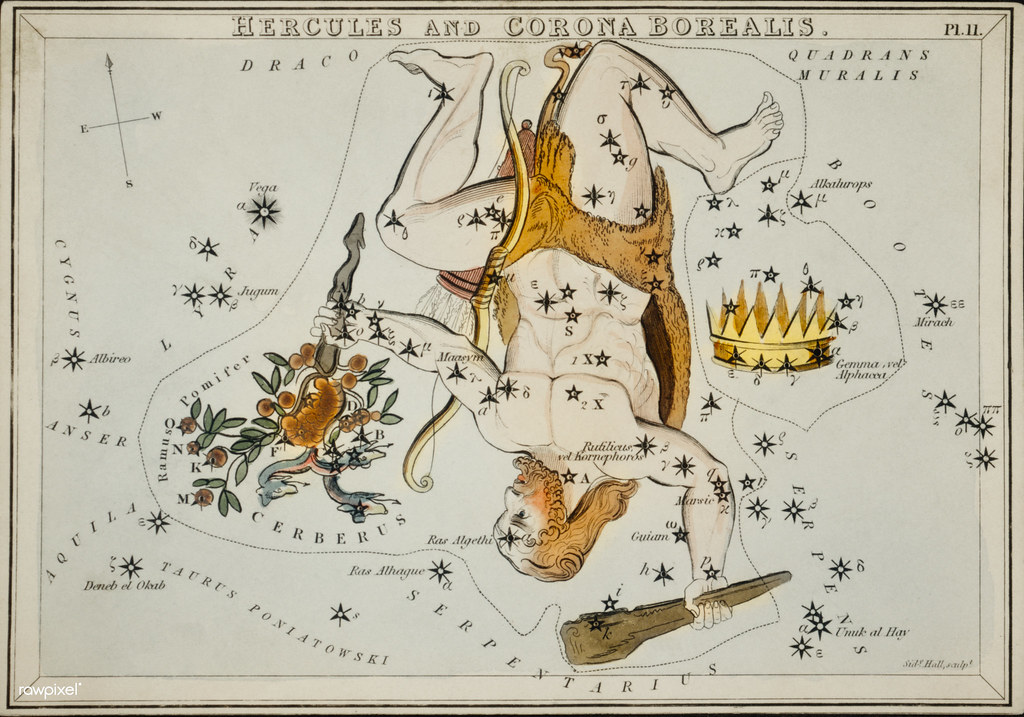
Hercules constellation map courtesy of Openverse
Hercules, “Hercules” – The Hercules constellation is located in the northern hemisphere, and symbolizes “Hercules” (no other meaning). Hercules is derived from its name from Hercules, the Roman equivalent of the Greek hero Heracles. Heracles, in turn, is frequently linked to the Sumerian hero Gilgamesh, and the constellation boasts a rich history that traces back to Sumerian civilization. Even though Hercules is a very large constellation, yet it does not contain any stars of first magnitude. In traditional illustrations, the star Ras Algethi (Alpha Herculis) symbolizes the head of Hercules, while a notable asterism known as the Keystone delineates his torso, as he triumphantly stands upon the head of Draco. The Keystone asterism consists of four luminous stars located in Hercules – Pi, Eta, Zeta, and Epsilon Herculis: symbolizing the torso of Hercules.
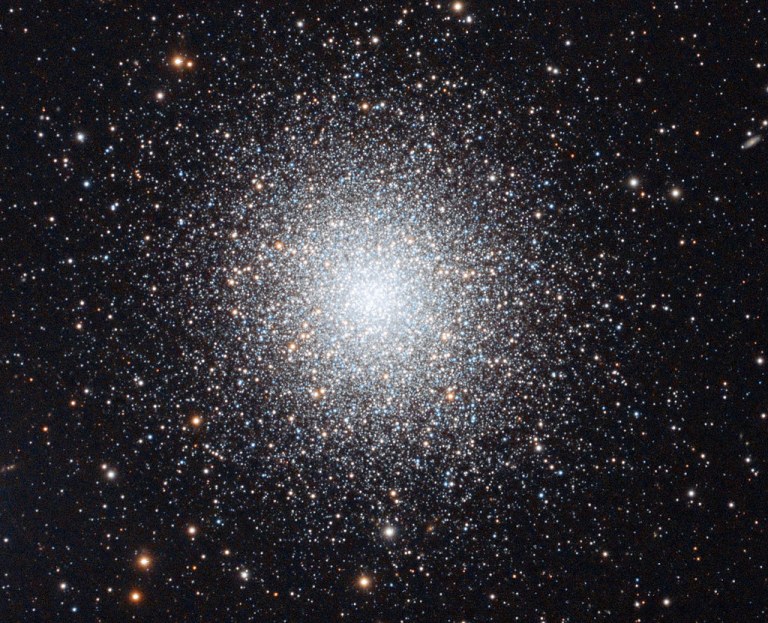
Messier 13 – The Hercules Globular Cluster courtesy of Openverse
Key points regarding Hercules:
- Meaning: The term “Hercules” translates to “Hercules” in Latin. The constellation Hercules is typically linked to the penultimate task of Heracles, which entailed vanquishing the dragon Ladon, the guardian of the Hesperides’ garden. This dragon is symbolized by the constellation Draco. The Hercules constellation was initially catalogued by the Greek astronomer Ptolemy during the 2nd century. Prominent deep sky objects within Hercules encompass the Great Globular Cluster (Messier 13), the globular cluster Messier 92, the planetary nebulae Abell 39 and the Turtle Nebula (NGC 6210), the Hercules Cluster of galaxies, and the galaxy cluster Abell 2199. Hercules has two Messier objects, M13 and M92, and 12 stars with known planets. Its brightest star is Kornephoros. The constellation has 14 named stars approved by the IAU.
- Notable stars: Beta Herculis, or Kornephoros, is the brightest star in the Hercules constellation. It is about 139 light years away and has an apparent magnitude of 2.81. This star system is binary, featuring a primary giant star, which is three times the mass of the Sun, and a less massive secondary star. Zeta Herculis is a multiple star system located 35 light years away with a combined apparent magnitude of 2.81. Its primary star is a subgiant much larger than the Sun, with a smaller companion star that has a long orbital period. Delta Herculis, around 75.1 light years away, is a star system with a main subgiant star twice the size of the Sun and an apparent magnitude of 3.126. Pi Herculis is a bright variable giant star about 377 light years away, showing daily brightness variations and possibly having a companion star. Alpha Herculis is a double star system roughly 360 light years from Earth. It includes a reddish giant and a binary of a yellow giant and a dwarf. Mu Herculis, 27.11 light years away, has a primary star more massive than the Sun and a binary companion. Eta Herculis is another star in this range with an apparent magnitude of 3.487. Other notable stars include Xi Herculis, Gamma Herculis, Iota Herculis, Omicron Herculis, and Theta Herculis, each with unique characteristics and distances.
- Other features: Messier 13, or the Hercules Globular Cluster, contains about 300,000 stars and is located in the Hercules constellation, roughly 22,200 light years away. Discovered by Edmond Halley in 1714 and cataloged by Charles Messier in 1764, it is visible with small telescopes. Its brightest star is V11, a variable star. The cluster is notable in science fiction and was the target of the Arecibo message sent to communicate with extraterrestrial life. Messier 92, another globular cluster in Hercules, is one of the oldest, about 14.2 billion years old, and was discovered in 1777. The Hercules Cluster, a galaxy cluster 500 million light years away, contains 200 galaxies. Abell 39 is a large spherical planetary nebula located 3,800 light years away. Other notable objects include NGC 6166, Hercules A, and the Turtle Nebula (NGC 6210), which was discovered in 1825.
- Mythology: The Hercules constellation has roots in ancient times, with its origins unclear even to the Greeks, who referred to it as Engonasin, or “the kneeling one.” Eratosthenes identified the figure as Heracles, envisioned as kneeling over a dragon. Aeschylus described another tale where Heracles was kneeling and tired from a battle. Heracles was the son of Zeus and the mortal Alcmene. As an infant, Zeus placed him at Hera’s breast, making him immortal. Hera’s anger led her to make his life difficult, resulting in Heracles losing his sanity and harming his children. To atone, he sought guidance from the Oracle at Delphi, who sent him to serve King Eurystheus for twelve years. During this time, he became known as Heracles, meaning “the glory of Hera. ” His original names varied according to different sources. Eurystheus assigned Heracles twelve tasks, starting with defeating the Nemean lion and using its skin as armor. The second task was to destroy the multi-headed Hydra, while another involved catching a golden-horned deer. The tasks continued with cleaning King Augeias’ stables, fighting birds, capturing a fire-breathing bull, bringing flesh-eating horses to Eurystheus, and retrieving the belt of the Amazon queen. After completing ten tasks, Eurystheus added two more, including stealing golden apples guarded by the dragon Ladon and fetching Cerberus from the Underworld. Upon finishing his labors, Heracles married Deianeira, but a tragic series of events led him to be poisoned by a shirt smeared with the centaur Nessus’ blood. In pain, he built a pyre on Mount Oeta, and upon his death, his immortal self ascended to Olympus, where he became the constellation known as Hercules.
- Visibility: Hercules is the 5th largest constellation, covering 1225 square degrees in the celestial sphere. This constellation is situated in the third quadrant of the northern hemisphere (NQ3) and is observable at latitudes ranging from +90° to -50°. The constellations that border it include Aquila, Boötes, Corona Borealis, Draco, Lyra, Ophiuchus, Sagitta, Serpens Caput, and Vulpecula. The name of the constellation, Hercules, is pronounced /ˈhɜːrkjʊliːz/. In the English language, it is referred to as Hercules. The genitive form of Hercules, which is utilized in the naming of stars, is Herculis (pronunciation: /ˈhɜːrkjʊlɪs/). The three-letter abbreviation, which was officially adopted by the International Astronomical Union (IAU) in 1922, is Her. Hercules is part of the Hercules family of constellations, which also includes Aquila, Ara, Centaurus, Corona Australis, Corvus, Crater, Crux, Cygnus, Hydra, Lupus, Lyra, Ophiuchus, Sagitta, Scutum, Sextans, Serpens, Triangulum Australe, and Vulpecula.
⁺‧₊☽◯☾₊‧⁺⋆⁺‧₊☽◯☾₊‧⁺⋆⁺‧₊☽◯☾₊‧⁺⋆⁺‧₊☽◯☾₊‧⁺⋆⁺‧₊☽◯☾₊‧⁺⋆⁺‧₊☽◯☾₊‧⁺⋆
Constellations:
| Constellations by Month | ||
| JANUARY [8] | FEBRUARY [7] | MARCH [7] |
| Taurus | Camelopardalis | Ursa Major |
| Orion | Auriga | Cancer |
| Lepus | Gemini | Canis Minor |
| Caelum | Monoceros | Pyxis |
| Reticulum | Canis Major | Vela |
| Dorado | Columba | Carina |
| Pictor | Puppis | Volans |
| Mensa | ||
| APRIL [8] | MAY [7] | JUNE [6] |
| Ursa Major | Canes Venatici | Ursa Minor |
| Leo Minor | Coma Berenices | Boötes |
| Leo | Virgo | Libra |
| Sextans | Corvus | Lupus |
| Crater | Centaurus | Circinus |
| Hydra | Crux | Apus |
| Antlia | Musca | |
| Chamaeleon | ||
| JULY [9] | AUGUST [9] | SEPTEMBER [6] |
| Draco | Lyra | Cygnus |
| Corona Borealis | Vulpecula | Delphinus |
| Hercules | Sagitta | Equuleus |
| Serpens | Aquila | Capricornus |
| Ophiuchus | Scutum | Microscopium |
| Scorpius | Sagittarius | Indus |
| Norma | Corona Australis | |
| Ara | Telescopium | |
| Triangulum Australe | Pavo | |
| OCTOBER [7] | NOVEMBER [8] | DECEMBER [6] |
| Cepheus | Cassiopeia | Perseus |
| Lacerta | Andromeda | Triangulum |
| Pegasus | Pisces | Aries |
| Aquarius | Cetus | Eridanus |
| Piscis Austrinus | Sculptor | Fornax |
| Grus | Phoenix | Horologium |
| Octans | Tucana | |
| Hydrus | ||

Sidney Hall’s (1831) astronomical chart illustration of the Hercules and the Corona Borealis. Original from Library of Congress. Digitally enhanced by rawpixel. courtesy of Openverse
Constellations of the Month:
July – Hercules
Material may be shared for personal and educational use, Share with family and friends. The material cannot be used in an educational setting whereby a “book fee” is charged in or above tuition costs, and the material here is being used without paying a licensing fee.. AI must file an application for use of such material.
| You May Also Like. . . | |
 NASA 1997 Liftoff Special |
 NASA Mission Patch Party |
More on Versatileer:
![be-kind-lettering-on-white-surface-4439458 kindness_1676669174.jpeg Vie Studio at Pexels]()
Random Acts of Kindness Day – 2023
02/17/2023![Happy Numeric Lineage String Day_12-31-23 at 1.23.jpg]()
Happy Numeric Lineage String Day in 2023: This Time It's 12-31-23 at 1:23 – Happening Twice Today!
12/31/2023![Dog Days '25 $15 Cash Event__BUTTON.jpg]()
All August Long! Ends 09-01 – Dog Days '25 $15 Cash Event & Weekly Prizes Events
07/30/2025![glass-jar-of-peanut-butter-on-wooden-cutting-board-5149348 peanut_butter_1677907993.jpeg ROMAN ODINTSOV at Pexels]()
Happy National Peanut Butter Lovers Day – 2023
03/03/2023![wp-17181234786067757283426011567517_.jpg]()
Featured Photo: Flower Bouquet Photo of the Day – 3rd Week of June
06/21/2024