Constellations of the Month: June – Lupus:
We start June with the next constellation of the month, Lupus, “The Wolf.”
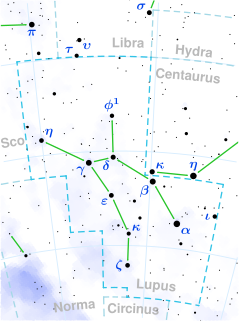
Lupus constellation map courtesy of Openverse
Lupus, “The Wolf” – The Lupus constellation is located in the southern hemisphere, and symbolizes “the wolf.” Lupus is nestled between Centaurus and Scorpius. Its name translates to “the wolf” in Latin. Initially catalogued by the Greek astronomer Ptolemy during the 2nd century, Lupus, despite its ancient origins, lacks any mythological associations. This constellation hosts a variety of fascinating stars and deep-sky objects, including the historic supernova remnant SN 1006, the globular clusters NGC 5824 and NGC 5986, as well as the Retina Nebula (IC 4406).
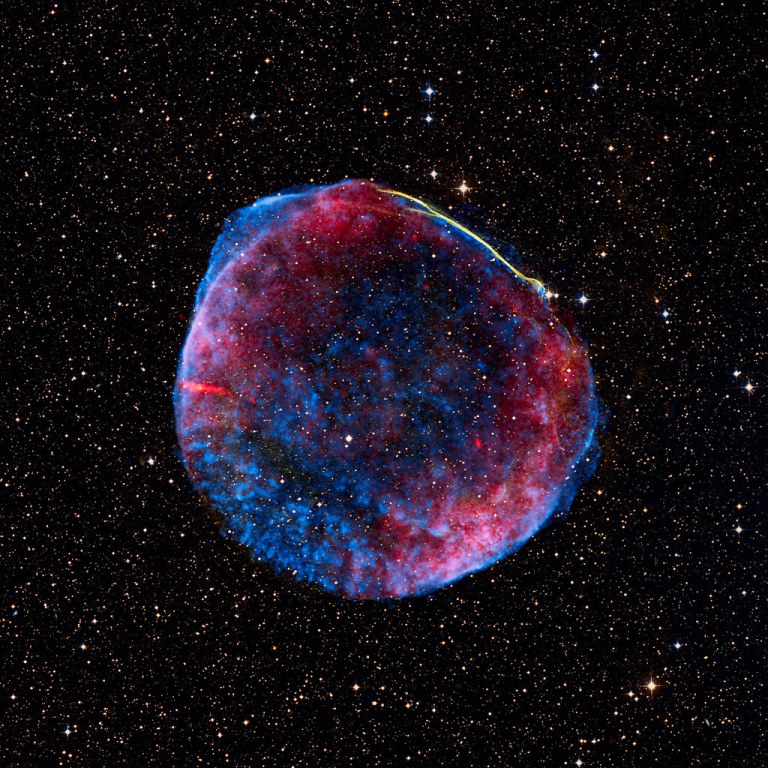
SN 1006: Liberating Star Stuff courtesy of Openverse
Key points regarding Lupus:
- Meaning: The term “Lupus” translates to “The Wolf” in Latin. The constellation Lupus is part of the Hercules family of constellations, which includes Aquila, Ara, Centaurus, Corona Australis, Corvus, Crater, Crux, Cygnus, Hercules, Hydra, Lyra, Ophiuchus, Sagitta, Scutum, Sextans, Serpens, Triangulum Australe, and Vulpecula. Lupus features two stars that have known planets and does not contain any Messier objects. The most luminous star in this constellation is Alpha Lupi, which has an apparent magnitude of 2.30. Additionally, there are no meteor showers linked to this constellation. Lupus has only one star with a designated name, Uridim (Alpha Lupi).
- Notable stars: Alpha Lupi is the brightest star in the Lupus constellation, located about 460 light years from Earth, with a magnitude of 2.30. It’s a blue-white giant, 10.1 times more massive than the Sun, and will eventually become a supernova. Beta Lupi is the second brightest, about 383 light years away, and also a blue-white giant. Gamma Lupi is the third brightest and a binary star. Delta Lupi, 900 light years away, is also a Beta Cephei variable. Epsilon Lupi is a double-lined spectroscopic binary, while Zeta and Eta Lupi are yellow and blue-white subgiants, respectively. Iota Lupi is a class B subgiant star, about 352 light years away with a visual magnitude of 3.54. Phi Lupi has two stars: Phi-1, an orange giant at 326 light years, and Phi-2, a blue-white star at 606 light years. Pi Lupi is a double system star about 497 light years away. KT Lupi is a blue-white subgiant, while Tau Lupi includes two stars: Tau-1, a Beta Cephei variable star at 1,035 light years, and Tau-2, at 314 light years. 1 Lupi is a yellow-white giant at 1,140 light years. Nu Lupi consists of two stars, with Nu-2 having three discovered planets. GQ Lupi is a young T Tauri star at 500 light years, and RU Lupi is another T Tauri variable star. Lupus-TR-3 is a dim orange star with an exoplanet.
- Other features: NGC 5986 is a globular cluster located 33,900 light years from Earth, notable for two bright A-F class stars nearing the end of their life cycle. It has an apparent magnitude of 7.52 and is 2.5 degrees west-northwest of Eta Lupi. IC 4406 is a bipolar planetary nebula in Lupus, 2,000 light years away from Earth, with a symmetrical appearance when viewed from the side. SN 1006 was a historic supernova witnessed in 1006, 7,200 light years from Earth, and the brightest documented stellar event. It was classified as a Type Ia supernova, with a visual magnitude of -7.5. NGC 5822 is an open cluster, 6,000 light years distant with a magnitude of 10.28, while NGC 5824, a globular cluster, is 104,400 light years away and has a magnitude of 9.09. NGC 5749 is another open cluster, discovered in 1826, with a magnitude of 11.23. NGC 5882 is also a planetary nebula with a magnitude of 9.4, and NGC 5927 is a globular cluster near Norma, at 24,800 light years.
- Mythology: The stars that currently constitute the constellation Lupus were once part of the Centaurus constellation. They symbolized a sacrificed animal that was impaled by the centaur, who was presenting it towards the constellation Ara, the altar. This constellation did not have a specific animal association until the Renaissance period, when the Latin translation of Ptolemy’s work linked it to the wolf. The Greeks referred to the constellation as Therium, meaning a wild animal, while the Romans named it Bestia, the beast. During Greek antiquity, the constellation was likely interpreted as a creature inspired by the Babylonian depiction of the Mad Dog. This creature was a hybrid, possessing a human head and torso, along with the legs and tail of a lion. It was often connected with the sun god and Bison-man, another mythological being, and was designated as UR.IDIM, where UR denoted a large carnivore, potentially a lion, wolf, or dog.
- Visibility: Lupus is the 46th largest constellation, covering 334 square degrees. It is situated in the third quadrant of the southern hemisphere (SQ3) and is observable at latitudes ranging from +35° to -90°. The constellations that border it include Centaurus, Circinus, Hydra, Libra, Norma, and Scorpius. The name of the constellation, Lupus, is pronounced /ˈljuːpəs/. In English, it is referred to as the Wolf. The genitive form of Lupus, which is utilized in the naming of stars, is Lupi (pronunciation: /ˈljuːpaɪ/). The three-letter abbreviation, which was officially adopted by the International Astronomical Union (IAU) in 1922, is Lup.
⁺‧₊☽◯☾₊‧⁺⋆⁺‧₊☽◯☾₊‧⁺⋆⁺‧₊☽◯☾₊‧⁺⋆⁺‧₊☽◯☾₊‧⁺⋆⁺‧₊☽◯☾₊‧⁺⋆⁺‧₊☽◯☾₊‧⁺⋆
Constellations:
| Constellations by Month | ||
| JANUARY [8] | FEBRUARY [7] | MARCH [7] |
| Taurus | Camelopardalis | Ursa Major |
| Orion | Auriga | Cancer |
| Lepus | Gemini | Canis Minor |
| Caelum | Monoceros | Pyxis |
| Reticulum | Canis Major | Vela |
| Dorado | Columba | Carina |
| Pictor | Puppis | Volans |
| Mensa | ||
| APRIL [8] | MAY [7] | JUNE [6] |
| Ursa Major | Canes Venatici | Ursa Minor |
| Leo Minor | Coma Berenices | Boötes |
| Leo | Virgo | Libra |
| Sextans | Corvus | Lupus |
| Crater | Centaurus | Circinus |
| Hydra | Crux | Apus |
| Antlia | Musca | |
| Chamaeleon | ||
| JULY [9] | AUGUST [9] | SEPTEMBER [6] |
| Draco | Lyra | Cygnus |
| Corona Borealis | Vulpecula | Delphinus |
| Hercules | Sagitta | Equuleus |
| Serpens | Aquila | Capricornus |
| Ophiuchus | Scutum | Microscopium |
| Scorpius | Sagittarius | Indus |
| Norma | Corona Australis | |
| Ara | Telescopium | |
| Triangulum Australe | Pavo | |
| OCTOBER [7] | NOVEMBER [8] | DECEMBER [6] |
| Cepheus | Cassiopeia | Perseus |
| Lacerta | Andromeda | Triangulum |
| Pegasus | Pisces | Aries |
| Aquarius | Cetus | Eridanus |
| Piscis Austrinus | Sculptor | Fornax |
| Grus | Phoenix | Horologium |
| Octans | Tucana | |
| Hydrus | ||
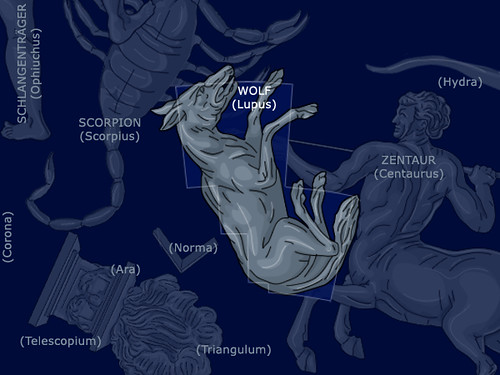
lupus courtesy of Openverse
Constellations of the Month:
June – Lupus
Material may be shared for personal and educational use, Share with family and friends. The material cannot be used in an educational setting whereby a “book fee” is charged in or above tuition costs, and the material here is being used without paying a licensing fee.. AI must file an application for use of such material.
| You May Also Like. . . | |
 NASA 1997 Liftoff Special |
 NASA Mission Patch Party |
More on Versatileer:
![wp-1713736838769817381582213744216.jpg]()
Featured Photo: Flower Bouquet Photo of the Day – The 4th Week of April
04/26/2024![SMGN-FallGiftGiudeGiveaway-NatGeoPOST.png]()
Ends 10-29 – National Geographic Kids Book Bundle Giveaway!
09/24/2022![INSTA_WinchesterCodex.png]()
Ends 05-29 – The Winchester Codex by Frances Spurrier Book Blitz + $25 Amazon Gift Card Giveaway*
05/18/2024![Ends 05-29 – So Hectic by Eve Dangerfield Book Blitz + $30 Amazon Gift Card Giveaway]()
Ends 05-29 – So Hectic by Eve Dangerfield Book Blitz + $30 Amazon Gift Card Giveaway
05/21/2024![20211014_204417.jpg]()
Featured Photos: The 13 Days of Halloween – Day 6: Friendly Oaks Red Devil Delight
10/23/2021































I am excited for the new moon.