Constellations of the Month: June – Libra:
We start June with the next constellation of the month, Libra, “The Scales.”

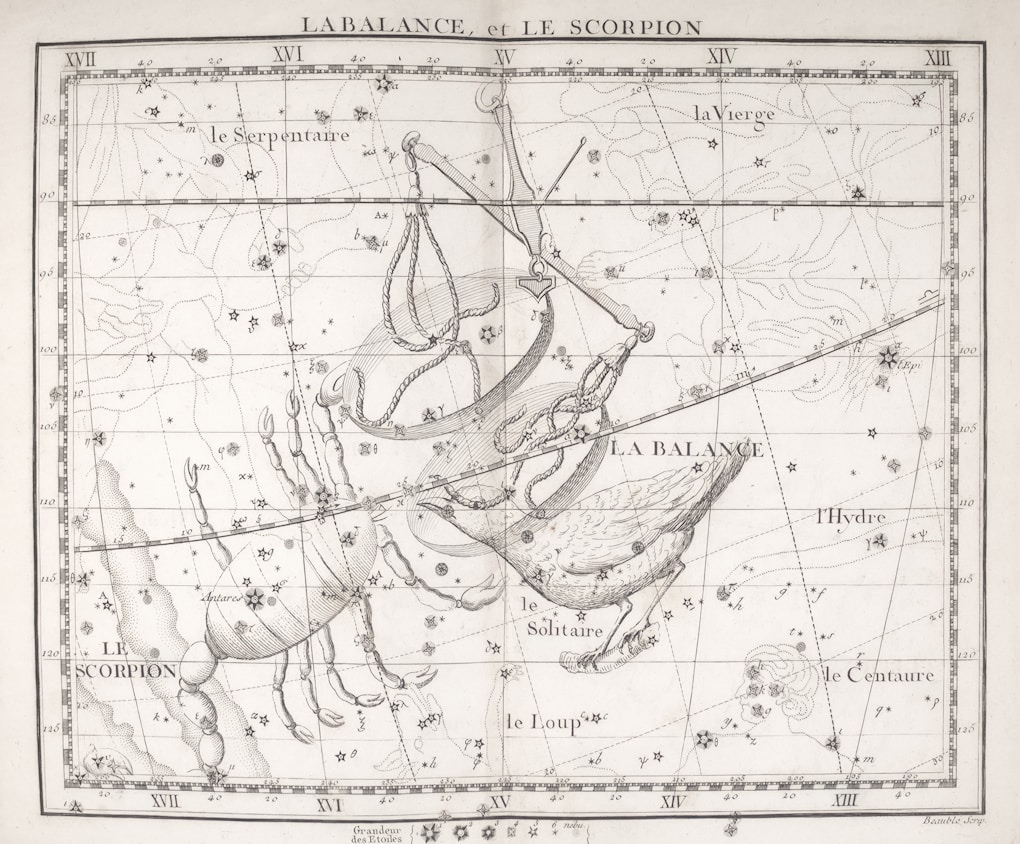
Libra constellation map courtesy of Openverse
Libra, “The Scales” – The Libra constellation is located in the southern hemisphere, and symbolizes “the scales.” Libra was first listed by the Greek astronomer Ptolemy in the 2nd century. Its name means “the weighing scales” in Latin. Unlike other zodiac constellations, Libra represents an inanimate object. Its four brightest stars form a quadrangle, with Alpha and Beta Librae as the balance beam and Gamma and Sigma Librae as the pans. Libra’s brightest stars shine at third magnitude and include Zubeneschamali and Zubenelgenubi. It is also home to the ancient Methuselah Star and another even older star.

Hubble Views a Galaxy with More than Meets the Eye courtesy of Openverse
Key points regarding Libra:
- Meaning: The term “Libra” translates to “The Scales” in Latin. The constellation Libra has a single meteor shower linked to the constellation, known as the May Librids. Libra comprises four stars that have been officially named. The names recognized by the International Astronomical Union (IAU) include Brachium (Sigma Librae A), Zubenelgenubi (Alpha2 Librae), Zubenelhakrabi (Gamma Librae A), and Zubeneschamali (Beta Librae). The optimal time to observe the constellation of Libra is in June, when it is positioned higher in the sky around 9 pm.
- Notable stars: Libra is a faint constellation in the zodiac, visible from the northern hemisphere, with no bright stars. Its three brightest stars are Zubeneschamali, Zubenelgenubi, and Brachium, which represent the celestial Scales. Zubeneschamali is the brightest star, located 185 light-years away and is a fast-spinning blue-white star. Zubenelgenubi is a multiple star system 75 light-years away, while Brachium is a red giant about 288 light-years away and varies in brightness. HD 140283, called the Methuselah Star, is very old at about 13.7 billion years. HE 1523-0901, another ancient red giant star, is about 13.2 billion years old and is 9,900 light-years away. Upsilon Librae is a binary system with an orange giant, approximately 3.14 billion years old, located 224 light-years away. Tau Librae is a double star system 367 light-years away, including a young blue main sequence star. Zubenelhakrabi is a yellow giant star with two exoplanets, located 163 light-years away. Delta Librae is a blue main sequence star that forms an eclipsing binary and is around 500 million years old. Gliese 581, a red dwarf 20.549 light-years away, has three confirmed planets, including Gliese 581 c, a super-Earth too hot for habitability. Additionally, 23 Librae, a yellow dwarf, has two confirmed planets, one in the habitable zone, and HD 141937 has a brown dwarf companion. Gliese 570 is a quadruple system about 19 light-years away.
- Other features: The constellation Libra has few bright deep sky objects for observation using binoculars or small telescopes. It does not contain any star clusters, galaxies, or nebulae from the Messier and Caldwell catalogues. However, it includes the globular cluster NGC 5897, which is 40,800 light-years away and has an apparent magnitude of 8.52. Discovered by William Herschel in 1785, it can be viewed in amateur telescopes. Other notable objects include NGC 5885, a barred spiral galaxy, and NGC 5792, another barred spiral galaxy, located 105 million and 70.27 million light-years away, respectively. NGC 5793 is a type II Seyfert active spiral galaxy found 150 million light-years away, while NGC 5728, also a barred spiral galaxy, is located 145.8 million light-years away and has an active galactic nucleus. Supernova SN 2009Y was discovered here in 2009. NGC 5917, a spiral galaxy, is approximately 90.4 million light-years away and interacting with neighboring galaxy PGC 54817. It had a supernova in 1990. Lastly, NGC 5890 is an unbarred lenticular galaxy with an apparent magnitude of 14. IRAS 14348-1447 is a pair of merging galaxies located about 1 billion light-years away with an apparent magnitude of 16.58.
- Mythology: The Ancient Greeks referred to the part of the sky now known as the Libra constellation as Chelae, meaning “claws,” associating it with Scorpio. This changed in the 1st century BCE when the Romans linked Libra to scales, symbolizing balance, as the Moon was in Libra when Rome was founded. The Romans considered it a lucky constellation related to equal seasons and day length. The autumnal equinox was in Libra until the year 729, when it shifted to Virgo, moving to Leo in 2439. Before the Romans, the Babylonians had already connected Libra to balance. Over time, Libra’s link to Scorpio faded, strengthening its ties to justice, personified by the goddess Dike.
- Visibility: Libra is the 29th largest constellation, covering 538 square degrees, located in the southern hemisphere. It is visible at latitudes from +65° to -90° and neighbors Centaurus, Hydra, Lupus, Ophiuchus, Scorpius, Serpens Caput, and Virgo. Its name means “Scales” in English, and its abbreviation is Lib. Libra is part of the zodiac and includes four stars with known planets but no Messier objects. The brightest star in Libra is Zubeneschamali, with an apparent magnitude of 2.61, among 83 visible stars.
⁺‧₊☽◯☾₊‧⁺⋆⁺‧₊☽◯☾₊‧⁺⋆⁺‧₊☽◯☾₊‧⁺⋆⁺‧₊☽◯☾₊‧⁺⋆⁺‧₊☽◯☾₊‧⁺⋆⁺‧₊☽◯☾₊‧⁺⋆
Constellations:
| Constellations by Month | ||
| JANUARY [8] | FEBRUARY [7] | MARCH [7] |
| Taurus | Camelopardalis | Ursa Major |
| Orion | Auriga | Cancer |
| Lepus | Gemini | Canis Minor |
| Caelum | Monoceros | Pyxis |
| Reticulum | Canis Major | Vela |
| Dorado | Columba | Carina |
| Pictor | Puppis | Volans |
| Mensa | ||
| APRIL [8] | MAY [7] | JUNE [6] |
| Ursa Major | Canes Venatici | Ursa Minor |
| Leo Minor | Coma Berenices | Boötes |
| Leo | Virgo | Libra |
| Sextans | Corvus | Lupus |
| Crater | Centaurus | Circinus |
| Hydra | Crux | Apus |
| Antlia | Musca | |
| Chamaeleon | ||
| JULY [9] | AUGUST [9] | SEPTEMBER [6] |
| Draco | Lyra | Cygnus |
| Corona Borealis | Vulpecula | Delphinus |
| Hercules | Sagitta | Equuleus |
| Serpens | Aquila | Capricornus |
| Ophiuchus | Scutum | Microscopium |
| Scorpius | Sagittarius | Indus |
| Norma | Corona Australis | |
| Ara | Telescopium | |
| Triangulum Australe | Pavo | |
| OCTOBER [7] | NOVEMBER [8] | DECEMBER [6] |
| Cepheus | Cassiopeia | Perseus |
| Lacerta | Andromeda | Triangulum |
| Pegasus | Pisces | Aries |
| Aquarius | Cetus | Eridanus |
| Piscis Austrinus | Sculptor | Fornax |
| Grus | Phoenix | Horologium |
| Octans | Tucana | |
| Hydrus | ||

Photo by The New York Public Library courtesy of Openverse
Constellations of the Month:
June – Libra
Material may be shared for personal and educational use, Share with family and friends. The material cannot be used in an educational setting whereby a “book fee” is charged in or above tuition costs, and the material here is being used without paying a licensing fee.. AI must file an application for use of such material.
| You May Also Like. . . | |
 NASA 1997 Liftoff Special |
 NASA Mission Patch Party |
































My mother is a Libra