
Constellations of the Month: June – Boötes:
We start June with the next constellation of the month, Boötes (boh-OH-tees), “Ox Driver, Plowman, or Herdsman.”
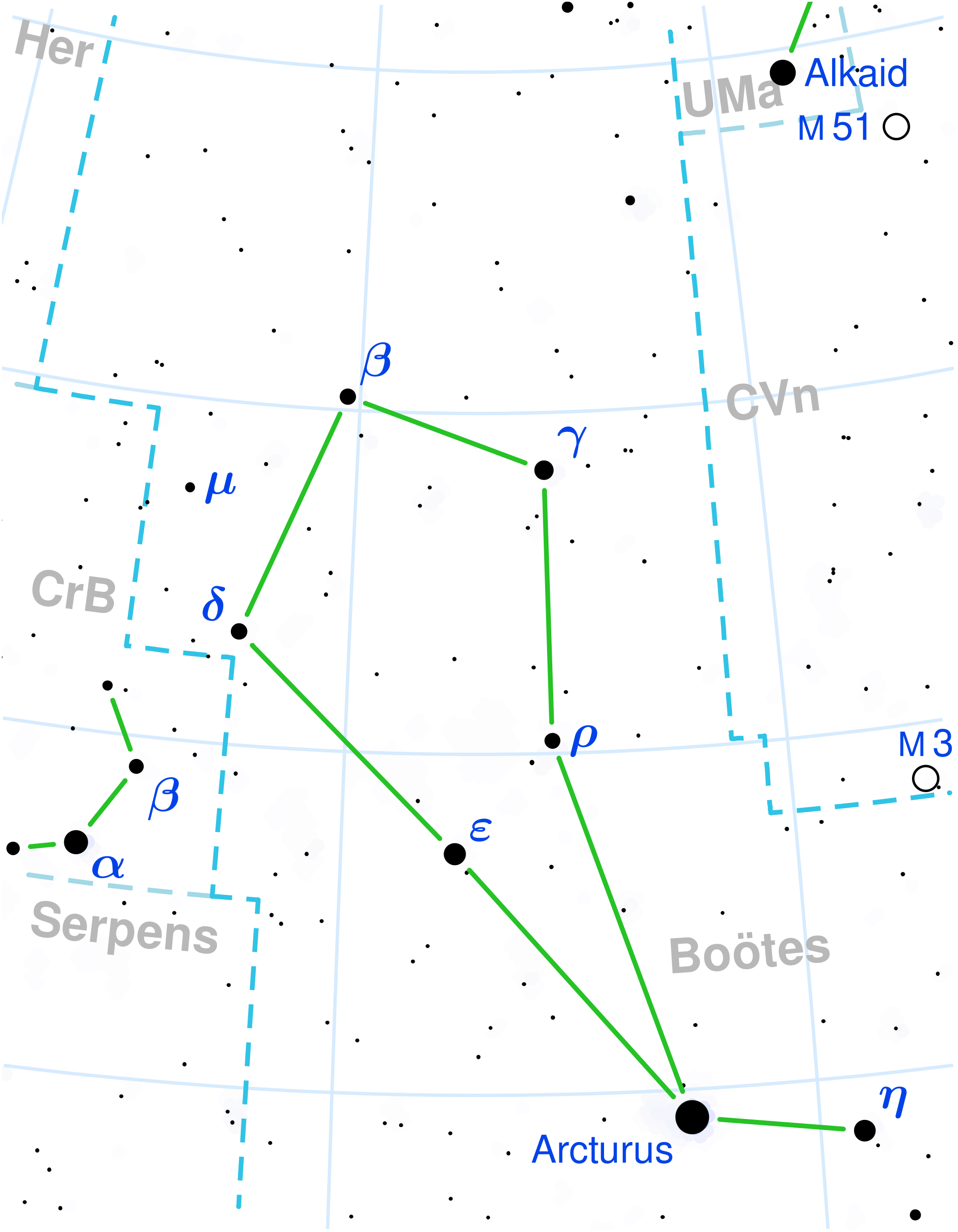
Boötes constellation map courtesy of Openverse
Boötes, “Ox Driver, Plowman, or Herdsman” – The Boötes constellation is located in the northern hemisphere, and symbolizes “ox driver, plowman, or herdsman.” Boötes is situated in the northern celestial hemisphere, this constellation is characterized by the Kite, a diamond-shaped asterism formed by its most luminous stars. The name of the constellation is derived from the Greek term Βοώτης, Boōtēs, which translates to ox driver, plowman, or herdsman. The proper pronunciation is /boʊˈoʊtɨs/, with each ‘o’ articulated distinctly and emphasis placed on the second syllable. Boötes was initially catalogued by the Greek astronomer Ptolemy during the 2nd century. This constellation features the contrasting double star Izar and Arcturus, which is the brightest star in the northern celestial hemisphere and ranks as the third brightest star overall in the sky, following Sirius in Canis Major and Canopus in the Carina constellation.
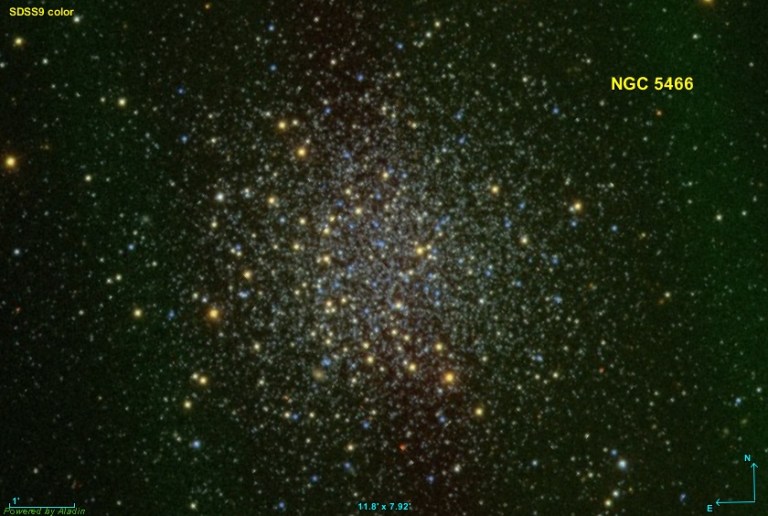
NGC 5466 SDSS2 courtesy of Openverse
Key points regarding Boötes:
- Meaning: The term “Boötes” translates to “Ox Driver, Plowman, or Herdsman” in Latin. The constellation Boötes hosts extra solar planets comprise the yellow-white main sequence stars Tau Boötis and WASP-14, the yellow giants Nikawiy (HD 136418) and 24 Boötis, the orange subgiant Arcalís (HD 131496), the yellow dwarfs HD 132406 and HAT-P-4, as well as the yellow-white giant HD 132563. The constellation Boötes is home to 11 named stars. The names of these stars, which have been sanctioned by the International Astronomical Union (IAU), include Alkalurops (Mu1 Boötis), Arcalís (HD 131496), Arcturus (Alpha Boötis), Izar (Epsilon Boötis A), Merga (38 Boötis), Muphrid (Eta Boötis A), Nekkar (Beta Boötis), Nikawiy (HD 136418), Quadrans (44 Boötis A), Seginus (Gamma Boötis Aa), and Xuange (Lambda Boötis). Boötes does not feature any Messier objects. Additionally, there are three meteor showers linked to the constellation: the January Bootids, the June Bootids, and the Quadrantids.
- Notable stars: Arcturus is the third brightest star in the night sky and the brightest in the northern hemisphere, with an apparent magnitude of -0.04. It is located near the bear constellations Ursa Major and Ursa Minor and is an orange giant star about 36.7 light years away. Arcturus has a luminosity at least 110 times that of the Sun and will come nearest to the Sun in about 4,000 years. Nekkar is a yellow giant star 219 light years from Earth, known for its sudden brightness increases. Seginus, about 85 light years away, is a variable star with changing brightness. Izar is a binary star located 300 light years away. Epsilon Boötis, also known as Pulcherrima, and Mu Boötis, also known as Alkalurops, are other notable stars, alongside Merga and Psi Boötis. Tau Boötis is a binary star with an extrasolar planet.
- Other features: The Boötes void, also called the Great Void or Supervoid, is a large, nearly empty area in space, about 250 million light years wide, with very few galaxies. It was discovered by Robert P. Kirshner in 1981, and now has at least 60 known galaxies. If the Milky Way were in the Boötes void, we might not have known about other galaxies until the 1960s. The Boötes Dwarf Galaxy is a faint galaxy found in 2006, located about 197,000 light years away from Earth, and is believed to be affected by the Milky Way. NGC 5466 is a globular cluster discovered by William Herschel in 1784, situated around 51,800 light years from Earth, with unique features like a blue horizontal branch of stars and low metal content.
- Mythology: Boötes is often shown as a herdsman with two dogs and a club, following the Ursa Major constellation in the sky. One story depicts him as a ploughman guiding oxen linked to the polar axis, symbolizing the rotation of the sky. Most frequently, Boötes represents Arcas, the son of Zeus and Callisto. Zeus saved Arcas from being eaten by his father, Lycaon, who was turned into a wolf for his actions. Hera turned Callisto into a bear, and later, Arcas, not recognizing her, chased her. To prevent a tragedy, Zeus turned them into stars: Callisto as Ursa Major and Arcas as Boötes. Another story identifies Boötes as Icarius, a grape grower who learned the art of winemaking from Dionysus. After being wrongly killed by his friends, Dionysus honored him by placing him among the stars. Boötes is also credited with inventing the plough.
- Visibility: Boötes is the 13th largest constellation, covering 907 square degrees in the northern sky and visible between latitudes +90° and -50°. It is located in the third quadrant of the northern hemisphere and is bordered by several other constellations. The name Boötes, pronounced /boʊˈoʊtiːz/, means “Herdsman,” with its genitive form being Boötis. The International Astronomical Union (IAU) uses the abbreviation Boo.The brightest star in Boötes is Arcturus (Alpha Boötis), the fourth brightest star in the sky. The nearest star is Gliese 526, a red dwarf 17.726 light-years away. Boötes contains 10 stars with known planets, including HD 141399 with four gas giants and HN Boötis with two confirmed planets.
⁺‧₊☽◯☾₊‧⁺⋆⁺‧₊☽◯☾₊‧⁺⋆⁺‧₊☽◯☾₊‧⁺⋆⁺‧₊☽◯☾₊‧⁺⋆⁺‧₊☽◯☾₊‧⁺⋆⁺‧₊☽◯☾₊‧⁺⋆
Constellations:
| Constellations by Month | ||
| JANUARY [8] | FEBRUARY [7] | MARCH [7] |
| Taurus | Camelopardalis | Ursa Major |
| Orion | Auriga | Cancer |
| Lepus | Gemini | Canis Minor |
| Caelum | Monoceros | Pyxis |
| Reticulum | Canis Major | Vela |
| Dorado | Columba | Carina |
| Pictor | Puppis | Volans |
| Mensa | ||
| APRIL [8] | MAY [7] | JUNE [6] |
| Ursa Major | Canes Venatici | Ursa Minor |
| Leo Minor | Coma Berenices | Boötes |
| Leo | Virgo | Libra |
| Sextans | Corvus | Lupus |
| Crater | Centaurus | Circinus |
| Hydra | Crux | Apus |
| Antlia | Musca | |
| Chamaeleon | ||
| JULY [9] | AUGUST [9] | SEPTEMBER [6] |
| Draco | Lyra | Cygnus |
| Corona Borealis | Vulpecula | Delphinus |
| Hercules | Sagitta | Equuleus |
| Serpens | Aquila | Capricornus |
| Ophiuchus | Scutum | Microscopium |
| Scorpius | Sagittarius | Indus |
| Norma | Corona Australis | |
| Ara | Telescopium | |
| Triangulum Australe | Pavo | |
| OCTOBER [7] | NOVEMBER [8] | DECEMBER [6] |
| Cepheus | Cassiopeia | Perseus |
| Lacerta | Andromeda | Triangulum |
| Pegasus | Pisces | Aries |
| Aquarius | Cetus | Eridanus |
| Piscis Austrinus | Sculptor | Fornax |
| Grus | Phoenix | Horologium |
| Octans | Tucana | |
| Hydrus | ||
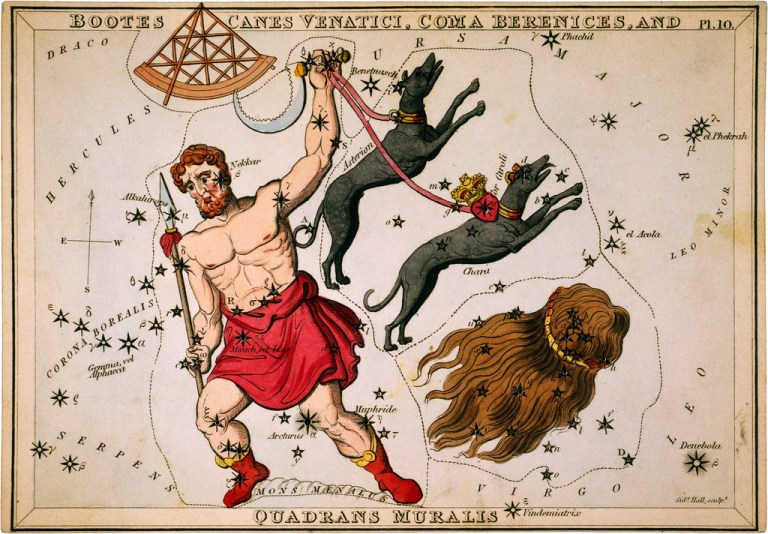
From Urania’s Mirror: Boötes, Canes Venatici, Coma Berenices, and Quadrans Muralis, 1825 courtesy of Openverse
Constellations of the Month:
June – Boötes
Material may be shared for personal and educational use, Share with family and friends. The material cannot be used in an educational setting whereby a “book fee” is charged in or above tuition costs, and the material here is being used without paying a licensing fee.. AI must file an application for use of such material.
| You May Also Like. . . | |
 NASA 1997 Liftoff Special |
 NASA Mission Patch Party |
More on Versatileer:
![florida_walt-disney-world-parade-procession-3.png]()
Mickey Mouse's Birthday – Photo at Disney Festival of Fantasy Parade in Walt Disney World
11/18/2022![20220612_142451.jpg]()
Featured Photo: Flower of the Day – Bouquet of the Week: Multi-Colored Variety Assortment – August F...
08/29/2022![20240926&27_HeleneLandfall_NOAA+3 Photos.jpg]()
Atlantic Category 4 Hurricane Helene Strikes Perry, Florida on Thursday! + Last Update on Pacific Tr...
09/27/2024![Independence Hall, National Historical Park, PA.jpg]()
Featured Photo: LEGO® Americana Roadshow U.S. Monuments – The Independence Hall
09/04/2024![New Year's Flowers Presentation '25__Montage.jpg]()
Featured Photos Montage – The New Year's & Flowers Presentation – 2025
01/01/2025































Very cool, thank you so much for sharing! It is amazing how many constellations there are, I haven’t heard of a lot of these.
Thank you for sharing this interesting information
wow, i am loving this series because i love constellations ad i’d never heard of this one before!!