
Constellations of the Month: June – Ursa Minor:
We start June with the first constellation of the month, Ursa Minor, “The Smaller Bear” or “The Lesser Bear.”
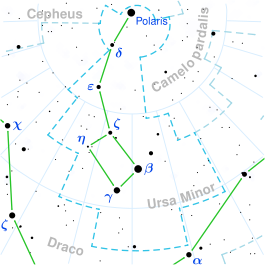
Ursa Minor constellation map courtesy of Openverse
Ursa Minor, “The Smaller Bear” or “The Lesser Bear” – The Ursa Minor constellation is located in the northern hemisphere, and symbolizes “The smaller bear” or “the lesser bear.” Ursa Minor is the constellation located farthest north in latitude. It represents one of the 48 Greek constellations catalogued by the astronomer Ptolemy in the 2nd century. It is recognizable due to the famous Little Dipper asterism. Ursa Minor also marks the north celestial pole and contains Polaris, the “North Star,” which is at the end of the Little Dipper’s handle and the tip of its tail.
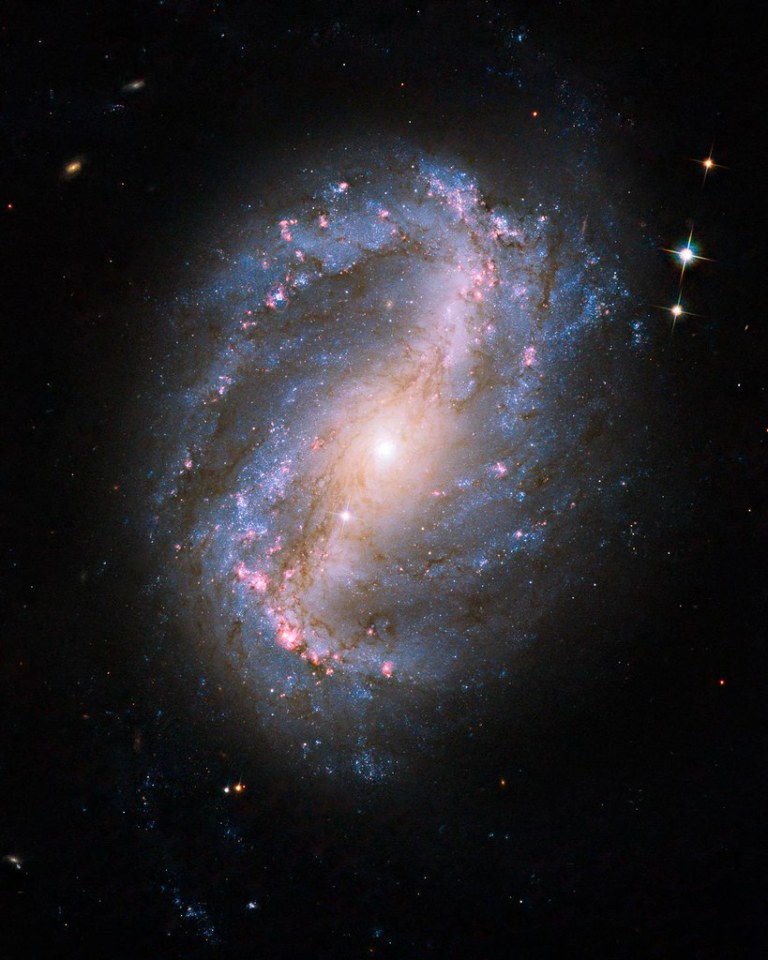
Incredible new Hubble pix: Barred Spiral Galaxy NGC 6217 courtesy of Openverse
Key points regarding Ursa Minor:
- Meaning: The term “Ursa Minor” translates to “The Smaller Bear” or “The Lesser Bear” in Latin. The constellation Ursa Minor is thought to have been created or introduced to the Greeks by Thales of Miletus, a philosopher from 625 BC to 545 BC. Thales came from a Phoenician background, and the Phoenicians used Ursa Minor for navigation. Located near the north celestial pole, Ursa Minor was previously called the Dog’s Tail or Cynosura, and the Greeks also referred to it as the Phoenician. Ursa Minor lacks prominent asterisms but includes the Little Dipper, a star pattern near the Big Dipper. It is visible in dark areas and features the Diamond Ring asterism near Polaris. The Little Dipper is a faint group of seven stars in Ursa Minor that is less bright than the Big Dipper. Its notable stars include Polaris, Yildun, Epsilon Ursae Minoris, Eta Ursae Minoris, Zeta Ursae Minoris, Pherkad, and Kochab. While Polaris, Kochab, and Pherkad are visible under less-than-ideal conditions, the other stars are harder to see in polluted skies. You can locate the Little Dipper by extending a line from the Big Dipper’s stars, Merak and Dubhe, toward Polaris.
- Notable stars: Ursa Minor has few bright stars, primarily Polaris (Alpha Ursae Minoris), Kochab (Beta Ursae Minoris), and Pherkad (Gamma Ursae Minoris). Polaris, the brightest, is the North Star and a triple star system, notable for its brightness and proximity to the north celestial pole. It varies in brightness and has been essential for navigation. Kochab is the second brightest star in Ursa Minor, while Pherkad is the third. Kochab is an orange giant, and Pherkad is a white giant with brightness variations. Other stars include Yildun, a main sequence dwarf. Kochab and Pherkad were once twin pole stars before Polaris took the lead. Yildun, also known as Zeta Ursae Minoris (ζ UMi), is a fast-spinning star with a rotational speed of 154 km/s and an age of about 327 million years. It has a mass of 3.4 solar masses and is much brighter than the Sun. Eta Ursae Minoris (η UMi) is a yellow-white star, larger than the Sun, with an age of 1.061 billion years. It has a visual companion star, possibly forming a binary system. Epsilon Ursae Minoris (ε UMi) is a binary system consisting of a yellow giant and a main sequence star, showing variable brightness. 5 Ursae Minoris (5 UMi) is a red giant star that is 2 billion years old. Baekdu (8 UMi) is a red clump giant with a planet discovered in its orbit. Calvera is a neutron star, known for being one of the hottest nearby, and H1504+65 is a white dwarf with an unusual atmospheric composition, lying 1,590 light-years away.
- Other features: Ursa Minor is a constellation that contains various deep sky objects, including stars, galaxies, and asterisms. While it lacks bright objects commonly observed through small telescopes, it does host some notable features. The Diamond Ring Asterism appears near Polaris and helps locate the north celestial pole. It consists of 9th magnitude stars forming a ring close to the constellation Cepheus. Ursa Minor also has the following notable galaxies: NGC 6217, a barred spiral galaxy approximately 67.2 million light-years away, observable with 4-inch telescopes. It has a history of supernova activity. Ursa Minor Dwarf is a dwarf spheroidal galaxy about 200,000 light-years away, primarily made up of old stars, with very little star formation. NGC 3172 (Polarissima Borealis) is a lenticular galaxy close to the north celestial pole, known to host supernovae. NGC 6251 is an active supergiant elliptical galaxy recognized for its bright radio jet and supermassive black hole. NGC 6331 possesses its brightest in the Abell 2256 galaxy cluster, located 737 million light-years away. NGC 5034 is a spiral galaxy discovered by William Herschel, situated 401.5 million light-years from Earth. Ursa Minor may not offer many bright deep sky objects, but it features interesting galaxies and the notable Diamond Ring asterism, contributing to its astronomical significance.
- Mythology: Ursa Minor is linked to two myths in Greek mythology. The first tale features Ida, a nymph who cared for baby Zeus on Crete, alongside Adrasteia, represented by Ursa Major. Zeus’ mother, Rhea, hid him from his father Cronus, who feared a prophecy that one child would overthrow him. While Cronus swallowed five of his children, Rhea tricked him with a stone, allowing Zeus to grow and eventually rescue his siblings, becoming the supreme god. In another story, Ursa Minor symbolizes Arcas, son of Zeus and the nymph Callisto. After Callisto was turned into a bear by Hera for betraying her vow to Artemis, she encountered Arcas, who almost harmed her. Zeus intervened, placing them in the sky as Ursa Major and Ursa Minor. An older myth suggests that the Little Dipper’s seven stars represent the Hesperides, daughters of Atlas who guarded golden apples in Hera’s orchard.
- Visibility: Ursa Minor is the 56th largest constellation, covering 256 square degrees in the northern hemisphere. It is visible from latitudes between +90° and -10° and is surrounded by Camelopardalis, Cepheus, and Draco. Known as the Little Bear, its genitive form is Ursae Minoris, and its abbreviation is UMi. Part of the Ursa Major family, Ursa Minor has four stars with confirmed planets and no Messier objects. Polaris, the brightest star, has an apparent magnitude of 1.97. The constellation features 39 visible stars and is associated with the Ursid meteor shower, which peaks from December 18 to 25. The best viewing time is in June around 9 pm.
⁺‧₊☽◯☾₊‧⁺⋆⁺‧₊☽◯☾₊‧⁺⋆⁺‧₊☽◯☾₊‧⁺⋆⁺‧₊☽◯☾₊‧⁺⋆⁺‧₊☽◯☾₊‧⁺⋆⁺‧₊☽◯☾₊‧⁺⋆
Constellations:
| Constellations by Month | ||
| JANUARY [8] | FEBRUARY [7] | MARCH [7] |
| Taurus | Camelopardalis | Ursa Major |
| Orion | Auriga | Cancer |
| Lepus | Gemini | Canis Minor |
| Caelum | Monoceros | Pyxis |
| Reticulum | Canis Major | Vela |
| Dorado | Columba | Carina |
| Pictor | Puppis | Volans |
| Mensa | ||
| APRIL [8] | MAY [7] | JUNE [6] |
| Ursa Major | Canes Venatici | Ursa Minor |
| Leo Minor | Coma Berenices | Boötes |
| Leo | Virgo | Libra |
| Sextans | Corvus | Lupus |
| Crater | Centaurus | Circinus |
| Hydra | Crux | Apus |
| Antlia | Musca | |
| Chamaeleon | ||
| JULY [9] | AUGUST [9] | SEPTEMBER [6] |
| Draco | Lyra | Cygnus |
| Corona Borealis | Vulpecula | Delphinus |
| Hercules | Sagitta | Equuleus |
| Serpens | Aquila | Capricornus |
| Ophiuchus | Scutum | Microscopium |
| Scorpius | Sagittarius | Indus |
| Norma | Corona Australis | |
| Ara | Telescopium | |
| Triangulum Australe | Pavo | |
| OCTOBER [7] | NOVEMBER [8] | DECEMBER [6] |
| Cepheus | Cassiopeia | Perseus |
| Lacerta | Andromeda | Triangulum |
| Pegasus | Pisces | Aries |
| Aquarius | Cetus | Eridanus |
| Piscis Austrinus | Sculptor | Fornax |
| Grus | Phoenix | Horologium |
| Octans | Tucana | |
| Hydrus | ||

Book of the Fixed Stars Auv0043 ursa minor cropped courtesy of Openverse
Constellations of the Month:
June – Ursa Minor
Material may be shared for personal and educational use, Share with family and friends. The material cannot be used in an educational setting whereby a “book fee” is charged in or above tuition costs, and the material here is being used without paying a licensing fee.. AI must file an application for use of such material.
| You May Also Like. . . | |
 NASA 1997 Liftoff Special |
 NASA Mission Patch Party |
More on Versatileer:
![Blue cells.jpg]()
Happy National Bubble Wrap Day – 2026
01/29/2026![National Maryland Day '24.png]()
Happy National Maryland Day – 2024
08/24/2024![Chasing Headlines_image2.jpeg]()
Ends 02-05 – Chasing Headlines by J. Rose Black Book Blitz + $30 Amazon Gift Card, Merch & eBook Cop...
01/25/2025![Featured Photo: 21 Days to Halloween – Day 18]()
Featured Photo: 21 Days to Halloween – Day 18
10/27/2020![20231121_183734.jpg]()
Featured Photo: Happy Thanksgiving Day Photo 4: Gobble of a Children's Art Display of a Turkey and t...
11/23/2023
































my favorite!
I need to make some time and look up to the night sky!