Constellations of the Month: May – Corvus:
We continue May with the next constellation of the month, Corvus, “The Crow” or “The Raven.”
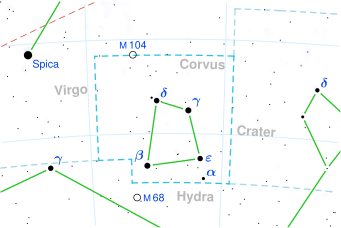
Corvus constellation map courtesy of Openverse
Corvus, “The Crow” or “The Raven” – Corvus is a constellation located in the southern hemisphere, and symbolizes a “crow” or “raven” in Latin. It represents Apollo’s sacred bird in Greek mythology and was catalogued by the Greek astronomer Ptolemy in the 2nd century. Corvus has few bright stars but is home to the Antennae Galaxies, which may show what happens when the Milky Way and Andromeda Galaxy collide. The four most luminous stars in the constellation Corvus – Delta, Gamma, Epsilon, and Beta Corvi – create an asterism referred to as the Sail, or Spica’s Spanker, as the stars Gamma and Delta Corvi direct observers towards Spica (Alpha Virginis), which is the most radiant star in Virgo and ranks as the 15th brightest star in the night sky.
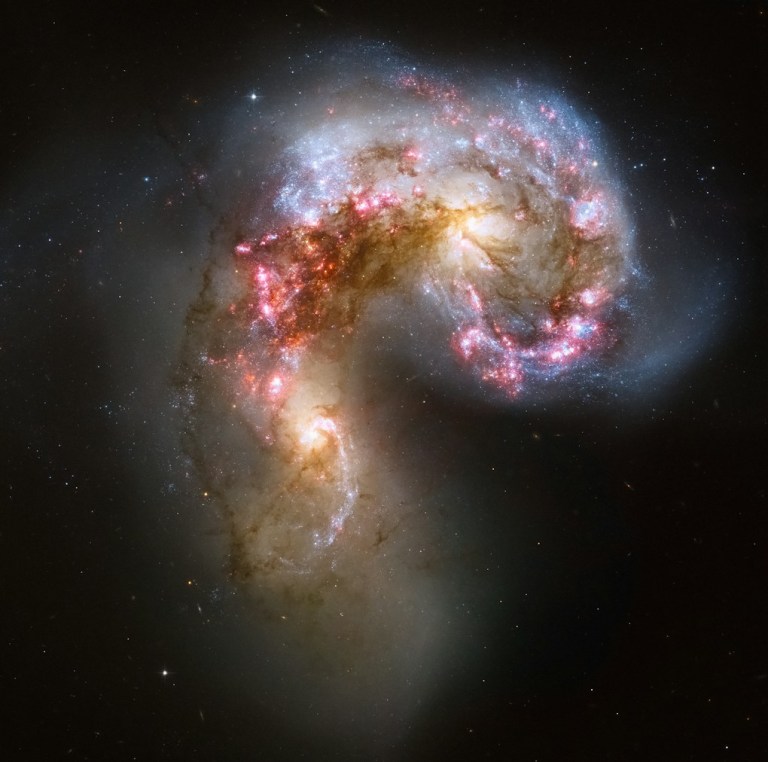
Photo by NASA Hubble Space Telescope courtesy of Openverse
Key points regarding Corvus:
- Meaning: The term “Corvus” translates to “The Crow” or “The Raven” in Latin. The constellation Corvus has one star with known planets and no Messier objects. The brightest star is Gienah, Gamma Corvi, with an apparent magnitude of 2.59. There is one meteor shower, the Corvids. Corvus has four named stars: Alchiba, Algorab, Gienah, and Kraz, approved by the International Astronomical Union (IAU).
- Notable stars: Gamma Corvi is the brightest star in the Corvus constellation, with a magnitude of 2.59 and located about 165 light years away. It might be a binary star and is traditionally named Gienah. Beta Corvi, or Kraz, is the second brightest, 140 light years distant, with a magnitude of 2.60 to 2.66, and has a luminosity 160 times that of the Sun. Delta Corvi, known as Algorab, is an A0 star about 87 light years away, with a magnitude of 3.1. Epsilon Corvi, or Minkar, is a K2 III star around 303 light years away, with a magnitude of 3.02. Alpha Corvi has a magnitude of 4.02 and is the fifth brightest star in Corvus. Alchiba is a class F0 dwarf 48.2 light years from Earth, four times more luminous than the Sun. Eta Corvi, a main sequence F2 V star, is 59.4 light years away with a magnitude of 4.31 and has two debris disks. VV Corvi is a close binary star system about 280 light years distant, with a tertiary companion.
- Other features: The Antennae Galaxies are a pair of interacting galaxies in Corvus, discovered by Sir William Herschel in 1785. They are currently in the starburst stage, forming stars rapidly. Known also as the Ring Tail galaxy, they are part of the NGC 4038 group. Named for their resemblance to insect antennae, they have long tails of gas, dust, and stars. They are 45 million light years away. The galaxies were separate a billion years ago and are expected to merge into one in 400 million years. NGC 4027, a barred spiral galaxy also in Corvus, is about 83 million light years away. It has a peculiar shape, with one spiral arm extending further due to a possible past collision. NGC 4361 is a large planetary nebula that resembles a faint elliptical galaxy, located in the same constellation and surrounding a 13th magnitude star.
- Mythology: The constellation Corvus symbolizes the raven, Apollo’s sacred bird in Greek mythology. Originally white, the raven reported to Apollo that his lover Coronis had fallen for a mortal man, Ischys. Angered that the raven did nothing to intervene, Apollo cursed it, turning its feathers black. Apollo then sent Artemis to kill Coronis, and before her body was burned, their unborn child, Asclepius, was taken out and raised by Chiron, becoming a famous healer linked to the constellation Ophiuchus. Babylonians also connected Corvus with their mythological raven and the god Adad, associating it with the rainy season.
- Visibility: Corvus is the 70th largest constellation, covering 184 square degrees. It is located in the third quadrant of the southern hemisphere and is visible from latitudes between +60° and -90°. Neighboring constellations include Crater, Hydra, and Virgo. The name Corvus is pronounced /ˈkɔːrvəs/, and it is known as the Crow in English. The genitive form for star names is Corvi (pronunciation: /ˈkɔːrvaɪ/), and its abbreviation is Crv. Corvus is part of the Hercules family of constellations, which includes several others like Aquila and Crux.
⁺‧₊☽◯☾₊‧⁺⋆⁺‧₊☽◯☾₊‧⁺⋆⁺‧₊☽◯☾₊‧⁺⋆⁺‧₊☽◯☾₊‧⁺⋆⁺‧₊☽◯☾₊‧⁺⋆⁺‧₊☽◯☾₊‧⁺⋆
Constellations:
| Constellations by Month | ||
| JANUARY [8] | FEBRUARY [7] | MARCH [7] |
| Taurus | Camelopardalis | Ursa Major |
| Orion | Auriga | Cancer |
| Lepus | Gemini | Canis Minor |
| Caelum | Monoceros | Pyxis |
| Reticulum | Canis Major | Vela |
| Dorado | Columba | Carina |
| Pictor | Puppis | Volans |
| Mensa | ||
| APRIL [8] | MAY [7] | JUNE [6] |
| Ursa Major | Canes Venatici | Ursa Minor |
| Leo Minor | Coma Berenices | Boötes |
| Leo | Virgo | Libra |
| Sextans | Corvus | Lupus |
| Crater | Centaurus | Circinus |
| Hydra | Crux | Apus |
| Antlia | Musca | |
| Chamaeleon | ||
| JULY [9] | AUGUST [9] | SEPTEMBER [6] |
| Draco | Lyra | Cygnus |
| Corona Borealis | Vulpecula | Delphinus |
| Hercules | Sagitta | Equuleus |
| Serpens | Aquila | Capricornus |
| Ophiuchus | Scutum | Microscopium |
| Scorpius | Sagittarius | Indus |
| Norma | Corona Australis | |
| Ara | Telescopium | |
| Triangulum Australe | Pavo | |
| OCTOBER [7] | NOVEMBER [8] | DECEMBER [6] |
| Cepheus | Cassiopeia | Perseus |
| Lacerta | Andromeda | Triangulum |
| Pegasus | Pisces | Aries |
| Aquarius | Cetus | Eridanus |
| Piscis Austrinus | Sculptor | Fornax |
| Grus | Phoenix | Horologium |
| Octans | Tucana | |
| Hydrus | ||

corvus courtesy of Openverse
Constellations of the Month:
May – Corvus
Material may be shared for personal and educational use, Share with family and friends. The material cannot be used in an educational setting whereby a “book fee” is charged in or above tuition costs, and the material here is being used without paying a licensing fee.. AI must file an application for use of such material.
| You May Also Like. . . | |
 NASA 1997 Liftoff Special |
 NASA Mission Patch Party |
More on Versatileer:
![Featured Photo + Video: The After Days of Christmas – Photo 5: Twofer: Yuletide on Parliament Avenue...]()
Featured Photo + Video: The After Days of Christmas – Photo 5: Twofer: Yuletide on Parliament Avenue...
12/31/2022![20211101_164529.jpg]()
Featured Photo: The Beauty of Fall Color – Northern Oak Tree
10/23/2022![wp-17344698444127718511156449209211.jpg]()
Featured Photo: Christmas Flower of the Day '24 – Bouquet #7
12/18/2024![bare tree during sunset.jpg]()
National Human Trafficking Awareness Day – 2025
01/12/2025![Conjunction of Jupiter and Saturn – Extremely Rare #LIVE Event]()
Conjunction of Jupiter and Saturn – Extremely Rare #LIVE Event
12/21/2020