
Constellations of the Month: April – Leo Minor:
We continue April with the next constellation of the month, Leo Minor, “The Smaller Lion.”

Leo Minor constellation map courtesy of Openverse
Leo Minor, “The Smaller Lion” – The Leo Minor constellation is located in the northern hemisphere, and symbolizes “the smaller lion” in Latin. Leo Minor is a small, faint constellation with only one star brighter than fourth magnitude. Its name means and was created by the Polish astronomer Johannes Hevelius in 1687, using 18 stars between the larger constellations Leo and Ursa Major. It is located between Ursa Major, Cancer, Lynx, and Leo. Notable deep sky objects in Leo Minor include Hanny’s Voorwerp and the interacting galaxies Arp 107.
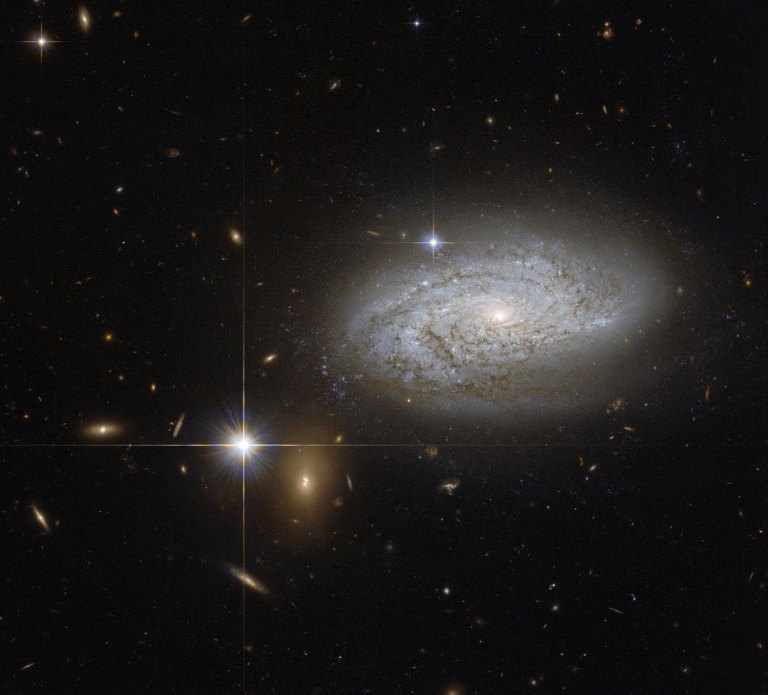
File:A cosmological measuring tape courtesy of Openverse
Key points regarding Leo Minor:
- Meaning: The term “Leo Minor” translates to “The Smaller Lion.” Leo Minor is part of the Ursa Major family of constellations, which includes Boötes, Camelopardalis, Canes Venatici, Coma Berenices, Corona Borealis, Draco, Lynx, Ursa Major, and Ursa Minor. Leo Minor has no Messier objects, and the only meteor shower connected to it is the Leo Minorids, occurring from October 19 to 27 each year, related to the comet C/1739 K1.
- Notable stars: Praecipua is the brightest star in Leo Minor, with an apparent magnitude of 3.83, located 94.9 light years from the Sun. It is classified as a K0+III-IV orange star, between the subgiant and giant stages, with 1.5 solar masses and 32 times the Sun’s luminosity. Praecipua was likely intended to be named Alpha, but this designation was omitted by Francis Baily in his catalogue. Its name means “the chief star of Leo Minor. ” Beta Leonis Minoris is the only star in Leo Minor with a Greek letter name and is the second brightest in the constellation. This binary star consists of a yellow giant-subgiant and a yellow-white subgiant, with the brighter star being 36 times more luminous than the Sun. They are located about 146 light years from the Sun. 21 Leonis Minoris is the third brightest star, with an apparent magnitude of 4.49, and is 92.1 light years away, classified as a white dwarf. 10 Leonis Minoris is a yellow giant with an apparent magnitude of 4.60. 37 Leonis Minoris is a yellow supergiant located about 580 light years away, with an apparent magnitude of 4.69. 20 Leonis Minoris is a binary system 49.1 light years from Earth, while 11 Leonis Minoris contains a yellow dwarf and a red dwarf, located 36. 5 light years away. HD 87883 is an orange dwarf star, approximately 59 light years away, with a long-period exoplanet, HD 87883 b, orbiting it.
- Other features: Hanny’s Voorwerp is a unique astronomical object known as a quasar ionization echo. Discovered in 2007 by Hanny van Arkel, a Dutch teacher and volunteer for the Galaxy Zoo project, it appears as a bright blob near the spiral galaxy IC 2497 and is thought to be the size of the Milky Way. The object has a central hole around 16,000 light years wide and is located about 650 million light years from Earth. Star formation is taking place in Hanny’s Voorwerp due to gas from the galaxy’s core interacting with the object. Some young stars in the area are a few million years old. A theory suggests that it consists of remnants from a small galaxy affected by a quasar event in IC 2497. The light observed is believed to be a ghost image from that quasar, while a newer theory points to a supermassive black hole in the galaxy as the source of this illumination. Arp 107 comprises two merging galaxies about 450 light years away. NGC 3432, or the Knitting Needle Galaxy, can be seen nearly edge-on from Earth. NGC 3003 is a barred spiral galaxy in Leo Minor, while NGC 3344 is face-on and located about 25 million light years away. NGC 3504 is a starburst galaxy with recent supernovae, and NGC 2859 is a barred lenticular galaxy with a supermassive black hole at its center and a detached ring. Leo Minor also contains Seyfert galaxies 3C 234 and 3C 223, as well as AGC 198691, a small galaxy known for its low metallicity.
- Mythology: Leo Minor is a relatively new constellation, and has no myths associated with it. It was first depicted in 1687 in Johannes Hevelius’ Catalogus Stellarum Fixarum. In 1845, the catalogue was revised by Francis Baily, who assigned Greek letters to stars that were brighter than magnitude 4.5, but he did not give the constellation’s brightest star the designation Alpha in his British Association Catalogue. In 1870, the English astronomer Richard A. Proctor renamed the constellation to Leaena, or the Lioness, in an attempt to shorten constellation names in order to make them easier to manage on star charts, but the name was not widely adopted.
- Visibility: Leo Minor is the 64th largest constellation, covering 232 square degrees. It is positioned in the second quadrant of the northern hemisphere and can be seen at latitudes from +90° to -40°. Neighboring constellations include Cancer, Leo, Lynx, and Ursa Major. The name Leo Minor means “Lesser Lion,” and its abbreviation is LMi. The brightest star, Praecipua, has a magnitude of 3.83, and the nearest star system is 11 Leonis Minoris, located 36.46 light years away. There are two formally named stars, Illyrian and Praecipua, and three stars in Leo Minor have known exoplanets: HD 87883, HD 82886, and Kelt-3.
⁺‧₊☽◯☾₊‧⁺⋆⁺‧₊☽◯☾₊‧⁺⋆⁺‧₊☽◯☾₊‧⁺⋆⁺‧₊☽◯☾₊‧⁺⋆⁺‧₊☽◯☾₊‧⁺⋆⁺‧₊☽◯☾₊‧⁺⋆
Constellations:
| Constellations by Month | ||
| JANUARY [8] | FEBRUARY [7] | MARCH [7] |
| Taurus | Camelopardalis | Leo Minor |
| Orion | Auriga | Cancer |
| Lepus | Gemini | Canis Minor |
| Caelum | Monoceros | Pyxis |
| Reticulum | Canis Major | Vela |
| Dorado | Columba | Carina |
| Pictor | Puppis | Volans |
| Mensa | ||
| APRIL [8] | MAY [7] | JUNE [6] |
| Ursa Major | Canes Venatici | Ursa Minor |
| Leo Minor | Coma Berenices | Boötes |
| Leo | Virgo | Libra |
| Sextans | Corvus | Lupus |
| Crater | Centaurus | Circinus |
| Hydra | Crux | Apus |
| Antlia | Musca | |
| Chamaeleon | ||
| JULY [9] | AUGUST [9] | SEPTEMBER [6] |
| Draco | Lyra | Cygnus |
| Corona Borealis | Vulpecula | Delphinus |
| Hercules | Sagitta | Equuleus |
| Serpens | Aquila | Capricornus |
| Ophiuchus | Scutum | Microscopium |
| Scorpius | Sagittarius | Indus |
| Norma | Corona Australis | |
| Ara | Telescopium | |
| Triangulum Australe | Pavo | |
| OCTOBER [7] | NOVEMBER [8] | DECEMBER [6] |
| Cepheus | Cassiopeia | Perseus |
| Lacerta | Andromeda | Triangulum |
| Pegasus | Pisces | Aries |
| Aquarius | Cetus | Eridanus |
| Piscis Austrinus | Sculptor | Fornax |
| Grus | Phoenix | Horologium |
| Octans | Tucana | |
| Hydrus | ||
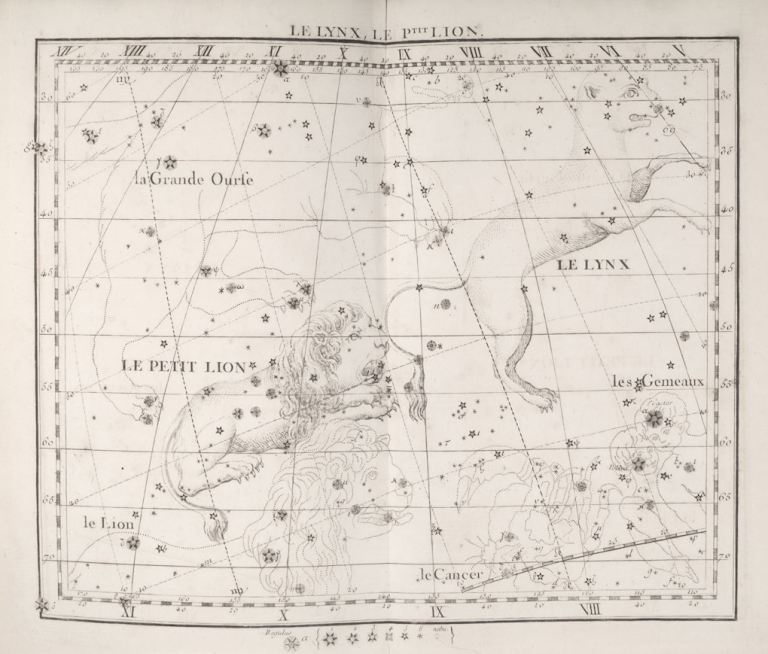
Photo by The New York Public Library courtesy of Openverse
Constellations of the Month:
April – Leo Minor
Material may be shared for personal and educational use, Share with family and friends. The material cannot be used in an educational setting whereby a “book fee” is charged in or above tuition costs, and the material here is being used without paying a licensing fee.. AI must file an application for use of such material.
| You May Also Like. . . | |
 NASA 1997 Liftoff Special |
 NASA Mission Patch Party |
More on Versatileer:
![20240511_024850_.jpg]()
The G5 Aurora Borealis – May 11th, 2024
05/12/2024![INSTA_MagicAndMedecine.png]()
Magic & Medicine by Olena Nikitin Cover Reveal – Release Date Coming October 2023
09/02/2023![popcorn-2337785 popcorn_1704941466.jpeg Vidal Balielo Jr. at Pexels]()
Happy National Popcorn Day – 2024
01/19/2024![From the Satellite...Tropical Storm Beta on .GIPHY]()
From the Satellite...Tropical Storm Beta on .GIPHY
09/26/2020![20211225_191156.jpg]()
Featured Photos: The 25 Days of Christmas – Photo 8 & Bonus Video: Yuletide on 50th Avenue
12/30/2021
































So cool
I love learning about the stars