
Constellations of the Month: March – Carina:
We continue March with the next constellation of the month, Carina, “The Keel.”

Carina constellation map courtesy of Openverse
Carina, “The Keel” – Carina is a constellation in the southern sky that symbolizes “the keel” in Latin. It was once part of the larger constellation Argo Navis, which also included Puppis and Vela. This constellation represented the ship Argo from the myth of Jason and the Argonauts. Ptolemy catalogued Argo Navis in the 2nd century CE. Later, in the 18th century, Nicolas Louis de Lacaille split it into Carina, Puppis, and Vela. The International Astronomical Union defined these constellations’ borders in the 20th century. Carina features Canopus, the second brightest star in the night sky, and notable stars like Eta Carinae near the Carina Nebula. Other deep sky objects include the Theta Carinae Cluster, the Wishing Well Cluster, the Southern Beehive Cluster, NGC 3603, and the Statue of Liberty Nebula.
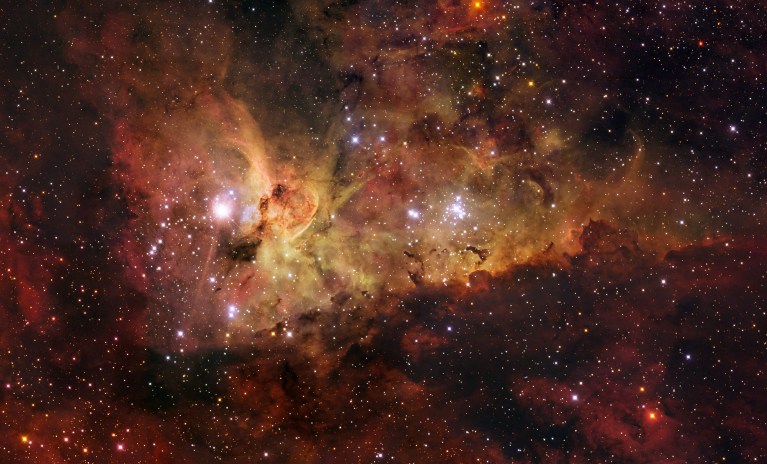
ESO – The Carina Nebula (by) courtesy of Openverse
Key points regarding Carina:
- Meaning: The term “Carina” translates to “The Keel” in Latin. Carina is the 34th largest constellation, covering 494 square degrees in the southern hemisphere. Carina is home to six stars that have been officially named. The names recognized by the International Astronomical Union (IAU) include Aiolos (HD 95086), Aspidiske (Iota Carinae), Avior (Epsilon Carinae A), Canopus (Alpha Carinae A), Miaplacidus (Beta Carinae), and Tapecue (HD 6376).
- Notable stars: Canopus is the second brightest star in the night sky at magnitude −1.46, following Sirius, and is located in the constellation Canis Major. It is visible from latitudes south of 37°18’ but not from northern latitudes. Canopus is a bright F-type giant star with a brightness 13,600 times that of the Sun and is about 310 light years away. Its name comes from the Greek name Kanôbos and it is also called Suhail in Arabic. Canopus is associated with the Scorpius-Centaurus Association, which contains several bright stars. Eta Carinae is a star system approximately 7,500 to 8,000 light years from Earth, made up of at least two stars with a brightness four million times that of the Sun. It is known as Tseen She in Chinese and for its powerful brightness variations. The system underwent a giant eruption in 1843 but survived, and it is expected to eventually end its life as a supernova or hypernova within the next several million years. The possible impact of this event on Earth is discussed. Miaplacidus, the second brightest star in its constellation, has an apparent magnitude of 1.67 and is about 111 light years away. Epsilon Carinae, with an apparent magnitude of 1.86, is a double star system 630 light years distant, and its components eclipse each other. Iota Carinae is a rare white supergiant star, around 690 light years away. Theta Carinae is a prominent star in the open cluster IC 2602. Upsilon Carinae is another double star system, while Omega Carinae is a blue-white B-type giant. AG Carinae is an exceptionally bright blue variable star about 6,000 light years away. PP Carinae is a blue-white dwarf star with a disc of gas around it. Other stars in the Carina constellation include V337, V357, χ Carinae, I Carinae, V382, and V533, each with various distances and brightness levels.
- Other features: The Eta Carinae Nebula is a large nebula that surrounds the massive stars Eta Carinae and HD 93129A, along with several open star clusters. It is one of the biggest diffuse nebulae known, being brighter and four times larger than the Orion Nebula. Its distance ranges from 6,500 to 10,000 light years, and it has an apparent magnitude of 1.0. It features several O-type stars, which are hot, bluish, and very bright. The nebula was discovered by French astronomer Nicolas Louis de Lacaille in 1751-52. Within the Carina Nebula are two smaller nebulae: the Homunculus Nebula and the Keyhole Nebula. The Keyhole Nebula is a small, dark cloud of dust and cold molecules with bright filaments of fluorescent gas. It is named by John Herschel in the 19th century and is about seven light years in diameter. The Homunculus Nebula surrounds Eta Carinae and formed after a significant outburst from the star, leading to the formation of two polar lobes and a thin equatorial disk moving away from the star at 670 km/s. Its peanut shape is still not fully understood, with various theories suggested about its origin. The Theta Carinae Cluster, also called the Southern Pleiades, is an open cluster about 479 light years away and can be seen with the naked eye. It was discovered by Lacaille and contains about 60 stars, with Theta Carinae being the brightest. NGC 3532, known as the Wishing Well Cluster, is another open cluster located approximately 1,321 light years away, composed of about 150 stars, with the cluster’s stars resembling twinkling coins. Another significant open cluster is NGC 3603, approximately 20,000 light years away, known for star formation studies. It contains abundant massive stars and H II regions. NGC 2808 is a globular star cluster estimated to be 12. 5 billion years old, consisting of three generations of stars. The Southern Beehive (NGC 2516) is another open cluster about 1,300 light years away, easily visible under good conditions. NGC 3293 is an open star cluster with over 50 stars, discovered by Lacaille in the 18th century.
- Mythology: Carina is not linked to any specific myth but belongs to the larger constellation Argo Navis, which represents the ship that Jason and the Argonauts used to go to Colchis for the Golden Fleece. Argo Navis was one of the 48 constellations known to the Greeks, catalogued by Ptolemy, and spanned between Canis Major and Crux. Pyxis, created from stars of the former constellation Malus, was added later. Carina represents the ship’s body, and the star Canopus is part of its steering oars. The ship was built by Argus under Athena’s guidance. Jason and his crew faced many challenges, including the Clashing Rocks, before securing the Golden Fleece. Sir Isaac Newton later suggested that the ship’s voyage might have influenced the zodiac signs. Additionally, Canopus is linked to a myth about King Menelaus’ helmsman.
- Visibility: Carina can be seen between latitudes +20° and -90°, neighboring constellations include Centaurus and Vela. The name is pronounced /kəˈraɪnə/, and the genitive form for star names is Carinae (/kəˈraɪniː/). Carina has 11 stars with known planets and no Messier objects. Its brightest star is Canopus. Two meteor showers, Alpha Carinids and Eta Carinids, are linked to it.
⁺‧₊☽◯☾₊‧⁺⋆⁺‧₊☽◯☾₊‧⁺⋆⁺‧₊☽◯☾₊‧⁺⋆⁺‧₊☽◯☾₊‧⁺⋆⁺‧₊☽◯☾₊‧⁺⋆⁺‧₊☽◯☾₊‧⁺⋆
Constellations:
| Constellations by Month | ||
| JANUARY [8] | FEBRUARY [7] | MARCH [7] |
| Taurus | Camelopardalis | Lynx |
| Orion | Auriga | Cancer |
| Lepus | Gemini | Canis Minor |
| Caelum | Monoceros | Pyxis |
| Reticulum | Canis Major | Vela |
| Dorado | Columba | Carina |
| Pictor | Puppis | Volans |
| Mensa | ||
| APRIL [8] | MAY [7] | JUNE [6] |
| Ursa Major | Canes Venatici | Ursa Minor |
| Leo Minor | Coma Berenices | Boötes |
| Leo | Virgo | Libra |
| Sextans | Corvus | Lupus |
| Crater | Centaurus | Circinus |
| Hydra | Crux | Apus |
| Antlia | Musca | |
| Chamaeleon | ||
| JULY [9] | AUGUST [9] | SEPTEMBER [6] |
| Draco | Lyra | Cygnus |
| Corona Borealis | Vulpecula | Delphinus |
| Hercules | Sagitta | Equuleus |
| Serpens | Aquila | Capricornus |
| Ophiuchus | Scutum | Microscopium |
| Scorpius | Sagittarius | Indus |
| Norma | Corona Australis | |
| Ara | Telescopium | |
| Triangulum Australe | Pavo | |
| OCTOBER [7] | NOVEMBER [8] | DECEMBER [6] |
| Cepheus | Cassiopeia | Perseus |
| Lacerta | Andromeda | Triangulum |
| Pegasus | Pisces | Aries |
| Aquarius | Cetus | Eridanus |
| Piscis Austrinus | Sculptor | Fornax |
| Grus | Phoenix | Horologium |
| Octans | Tucana | |
| Hydrus | ||

Hubble Captures Cosmic Ice Sculptures courtesy of Openverse
Constellations of the Month:
March – Carina
Material may be shared for personal and educational use, Share with family and friends. The material cannot be used in an educational setting whereby a “book fee” is charged in or above tuition costs, and the material here is being used without paying a licensing fee.. AI must file an application for use of such material.
| You May Also Like. . . | |
 NASA 1997 Liftoff Special |
 NASA Mission Patch Party |
More on Versatileer:
![NS_TheDarkestChase_Insta.jpg]()
Ends 07-31 – The Darkest Chase by Nicole Snow Book Blitz + $10 Amazon Gift Card & Signed Copy Giveaw...
07/24/2024![Barcelona Smoothies.jpg]()
Happy National Smoothie Day – 2025
06/23/2025![Docking of SpaceX CRS-21 Dragon Cargo Craft to the ISS]()
Docking of SpaceX CRS-21 Dragon Cargo Craft to the ISS
12/07/2020![stainless-steel-faucet-mounted-on-ceramic-tiles-8925979 no_plumbing_1710194800.jpeg Karolina Grabowska at Pexels]()
Happy National Plumbing Day – 2024 + The Importance of Plumbing & Resources
04/25/2024![wp-17607521799867273594689261094529_.jpg]()
Featured Photo: Flower of the Day – The Daisy Fleabane
10/17/2025































I am looking forward to the solar eclispe on the 29th.