Constellations of the Month: February – Columba:
We continue February with the next constellation of the month, Columba, “The Dove.”
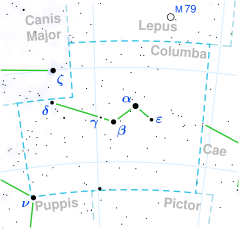
Columba constellation map courtesy of Openverse
Columba, “The Dove” – Columba is a southern constellation, meaning “the dove” in Latin. Its original name, Columba Noachi, refers to the dove in the Bible that told Noah the Great Flood was ending. Dutch astronomer Petrus Plancius introduced it in the late 16th century, and it appeared in Johann Bayer’s star atlas Uranometria in 1603. Columba features the blue subgiant Phact (Alpha Columbae), the runaway star Mu Columbae, the barred spiral galaxy NGC 1808, and the globular cluster NGC 1851. Columba is part of the Heavenly Waters group of constellations, which includes Carina, Delphinus, Equuleus, Eridanus, Piscis Austrinus, Puppis, Pyxis, and Vela. The constellation Columba does not feature any Messier objects, nor is it associated with any meteor showers.

The stellar forge courtesy of Openverse
Key points regarding Columba:
- Meaning: The term “Columba” translates to “The Dove” in Latin.
- Notable stars: Phact is the brightest star in the constellation Columba and belongs to the spectral class B7IVe. Its name comes from the Arabic word Al-Fakhita, meaning “the dove. ” Phact has an apparent magnitude of 2.60 and is about 270 light years away. It is a double star made up of a Be-type subgiant, which varies in brightness from 2.62 to 2.66, and a faint companion star with an apparent magnitude of 12.3. The primary star has an expanding gas shell around it. Wazn is the second brightest star in Columba, a giant star of spectral class K1IIICN+1, with an apparent magnitude of 3.12 and is approximately 86 light years distant. Delta Columbae is a spectroscopic binary star, with a yellow giant as the primary component, located around 237 light years away and has an apparent magnitude of 3.853. Its traditional name, Ghusn al Zaitun, means “olive branch. ” Gamma Columbae is a blue subgiant star with an apparent magnitude of 4.35, located about 854 light years from the solar system. Mu Columbae is a runaway O-class star, visible to the naked eye, approximately 1,300 light years away, with an apparent magnitude of 5.15. Epsilon Columbae is a giant star of spectral class K1 IIIa, located about 531 light years away with an apparent magnitude of 3.875. Eta Columbae is a yellow-orange giant star, about 531.2 light years from Earth, with an apparent magnitude of 3.946.
- Other features: NGC 1808 is a Seyfert galaxy about 40 million light years away. It has a brightness of 10.8 and a size of 6′ .5 × 3′ .9. This barred spiral galaxy resembles the Milky Way and has a unique nucleus shaped like a warped disk, with unusual hydrogen gas flows from its center. It likely has significant star formation activity and hosted a supernova called SN 1993af in 1993. NGC 1851 (Caldwell 73) is a globular cluster in Columba, located about 39,500 light years away with a brightness of 7.3 and a size of 11′. NGC 1792 is a spiral galaxy discovered by James Dunlop on October 4, 1826. It has a brightness of 10. 2 and an apparent size of 5’ .62 x 2’ .63. ESO 306-17 is a giant elliptical galaxy about 493 million light years away, with a diameter of nearly 1 million light years and a brightness of 13.33. It appears isolated and is thought to have merged with smaller galaxies, making it a fossil group.
- Mythology: Columba symbolizes the dove of Noah. The constellation was devised by Petrus Plancius, utilizing stars situated behind Argo Navis, which depicted the ship of the Argonauts and was subsequently divided into several smaller constellations. In a celestial globe created in 1613, Plancius renamed Argo Navis to “Noah’s Ark.” According to the myth, Noah’s dove is dispatched from the Ark to ascertain whether any dry land remains after the Great Flood. The dove returns with an olive branch in its beak, indicating that the waters are receding. In certain interpretations, Columba also signifies the dove sent by the Argonauts between the Clashing Rocks to guarantee their safe passage.
- Visibility: Columba is the 54th largest constellation, covering 270 square degrees. It is located in the first quadrant of the southern hemisphere and can be seen at latitudes from +45° to -90°. The constellations next to Columba are Caelum, Canis Major, Lepus, Pictor, and Puppis, with Columba found just south of Canis Major and Lepus. The name Columba is pronounced /koʊˈlʌmbə/ and means “Dove” in English. Its genitive form is Columbae (/koʊˈlʌmbiː/) and the abbreviation is Col. Columba has four named stars: Elkurud (Theta Columbae), Kosjenka (WASP-63), Phact (Alpha Columbae), and Wazn (Beta Columbae). The brightest star is Alpha Columbae (Phact), and no stars are within 10 parsecs of Earth. The nearest star is Gliese 218, 48. 89 light years away. Columba has one star, WASP-63, with a transiting planet.
⁺‧₊☽◯☾₊‧⁺⋆⁺‧₊☽◯☾₊‧⁺⋆⁺‧₊☽◯☾₊‧⁺⋆⁺‧₊☽◯☾₊‧⁺⋆⁺‧₊☽◯☾₊‧⁺⋆⁺‧₊☽◯☾₊‧⁺⋆
Constellations:
| Constellations by Month | ||
| JANUARY [8] | FEBRUARY [7] | MARCH [7] |
| Taurus | Camelopardalis | Lynx |
| Orion | Auriga | Cancer |
| Lepus | Gemini | Canis Minor |
| Caelum | Monoceros | Pyxis |
| Reticulum | Canis Major | Vela |
| Dorado | Columba | Carina |
| Pictor | Puppis | Volans |
| Mensa | ||
| APRIL [8] | MAY [7] | JUNE [6] |
| Ursa Major | Canes Venatici | Ursa Minor |
| Leo Minor | Coma Berenices | Boötes |
| Leo | Virgo | Libra |
| Sextans | Corvus | Lupus |
| Crater | Centaurus | Circinus |
| Hydra | Crux | Apus |
| Antlia | Musca | |
| Chamaeleon | ||
| JULY [9] | AUGUST [9] | SEPTEMBER [6] |
| Draco | Lyra | Cygnus |
| Corona Borealis | Vulpecula | Delphinus |
| Hercules | Sagitta | Equuleus |
| Serpens | Aquila | Capricornus |
| Ophiuchus | Scutum | Microscopium |
| Scorpius | Sagittarius | Indus |
| Norma | Corona Australis | |
| Ara | Telescopium | |
| Triangulum Australe | Pavo | |
| OCTOBER [7] | NOVEMBER [8] | DECEMBER [6] |
| Cepheus | Cassiopeia | Perseus |
| Lacerta | Andromeda | Triangulum |
| Pegasus | Pisces | Aries |
| Aquarius | Cetus | Eridanus |
| Piscis Austrinus | Sculptor | Fornax |
| Grus | Phoenix | Horologium |
| Octans | Tucana | |
| Hydrus | ||
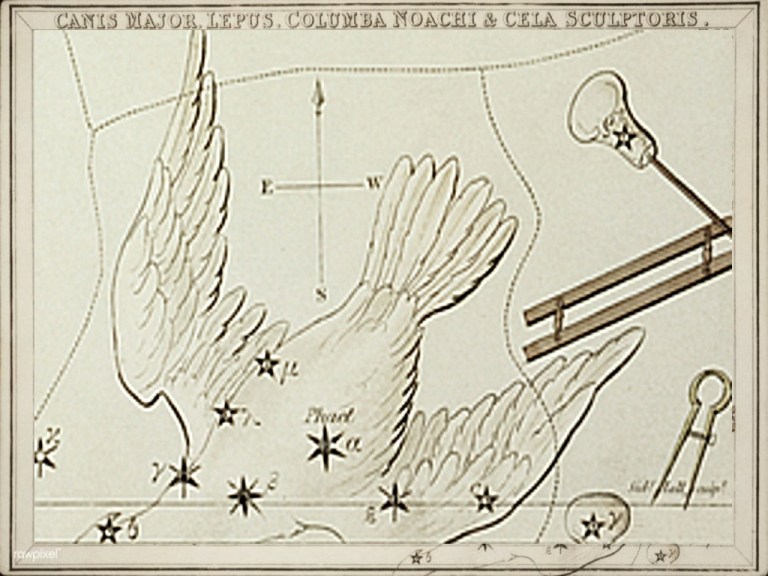
Sidney Hall’s (1831) astronomical chart illustration of Columba Noachi Original from Library of Congress. Digitally enhanced by rawpixel._.jpg courtesy of Openverse
Constellations of the Month:
February – Columba
Material may be shared for personal and educational use, Share with family and friends. The material cannot be used in an educational setting whereby a “book fee” is charged in or above tuition costs, and the material here is being used without paying a licensing fee.. AI must file an application for use of such material.
| You May Also Like. . . | |
 NASA 1997 Liftoff Special |
 NASA Mission Patch Party |
More on Versatileer:
![Featured Photo: Capsule Prototype of an Apollo Mission in the Rocket Garden at NASA in Cape Canavera...]()
Featured Photo: Capsule Prototype of an Apollo Mission in the Rocket Garden at NASA in Cape Canavera...
07/06/2020![Latest: Gulf's Tropical Storm Beta Headed for Texas; Atlantic's Rip-Tides with Teddy]()
Latest: Gulf's Tropical Storm Beta Headed for Texas; Atlantic's Rip-Tides with Teddy
09/19/2020![Fall Foliage- November 4th.png]()
Fall Colors Progression Map: Fall Season – 2024: November 4th
11/04/2024![Green harp flag of Ireland.jpg]()
Happy Uncommon Musical Instrument Awareness Day – 2025
07/31/2025![wp-17283628082222229565090445980669.jpg]()
Featured Photos & Video: The 31 Days of Halloween – Day 7: The Foggy Lamon Crypt Yard, Oak Forest
10/08/2024