Constellations of the Month: February – Canis Major:
We continue February with the next constellation of the month, Canis Major, “The Greater Dog.”
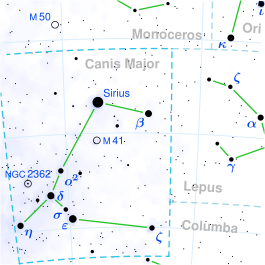
Canis Major constellation map courtesy of Openverse
Canis Major, “The Greater Dog” – Canis Major is a southern constellation, meaning “the greater dog” in Latin. It symbolizes a larger dog following Orion, the hunter, in Greek mythology. Canis Major is shown chasing a hare, which is depicted by the constellation Lepus, while the smaller dog is represented by Canis Minor. Both Canis Major and Canis Minor are part of the 48 Greek constellations listed by Claudius Ptolemy in the 2nd century A.D. Canis Major includes Sirius, the brightest star other than the Sun, at −1.46 magnitude. Sirius, or “The Dog Star,” is indicative of “The Dog Days of Summer,” as August 1st is the first day that Sirius exposes itself after being on the morning side of the Sun–rising in the east. Canis Major also contains VY Canis Majoris, one of the largest stars. It also features deep sky objects like Messier 41, Caroline’s Cluster, and several nebulae and galaxies. Canis Major does not have any constellation-based asterisms. However, Sirius is part of three large asterisms with bright stars in other constellations. Sirius forms the Winter Circle with Procyon, Pollux, Capella, Aldebaran, and Rigel, known as the Winter Hexagon, visible in the evening sky from December to March in the northern hemisphere. The Winter Triangle is part of the Winter Hexagon, made up of Sirius, Procyon, and Betelgeuse. The Egyptian X is a larger asterism that includes these stars plus Naos and Phact.

Canis Major courtesy of Openverse
Key points regarding Canis Major:
- Meaning: The term “Canis Major” translates to “The Greater Dog” in Latin.
- Notable stars: Sirius can be located by extending a line through Orion’s Belt, while the others form a triangle southeast of it. Sirius, having twice the mass of the Sun and being 25. 4 times more luminous, stands out because it is one of the closest stars to Earth. Sirius A is part of a binary system with a dim companion, Sirius B, the nearest known white dwarf. The star’s name reflects its association with summer heat in ancient cultures, including Egypt and Greece. Adhara, the second brightest star in Canis Major, is a binary star that is expected to end its life as a supernova. Wezen, a yellow-white supergiant, and Mirzam, a variable blue giant, are also supernova candidates. Aludra, another supergiant, is expected to go out as a supernova soon. Furud is a binary star, while Tau Canis Majoris is a massive multiple star system known for its brightness within an open cluster. VY Canis Majoris is a large red hypergiant star classified as M5Iae. It has a radius approximately 1,420 times that of the Sun and is located about 3,820 light-years away. If it replaced the Sun, its size would extend beyond Jupiter’s orbit. It is 8. 2 million years old, has 17 times the Sun’s mass, is unstable, and is expected to explode as a supernova within 100,000 years. VY Canis Majoris shines with a luminosity 178,000 times that of the Sun, varying in brightness as a pulsating star. EZ Canis Majoris is a binary system with a Wolf-Rayet star and a smaller companion, about 4,900 light-years away. The primary star has 23 times the Sun’s mass, while the companion star has 1. 5 solar masses. The system may be part of the Collinder 121 cluster and is surrounded by the Dolphin-Head Nebula.
- Other features: The constellation Canis Major has several bright deep sky objects that can be seen with amateur telescopes. Important objects include the Messier 41 (Little Beehive Cluster), Caroline’s Cluster, and the Tau Canis Majoris Cluster, all varying in unique characteristics and distances from Earth. Messier 41 is around 2,300 light-years away, has an apparent magnitude of 4. 5, and contains about 100 stars. Caroline’s Cluster, located 3,700 light-years away, has an apparent magnitude of 7. 2 and was discovered by Caroline Herschel. The Tau Canis Majoris Cluster is farther at 4,830 light-years away, with an apparent magnitude of 3. 8, known for its hot O-type stars. The Canis Major Dwarf Galaxy is a debated galaxy behind the Milky Way that likely has about 1 billion stars. NGC 2359, or the Duck Nebula, is an emission nebula linked to a Wolf-Rayet star, positioned about 11,960 light-years away. Sharpless 310 (Gum 8) is a large H II region covering about 681 light-years in eastern Canis Major, ionized by bright stars like Tau Canis Majoris. The hypergiant star VY Canis Majoris is nearby but may not be part of the nebula. Sharpless 308, known as the Dolphin Head Nebula, is about 4,530 light-years away, formed from material from the Wolf-Rayet star EZ Canis Majoris. NGC 2283, discovered by William Herschel, is a barred spiral galaxy 47. 8 million light-years away and had a supernova in 2023. NGC 2217, another barred spiral galaxy at 73 million light-years, had a supernova in 2017. NGC 2293 is a lenticular galaxy 107 million light-years away, interacting with NGC 2292. Gaia 1 is an open cluster situated 15,000 light-years away, discovered in 2017, while Collinder 140 is a bright open cluster about 1,226 light-years away, estimated to be 20 million years old, discovered by Nicolas Louis de Lacaille in 1751.
- Mythology: Canis Major is known as the “greater dog” following the hunter Orion in Greek mythology. It is shown as a dog on its hind legs chasing a hare, represented by the constellation Lepus. Manilius called it “the dog with the blazing face” because it seems to hold the brightest star, Sirius, in its mouth. This constellation is linked to Laelaps, the fastest dog, which could catch anything it chased. Zeus gave Laelaps to Europa, along with a javelin that could not miss. Unfortunately, Europa was killed by her husband Cephalus while hunting. Cephalus took Laelaps to catch the Teumessian fox, also very fast and destined to evade capture. Zeus ended their endless chase by turning them to stone and placing the dog in the sky as Canis Major.
- Visibility: Canis Major is the 43rd largest constellation, covering 380 square degrees. It is found in the southern celestial hemisphere and can be observed from latitudes +60° to -90°. Neighboring constellations include Columba, Lepus, Monoceros, and Puppis. The name Canis Major means “Great Dog” and is pronounced /ˈkeɪnɪs ˈmeɪdʒər/. Its genitive form for star names is Canis Majoris (/ˈkeɪnɪs məˈdʒɒrɪs/), and it has an abbreviation of CMa. It is part of the Orion family of constellations and is one of three dog constellations, along with Canis Minor and Canes Venatici. Canis Major includes one Messier object, the star cluster Messier 41. Sirius, the brightest star in this constellation, is also the brightest star in the night sky, known as the Dog Star. The constellation hosts at least 10 stars with known planets and has 10 formally named stars recognized by the IAU.
⁺‧₊☽◯☾₊‧⁺⋆⁺‧₊☽◯☾₊‧⁺⋆⁺‧₊☽◯☾₊‧⁺⋆⁺‧₊☽◯☾₊‧⁺⋆⁺‧₊☽◯☾₊‧⁺⋆⁺‧₊☽◯☾₊‧⁺⋆
Constellations:
| Constellations by Month | ||
| JANUARY [8] | FEBRUARY [7] | MARCH [7] |
| Taurus | Camelopardalis | Lynx |
| Orion | Auriga | Cancer |
| Lepus | Gemini | Canis Minor |
| Caelum | Monoceros | Pyxis |
| Reticulum | Canis Major | Vela |
| Dorado | Columba | Carina |
| Pictor | Puppis | Volans |
| Mensa | ||
| APRIL [8] | MAY [7] | JUNE [6] |
| Ursa Major | Canes Venatici | Ursa Minor |
| Leo Minor | Coma Berenices | Boötes |
| Leo | Virgo | Libra |
| Sextans | Corvus | Lupus |
| Crater | Centaurus | Circinus |
| Hydra | Crux | Apus |
| Antlia | Musca | |
| Chamaeleon | ||
| JULY [9] | AUGUST [9] | SEPTEMBER [6] |
| Draco | Lyra | Cygnus |
| Corona Borealis | Vulpecula | Delphinus |
| Hercules | Sagitta | Equuleus |
| Serpens | Aquila | Capricornus |
| Ophiuchus | Scutum | Microscopium |
| Scorpius | Sagittarius | Indus |
| Norma | Corona Australis | |
| Ara | Telescopium | |
| Triangulum Australe | Pavo | |
| OCTOBER [7] | NOVEMBER [8] | DECEMBER [6] |
| Cepheus | Cassiopeia | Perseus |
| Lacerta | Andromeda | Triangulum |
| Pegasus | Pisces | Aries |
| Aquarius | Cetus | Eridanus |
| Piscis Austrinus | Sculptor | Fornax |
| Grus | Phoenix | Horologium |
| Octans | Tucana | |
| Hydrus | ||
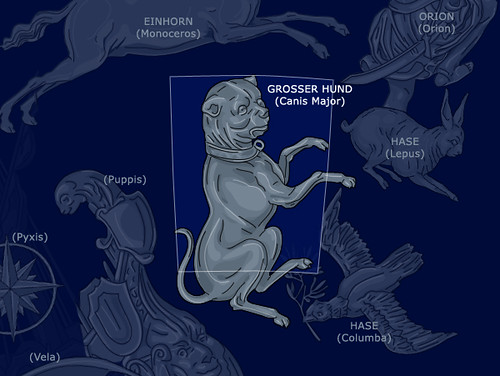
Canis Major | Großer Hund courtesy of Openverse
Constellations of the Month:
February – Canis Major
Material may be shared for personal and educational use, Share with family and friends. The material cannot be used in an educational setting whereby a “book fee” is charged in or above tuition costs, and the material here is being used without paying a licensing fee.. AI must file an application for use of such material.
| You May Also Like. . . | |
 NASA 1997 Liftoff Special |
 NASA Mission Patch Party |
More on Versatileer:
![20220619_115413.jpg]()
Featured Photo: Flower of the Day – Bouquet of the Week: Red, White & Blue Rose Assortment – First W...
09/05/2022![green plant in blue pot.jpg]()
Happy National Arbor Day – 2024
04/26/2024![trees with wind photo.jpg]()
The Danger of High Winds '24 – Spring & Summer Weather Series + Resources
05/19/2024![woman-with-binoculars-observing-river-in-gloomy-weather-7760644 weather_observer_1683297773.jpeg Dmitriy Ganin at Pexels]()
Happy National Weather Observers Day – 2023
05/05/2023![National Beach Day – 2024.jpg]()
Happy National Beach Day – 2024
08/30/2024