
Constellations of the Month: January – Mensa:
We continue January with the last constellation of the month, Mensa, “The Table.”
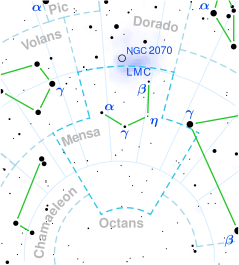
Mensa constellation map courtesy of Openverse
Mensa, “The Table” – The Mensa constellation is located in the southern hemisphere. Its name is derived from the Latin word for “table.” Mensa, alongside Octans, ranks as the southernmost of the 88 recognized constellations and is not visible from the northern hemisphere. This constellation was established by the French astronomer Nicolas Louis de Lacaille during the 18th century. Lacaille designated it as Mons Mensae, translating to Table Mountain, in reference to the mountain located in South Africa, which served as his vantage point for observing the southern celestial sphere. The constellation known as Mensa is pronounced /ˈmɛnsə/. In English, it is referred to as Table Mountain. The genitive form of Mensa, which is utilized in the naming of stars, is Mensae (pronunciation: /ˈmɛnsiː/). The three-letter abbreviation, established by the International Astronomical Union (IAU) in 1922, is Men.

Large Magellanic Cloud courtesy of Openverse
Key points regarding Mensa:
- Meaning: The term “Mensa” translates to “The Table” in Latin.
- Notable stars: Mensa has two stars with confirmed planets but no Messier objects. The brightest star, Alpha Mensae, has an apparent magnitude of 5.09 and is 33.1 light years away. It is a yellow main sequence dwarf, similar in mass and radius to the Sun but less luminous. Alpha Mensae has a red dwarf companion close by. Gamma Mensae is the second brightest star, with an apparent magnitude of 5.18 and located around 101 light years from the Sun. It is a double star, with an orange giant as its primary component. Beta Mensae follows as the third brightest star, at 5.302 apparent magnitude and about 640 light years away. It is a yellow giant star. Theta Mensae is a blue-white giant at 5.45 apparent magnitude and found 356 light years distant. Mu Mensae is another blue giant with an apparent magnitude of 554, sitting approximately 483 light years from the solar system. Zeta Mensae, a white giant, has an apparent magnitude of 5.61 and is 403.97 light years away. Pi Mensae, a yellow subgiant, is closer at 59.7 light years and has notable proper motion. An extrasolar planet was discovered around Pi Mensae in 2001, a superjovian planet with an unusual orbit. Lambda Mensae, an orange giant with an apparent magnitude of 6.54, is found 385.80 light years away. W Mensae is a yellow-white supergiant located in the Large Magellanic Cloud at about 168,000 light years. It is known for its brightness variability, classified as an R Coronae Borealis type variable star, with significant changes in brightness noted since its variability discovery in 1927.
- Other features: The Large Magellanic Cloud is an irregular galaxy located 163,000 light years from Earth. It is a satellite of the Milky Way and the third closest galaxy to us. With a diameter of about 14,000 light years, it is much less massive than the Milky Way and the fourth largest in the Local Group. The galaxy features a central bar and has likely changed shape due to its interactions with the Milky Way and the Small Magellanic Cloud. NGC 1987 is a globular star cluster in Mensa, discovered by John Herschel. PKS 0637-752 is a luminous quasar in Mensa, about 6 billion light years away, powered by a supermassive black hole, with a gas jet that stretches at least 200,000 light years.
- Mythology: Mensa is devoid of any associations with myths. It was established by Lacaille, who drew it from the faint stars of the southern hemisphere to honor Table Mountain, located near Cape Town, South Africa. Lacaille observed and catalogued the southern stars during the years 1751 and 1752. The constellation Mensa includes a portion of the Large Magellanic Cloud, giving it the appearance of being topped by a white cloud, reminiscent of the cloud formations that often crown Table Mountain. Initially, Lacaille referred to the constellation as Montagne de la Table in his 1756 planisphere, but he later Latinized the name to Mons Mensae in the second edition published in 1763. The English astronomer John Herschel proposed the abbreviated name Mensa, which was subsequently adopted by Francis Baily in his British Association Catalogue in 1845.
- Visibility: Mensa ranks as the 75th largest constellation, covering an area of merely 153 square degrees. It is situated in the first quadrant of the southern hemisphere (SQ1) and is observable at latitudes ranging from +4° to -90°. The constellations that border Mensa include Chamaeleon, Dorado, Hydrus, Octans, and Volans. This constellation is part of the Lacaille family, which also encompasses Antlia, Caelum, Circinus, Fornax, Horologium, Microscopium, Norma, Octans, Pictor, Reticulum, Sculptor, and Telescopium. Within Mensa, there is one star that has been officially named; the International Astronomical Union (IAU) recognizes it as Bubup (HD 38283).
⁺‧₊☽◯☾₊‧⁺⋆⁺‧₊☽◯☾₊‧⁺⋆⁺‧₊☽◯☾₊‧⁺⋆⁺‧₊☽◯☾₊‧⁺⋆⁺‧₊☽◯☾₊‧⁺⋆⁺‧₊☽◯☾₊‧⁺⋆
Constellations:
| Constellations by Month | ||
| JANUARY [8] | FEBRUARY [7] | MARCH [7] |
| Taurus | Camelopardalis | Lynx |
| Orion | Auriga | Cancer |
| Lepus | Gemini | Canis Minor |
| Caelum | Monoceros | Pyxis |
| Reticulum | Canis Major | Vela |
| Dorado | Columba | Carina |
| Pictor | Puppis | Volans |
| Mensa | ||
| APRIL [8] | MAY [7] | JUNE [6] |
| Ursa Major | Canes Venatici | Ursa Minor |
| Leo Minor | Coma Berenices | Boötes |
| Leo | Virgo | Libra |
| Sextans | Corvus | Lupus |
| Crater | Centaurus | Circinus |
| Hydra | Crux | Apus |
| Antlia | Musca | |
| Chamaeleon | ||
| JULY [9] | AUGUST [9] | SEPTEMBER [6] |
| Draco | Lyra | Cygnus |
| Corona Borealis | Vulpecula | Delphinus |
| Hercules | Sagitta | Equuleus |
| Serpens | Aquila | Capricornus |
| Ophiuchus | Scutum | Microscopium |
| Scorpius | Sagittarius | Indus |
| Norma | Corona Australis | |
| Ara | Telescopium | |
| Triangulum Australe | Pavo | |
| OCTOBER [7] | NOVEMBER [8] | DECEMBER [6] |
| Cepheus | Cassiopeia | Perseus |
| Lacerta | Andromeda | Triangulum |
| Pegasus | Pisces | Aries |
| Aquarius | Cetus | Eridanus |
| Piscis Austrinus | Sculptor | Fornax |
| Grus | Phoenix | Horologium |
| Octans | Tucana | |
| Hydrus | ||

Photo by Aperture Vintage on Unsplash
Constellations of the Month:
January – Mensa
Material may be shared for personal and educational use, Share with family and friends. The material cannot be used in an educational setting whereby a “book fee” is charged in or above tuition costs, and the material here is being used without paying a licensing fee.. AI must file an application for use of such material.
| You May Also Like. . . | |
 NASA 1997 Liftoff Special |
 NASA Mission Patch Party |





























This was very interesting.