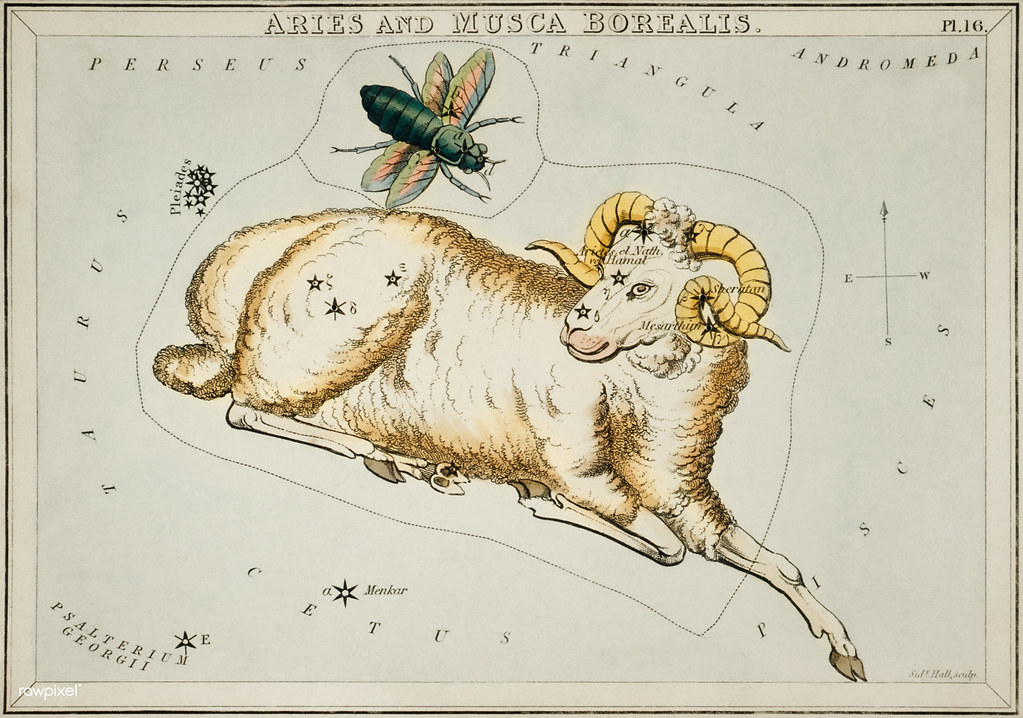
Constellations of the Month: December – Aries:
We continue December with the next constellation of the month, Aries, “The Ram.”

Aries constellation map courtesy of Openverse
Aries, “The Ram” – The Aries constellation is located in the northern hemisphere, and symbolizes “the ram.” Aries is distinguished with the symbol representing this constellation is ♈, which signifies the horns of a ram. Typically, the constellation Aries is linked to the tale of the Golden Fleece in Greek mythology. Like all zodiac constellations, Aries was initially catalogued by the Greek astronomer Ptolemy in his work Almagest during the 2nd century CE. Aries features the prominent stars Hamal and Sheratan and hosts several remarkable deep sky objects, including the unbarred spiral galaxy NGC 772, known as the Fiddlehead Galaxy, and the dwarf irregular galaxy NGC 1156. The constellation Aries lacks noticeable star patterns, but it includes Musca Borealis, which is made up of several brighter stars. Musca Borealis, or the Northern Fly, consists of Bharani (41 Arietis), 33 Arietis, 35 Arietis, and 39 Arietis (Lilii Borea). This asterism is a remnant of the old constellation Musca Borealis, formerly called Apes, Vespa, and Lilium. The name Lilium appears in the formal name of 39 Arietis. The southern version, Musca Australis, is known today as Musca.
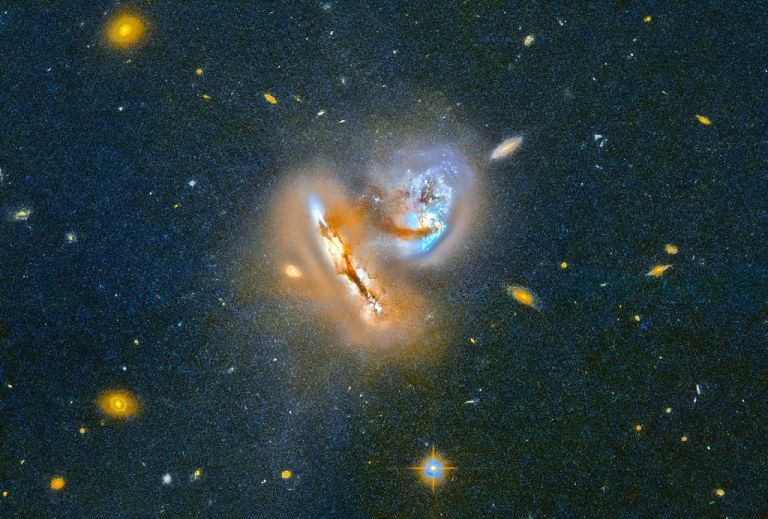
Interacting Galaxies, variant courtesy of Openverse
Key points regarding Aries:
- Meaning: The term “Aries” translates to “The Ram” in Latin. The constellation Aries does not include any Messier objects. The most luminous star in Aries is Hamal, Alpha Arietis, which has an apparent magnitude of 2.0. Hamal is known to host a candidate exoplanet, Alpha Arietis b, which was discovered in 2011. The constellation comprises 13 stars that have reported planets. The yellow dwarf HD 12661 is known to host two planets, both of which are more massive than Jupiter, while HIP 14810, another yellow dwarf, has a system of three confirmed orbiting planets, discovered in 2007 and 2009. There are multiple meteor showers linked to the Ram constellation: the May Arietids, Autumn Arietids, Delta Arietids, Epsilon Arietids, Daytime Arietids, and Aries-Triangulids. Aries features six stars that have been formally named. The names of the stars that have received approval from the International Astronomical Union (IAU) include Bharani (41 Arietis), Botein (Delta Arietis), Hamal (Alpha Arietis), Lilii Borea (39 Arietis), Mesarthim (Gamma2 Arietis), and Sheratan (Beta Arietis A). The optimal time of year to observe the constellation Aries is in December, when it is positioned higher in the sky around 9 pm.
- Notable stars: Hamal and Sheratan are the brightest stars in Aries, both exceeding magnitude 3.0, and form a triangle with the fainter star Mesarthim. Hamal (α Ari) is the brightest of these, an orange giant with a magnitude of 2.00, located 65.8 light-years away. It has a mass 1.5 times that of the Sun and is about 3.4 billion years old. Sheratan (β Ari), a white main sequence star, has a magnitude of 2.655 and lies 59.6 light-years distant. It has a mass 2.067 times that of the Sun. Bharani (41 Ari) is a hot blue star, while Mesarthim (γ Ari) is a binary star system that contains two stars with a combined magnitude of 3.86, located 164 light-years away. Botein (δ Ari) is a red giant star located about 170 light-years away. It has a brightness that varies slightly, is larger and more luminous than the Sun, and its name means “the belly” in Arabic. Lilii Borea (39 Ari) is another red giant, lying 172 light-years away with a similar brightness and is named after a now-defunct constellation. Teegarden’s Star (GJ 10393) is a faint dwarf star close to 12.5 light-years away, hosting three confirmed planets, including two in the habitable zone. SX Arietis (56 Ari) is a fast-spinning star that varies in brightness and is 415 light-years away. HIP 14810 is a yellow dwarf with three confirmed exoplanets, and Epsilon Arietis (ε Ari) is a double star system located 330 light-years away, with both stars being A-type main sequence stars.
- Other features: Aries has no particularly bright deep sky objects, mainly featuring galaxies. The only object from the Herschel 400 catalogue is NGC 772, a larger spiral galaxy located about 130 million light-years from Earth. It has hosted three supernovae in recent years. NGC 770 is an elliptical galaxy nearby, while NGC 821 and NGC 1156 are also part of the constellation. NGC 972 and NGC 691 were discovered by William Herschel, with NGC 691 being part of the NGC 691 Group. NGC 680 is another elliptical galaxy facing interactions with others. NGC 695 is a disturbed spiral galaxy, 450 million light-years away, discovered by William Herschel in 1786. It has a luminous starburst disk and loosely wound spiral arms due to interaction with a companion galaxy. NGC 674 is a spiral galaxy located 105 million light-years away, also discovered by Herschel in 1784, originally listed as NGC 697. NGC 918 is a barred spiral galaxy, 67 light-years away, classified as an active nucleus galaxy, and discovered by John Herschel in 1831. It has hosted two supernovae. NGC 935 and IC 1801 are an interacting pair of galaxies, 189 million light-years away, with notable supernova detections. UGC 2369 is another pair of interacting galaxies, 424 million light-years away, linked by a bridge of stars. NGC 877 is an intermediate spiral galaxy, 154 million light-years away, discovered by Herschel in 1784, with a high star formation rate. It interacts with NGC 876. NGC 719 is a lenticular galaxy, about 400 million light-years away, discovered in 1861. PSO J0309+27 is a distant blazar, identified in 2000, with light reaching Earth from when the universe was less than a billion years old.
- Mythology: The Babylonians identified the constellation Aries as an agrarian worker, naming it MULLÚ. ḪUN. GÁ, meaning “the hired man.” Later, it became known as the Ram, possibly due to its connection with a Mesopotamian god, Dumuzid the Shepherd. In early Bedouin stories, the Pleiades star cluster represented the Ram’s tail. In the 7th century BC, Neo-Babylonians revised the zodiac, moving Alpha Arietis, or Hamal, near the vernal equinox, which was then placed in Taurus. In 130 BCE, Greek astronomer Hipparchus defined the first point of Aries as where the Sun crossed the celestial equator in March, marking the beginning of Aries. Due to Earth’s axial precession, this point has moved to neighboring Pisces. In ancient Egypt, Aries was linked to the god Amon-Ra and was called “Lord of the Head. ” In Greek mythology, Aries is represented by Chrysomallos, the golden ram that saved Phrixus and his sister Helle. Phrixus eventually sacrificed the ram and received the Golden Fleece, which King Aeëtes later kept. This fleece became significant for Jason and the Argonauts on their quest for kingship.
- Visibility: Aries is the 78th largest constellation, covering 441 square degrees. It is situated in the first quadrant of the northern hemisphere (NQ1). This constellation is visible from locations with latitudes ranging from +90° to -60°. The constellations that border Aries include Cetus, Perseus, Pisces, Taurus, and Triangulum. Aries is part of the zodiac family of constellations, which also includes Taurus, Gemini, Cancer, Leo, Virgo, Libra, Scorpius, Sagittarius, Capricornus, Aquarius, and Pisces. All of these constellations are positioned along the ecliptic. The name Aries is pronounced /ˈɛər(i)iːz/. In English, it is referred to as the Ram. The genitive form of Aries, which is utilized in the naming of stars, is Arietis (pronunciation: /əˈraɪ.ɪtɪs/). The three-letter abbreviation, which was established by the International Astronomical Union (IAU) in 1922, is Ari.
⁺‧₊☽◯☾₊‧⁺⋆⁺‧₊☽◯☾₊‧⁺⋆⁺‧₊☽◯☾₊‧⁺⋆⁺‧₊☽◯☾₊‧⁺⋆⁺‧₊☽◯☾₊‧⁺⋆⁺‧₊☽◯☾₊‧⁺⋆
Constellations:
| Constellations by Month | ||
| JANUARY [8] | FEBRUARY [7] | MARCH [7] |
| Taurus | Camelopardalis | Ursa Major |
| Orion | Auriga | Cancer |
| Lepus | Gemini | Canis Minor |
| Caelum | Monoceros | Pyxis |
| Reticulum | Canis Major | Vela |
| Dorado | Columba | Carina |
| Pictor | Puppis | Volans |
| Mensa | ||
| APRIL [8] | MAY [7] | JUNE [6] |
| Ursa Major | Canes Venatici | Ursa Minor |
| Leo Minor | Coma Berenices | Boötes |
| Leo | Virgo | Libra |
| Sextans | Corvus | Lupus |
| Crater | Centaurus | Circinus |
| Hydra | Crux | Apus |
| Antlia | Musca | |
| Chamaeleon | ||
| JULY [9] | AUGUST [9] | SEPTEMBER [6] |
| Draco | Lyra | Cygnus |
| Corona Borealis | Vulpecula | Delphinus |
| Hercules | Sagitta | Equuleus |
| Serpens | Aquila | Capricornus |
| Ophiuchus | Scutum | Microscopium |
| Scorpius | Sagittarius | Indus |
| Norma | Corona Australis | |
| Ara | Telescopium | |
| Triangulum Australe | Pavo | |
| OCTOBER [7] | NOVEMBER [8] | DECEMBER [6] |
| Cepheus | Cassiopeia | Perseus |
| Lacerta | Andromeda | Triangulum |
| Pegasus | Pisces | Aries |
| Aquarius | Cetus | Eridanus |
| Piscis Austrinus | Sculptor | Fornax |
| Grus | Phoenix | Horologium |
| Octans | Tucana | |
| Hydrus | ||
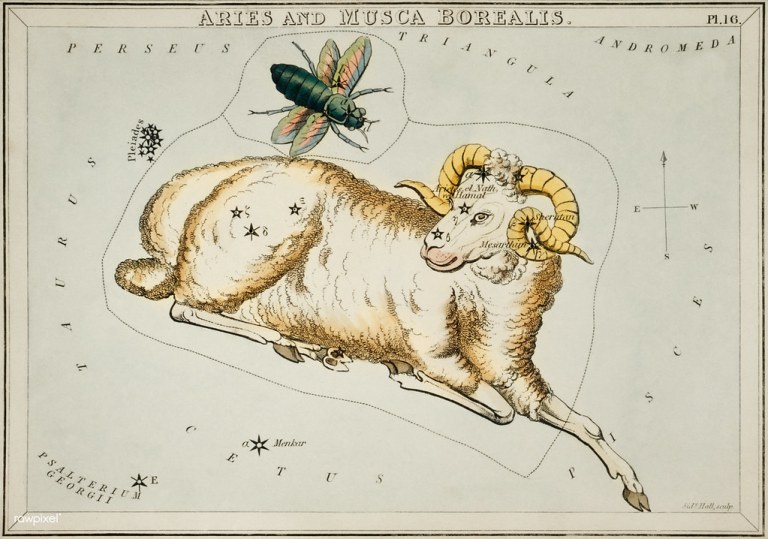
Sidney Hall’s (1831) astronomical chart illustration of Aries and Musca Borealis. Original from Library of Congress. Digitally enhanced by rawpixel. courtesy of Openverse
Constellations of the Month:
December – Aries
Material may be shared for personal and educational use, Share with family and friends. The material cannot be used in an educational setting whereby a “book fee” is charged in or above tuition costs, and the material here is being used without paying a licensing fee.. AI must file an application for use of such material.
| You May Also Like. . . | |
 NASA 1997 Liftoff Special |
 NASA Mission Patch Party |
More on Versatileer:
![Chasing Headlines_image2.jpeg]()
Ends 02-05 – Chasing Headlines by J. Rose Black Book Blitz + $30 Amazon Gift Card, Merch & eBook Cop...
01/25/2025![a white table topped with candy canes and christmas decorations.jpg]()
Happy National Candy Cane Day – 2024
12/26/2024![Disabled access sign on building.jpg]()
International Day of People with Disabilities – 2023
12/08/2023![Peace Rose.jpg]()
Happy National Peace Rose Day – 2025
04/29/2025![INSTA_Awakening.png]()
Ends 02-28 – Awakening by Elexis Bell Book Blitz + $25 Amazon Gift Card Giveaway
02/17/2024































Thank you for sharing
I am excited for the new moon.