
Constellations of the Month: December – Perseus:
We start December with the first constellation of the month, Perseus, “The Hero Perseus.”
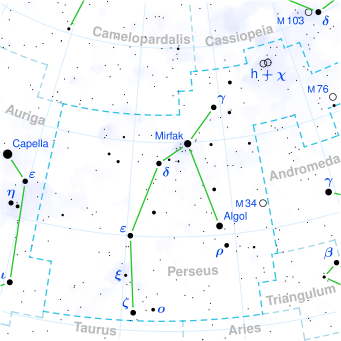
Perseus constellation map courtesy of Openverse
Perseus, “The Hero Perseus” – The Perseus constellation is located in the northern hemisphere, and symbolizes “the hero Perseus in Greek mythology.” Perseus derives its name from the hero Perseus in Greek mythology. Perseus ranks among the larger constellations in the northern hemisphere. It was initially catalogued by the Greek astronomer Ptolemy during the 2nd century. This constellation is particularly renowned for hosting the annual Perseid meteor shower. Additionally, it is home to the well-known variable star Algol, also referred to as Beta Persei. Perseus encompasses several notable deep sky objects, including Messier 34, the Double Cluster, the California Nebula (NGC 1499), and the Little Dumbbell Nebula (Messier 76). Perseus is quite simple to locate due to its unique shape and its position amidst several well-known patterns: Cassiopeia’s W to the north, Auriga’s hexagon featuring the bright star Capella to the east, the Pleiades to the south, and the trio of the brightest stars in Andromeda to the west.
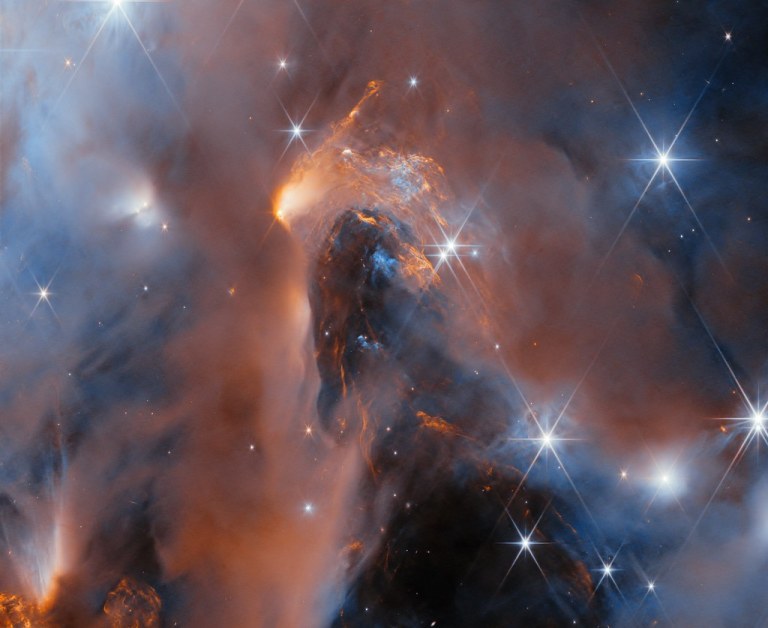
Peeking into Perseus (NGC 1333) courtesy of Openverse
Key points regarding Perseus:
- Meaning: The term “Perseus” translates to “The Hero Perseus” in Greek. The constellation Perseus features two Messier objects – Messier 34 (M34, NGC 1039) and Messier 76 (M76, also known as the Little Dumbbell Nebula, NGC 650 & NGC 651) – and features six stars that have confirmed planets. The constellation’s brightest star is Mirfak, designated as Alpha Persei, which has an apparent magnitude of 1.79. Additionally, there are two meteor showers linked to this constellation: the Perseids and the September Perseids. Perseus is home to nine named stars. The official names of the stars, as recognized by the International Astronomical Union (IAU), include Algol, Atik, Berehinya, Dajiangjunbei, Menkib, Miram, Mirfak, Misam, and Muspelheim. The constellation of Perseus has a curved line of stars known as the Segment of Perseus. It starts with Miram (Eta Persei) and includes Gamma Persei and Mirfak (Alpha Persei), ending with Sigma, Psi, and Delta Persei. This Segment can be found by drawing a line from Gamma Cassiopeiae through Ruchbah.
- Notable stars: Alpha Persei, also known as Mirfak, is a supergiant star in the Perseus constellation, approximately 510 light years away. It has a visual magnitude of 1.806, making it the brightest star in its constellation and one of the brightest in the sky. Algol, or the Demon Star, is a well-known triple star system with eclipsing behavior, demonstrating unusual mass transfer between its components. It is 92.8 light years distant and has an apparent magnitude that varies. Zeta Persei is a blue-white supergiant, about 750 light years away, while Epsilon Persei consists of multiple stars and has similar luminosity to Zeta Persei. Gamma Persei is a double star system, and Delta Persei may be a binary or even triple system. Rho Persei is a variable star associated with the myth of Gorgons, while Eta Persei is a K3 star located around 1331 light years away. Kappa Persei is a triple star system about 112 light years away, consisting of a binary star and a companion. Nu Persei is a yellow-white giant star located 556 light years away. Omicron Persei is a spectroscopic double star between 1000 and 1600 light years away, known for its appearances in science fiction. Xi Persei, a blue giant about 1800 light years distant, is one of the hottest visible stars. Phi Persei is a double star about 720 light years away. Other stars mentioned include Iota Persei, Theta Persei, and Psi Persei, with varying distances and classifications. The Perseid meteor shower occurs every summer and is associated with the comet Swift-Tuttle, which has an orbital period of 133 years.
- Other features: Messier 34 is an open star cluster about 1,500 light years away, containing around 400 stars and discovered in the mid-17th century. The Little Dumbbell Nebula, also known as Messier 76, is a challenging planetary nebula located about 2,500 light years from the Sun. The Alpha Persei Cluster, with its brightest star Mirfak, is approximately 600 light years away and contains blue stars. The Perseus molecular cloud, a stellar nursery, is located about 600 light years from us. The Perseus Cluster is a massive cluster of galaxies, while the Double Cluster consists of two young clusters, visible without binoculars. NGC 1333 is a reflection nebula in the Perseus cloud, and NGC 1260 is a spiral galaxy famous for a supernova. The California Nebula is an emission nebula that resembles California’s outline. NGC 1275 is a dominant Seyfert galaxy in the Perseus Cluster, and NGC 1058 is a Seyfert Type 2 galaxy located about 27.4 million light years away.
- Mythology: The constellation Perseus represents the Greek hero Perseus, who was the son of Danaë and King Acrisius of Argos. To avoid a prophecy that his grandson would kill him, Acrisius locked Danaë away. Zeus, in the form of golden rain, visited her, resulting in her pregnancy. When Perseus was born, Acrisius cast them into the sea in a chest. They landed on the island of Seriphos, where a fisherman named Dictys rescued them and raised Perseus. King Polydectes of Seriphos desired Danaë and sought to get rid of Perseus. He tricked Perseus into going after the head of Medusa, one of the three Gorgons whose gaze turned people into stone. Medusa was cursed by Athena after being violated by Poseidon. Perseus received help from gods: Athena provided a shield, Hephaestus a diamond sword, Hades a helmet of invisibility, and Hermes winged sandals. With these gifts, Perseus found the Gorgons and, using his shield to avoid direct eye contact, beheaded Medusa while she slept. From her body sprang the winged horse Pegasus and warrior Chrysaor. He later turned Atlas to stone for refusing him hospitality and rescued Andromeda from a sea monster, Cetus. Back in Seriphos, he confronted Polydectes and turned him to stone using Medusa’s head. The prophecy concerning Acrisius came true accidentally during an athletic contest. Perseus and Andromeda married, and they lie together in the sky alongside their family, including Cetus and Pegasus. Perseus is often depicted with Medusa’s head and a jeweled sword.
- Visibility: Perseus is the 24th largest constellation, covering 615 square degrees. It is situated in the first quadrant of the northern hemisphere (NQ1) and is visible at latitudes ranging from +90° to -35°. The constellations that border it include Andromeda, Aries, Auriga, Camelopardalis, Cassiopeia, Taurus, and Triangulum. The name of the constellation, Perseus, is pronounced /ˈpɜːrsiəs/. In English, it is referred to as Perseus or the Hero. The genitive form of Perseus, which is utilized in the naming of stars, is Persei (pronunciation: /ˈpɜːrsiaɪ/). The three-letter abbreviation, which was established by the International Astronomical Union (IAU) in 1922, is Per. Perseus is part of the Perseus family of constellations, which also includes Andromeda, Auriga, Cassiopeia, Cepheus, Cetus, Lacerta, Pegasus, and Triangulum. Mirfak is the brightest star in Perseus and can be located using stars from Andromeda and Pegasus. Algol, a variable star and the second brightest in Perseus, is positioned south of Mirfak.
⁺‧₊☽◯☾₊‧⁺⋆⁺‧₊☽◯☾₊‧⁺⋆⁺‧₊☽◯☾₊‧⁺⋆⁺‧₊☽◯☾₊‧⁺⋆⁺‧₊☽◯☾₊‧⁺⋆⁺‧₊☽◯☾₊‧⁺⋆
Constellations:
| Constellations by Month | ||
| JANUARY [8] | FEBRUARY [7] | MARCH [7] |
| Taurus | Camelopardalis | Ursa Major |
| Orion | Auriga | Cancer |
| Lepus | Gemini | Canis Minor |
| Caelum | Monoceros | Pyxis |
| Reticulum | Canis Major | Vela |
| Dorado | Columba | Carina |
| Pictor | Puppis | Volans |
| Mensa | ||
| APRIL [8] | MAY [7] | JUNE [6] |
| Ursa Major | Canes Venatici | Ursa Minor |
| Leo Minor | Coma Berenices | Boötes |
| Leo | Virgo | Libra |
| Sextans | Corvus | Lupus |
| Crater | Centaurus | Circinus |
| Hydra | Crux | Apus |
| Antlia | Musca | |
| Chamaeleon | ||
| JULY [9] | AUGUST [9] | SEPTEMBER [6] |
| Draco | Lyra | Cygnus |
| Corona Borealis | Vulpecula | Delphinus |
| Hercules | Sagitta | Equuleus |
| Serpens | Aquila | Capricornus |
| Ophiuchus | Scutum | Microscopium |
| Scorpius | Sagittarius | Indus |
| Norma | Corona Australis | |
| Ara | Telescopium | |
| Triangulum Australe | Pavo | |
| OCTOBER [7] | NOVEMBER [8] | DECEMBER [6] |
| Cepheus | Cassiopeia | Perseus |
| Lacerta | Andromeda | Triangulum |
| Pegasus | Pisces | Aries |
| Aquarius | Cetus | Eridanus |
| Piscis Austrinus | Sculptor | Fornax |
| Grus | Phoenix | Horologium |
| Octans | Tucana | |
| Hydrus | ||

From Urania’s Mirror: Perseus and Caput Medusæ, 1825 courtesy of Openverse
Constellations of the Month:
December – Perseus
Material may be shared for personal and educational use, Share with family and friends. The material cannot be used in an educational setting whereby a “book fee” is charged in or above tuition costs, and the material here is being used without paying a licensing fee.. AI must file an application for use of such material.
| You May Also Like. . . | |
 NASA 1997 Liftoff Special |
 NASA Mission Patch Party |
More on Versatileer:
![6184562_88499b20.jpg]()
The 147th Westminster Kennel Club Dog Show – 2023: Today & Tomorrow
05/08/2023![20231009_15_00__two_pac_2d0__Max.jpg]()
From the Satellite...Pacific Tropical Storm Max on .GIPHY & Video + 2023 Season Info
05/07/2024![Rhythm and Design.png]()
Ends 03-04 – Rhythm and Design by Long Temple Book Blitz + $25 Amazon Gift Card Giveaway
02/21/2026![man-trapped-in-barricade-tape-18703510 spanish_1705345315.jpeg Shots _From_skar at Pexels]()
What Are the Benefits of Learning a New Language?
01/15/2024![Hot Dog.jpg]()
Happy National Hot Dog Day – 2025
07/16/2025































thanks for sharing
Thank you for sharing