Constellations of the Month: October – Octans:
We continue October with the last constellation of the month, Octans, “The Octant.”

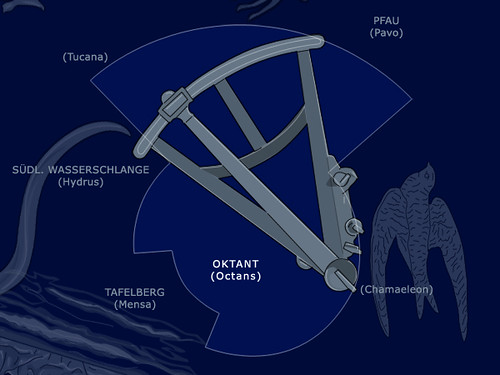
Octans constellation map courtesy of Openverse
Octans, “The Octant” – The Octans constellation is located in the southern hemisphere, and symbolizes “the octant,” a navigational tool. This constellation was first introduced by the French astronomer Nicolas Louis de Lacaille during the 18th century. Octans marks the position of the South Celestial Pole. It is circumpolar to the South Pole, meaning it never descends below the horizon. Notably, it lacks any stars that are brighter than fourth magnitude, as well as any sufficiently luminous deep sky objects for observers. Octans is home to the southern pole star, Sigma Octantis (Polaris Australis), which is positioned approximately one degree from the South Celestial Pole. However, this star is not useful for navigation due to its faintness.

Kalahari Desert Star Trails courtesy of Openverse
Key points regarding Octans:
- Meaning: The term “Octans” translates to “The Octant” in Latin. Octans comprises two stars that have known planets and does not include any Messier objects. The most luminous star in this constellation is Nu Octantis, which has an apparent magnitude of 3.76. Additionally, there are no meteor showers linked to this constellation. Octans features one star that has been formally named. The name recognized by the International Astronomical Union (IAU) is Polaris Australis (Sigma Octantis).
- Notable stars: Nu Octantis is the brightest star in its constellation, located about 69 light years away. It is an orange giant with an apparent magnitude of 3.76 and a luminosity 16 times that of the Sun. Its future expansion will make it 15 times larger and 60 times brighter in about 100 million years. Beta Octantis, a white star, is the second brightest in Octans, 140 light years away with a magnitude of 4.14. Delta Octantis, an orange giant, is further at 279 light years with a magnitude of 4.31. Theta Octantis is also an orange giant, while Alpha Octantis is a binary star system with a magnitude of 5.15. Sigma Octantis, known as the South Star, is too faint for navigation. Lastly, Mu-2 Octantis is a binary system of yellow dwarf stars, about 144 light years distant.
- Other features: HD 142022 is a binary star system located in the constellation, with an apparent magnitude of 7.69 and a distance of about 117 light years from the Sun. The main star is a G9V type and is slightly less massive than the Sun. It is very old, about 400 million years younger than the Universe. A planet was found orbiting it in 2005. HD 212301 is a yellow-white dwarf star classified as F8V, with an apparent magnitude of 7.77 and located 171.93 light years away. It also has a planet orbiting it that takes 2.24572 days to complete an orbit.
- Mythology: Octans was established by Nicolas Louis de Lacaille in 1752. There are no legends linked to the constellation, partly due to its position being too far south. Lacaille formed it from faint circumpolar stars and initially referred to it as l’Octans de Reflexion, meaning “the reflecting octant,” which served as a precursor to the contemporary sextant. The constellation was also referred to as Octans Hadleianus, named after John Hadley, the English mathematician who developed the octant in 1730. In the process of creating the constellation, Lacaille relocated several stars from the adjacent constellation Hydrus.
- Visibility: Octans is the 50th largest constellation, covering 291 square degrees. It is located in the fourth quadrant of the southern hemisphere (SQ4) and can be observed at latitudes ranging from +0° to -90°. The constellations that border it include Apus, Chamaeleon, Hydrus, Indus, Mensa, Pavo, and Tucana. The name of the constellation, Octans, is pronounced /ˈɒktænz/. In English, it is referred to as the Octant. The genitive form of Octans, which is utilized in the naming of stars, is Octantis (pronunciation: /ɒkˈtæntɪs/). The three-letter abbreviation, which was officially adopted by the International Astronomical Union (IAU) in 1922, is Oct. Octans is part of the Lacaille family of constellations, which also includes Antlia, Caelum, Circinus, Fornax, Horologium, Mensa, Microscopium, Norma, Pictor, Reticulum, Sculptor, and Telescopium.
⁺‧₊☽◯☾₊‧⁺⋆⁺‧₊☽◯☾₊‧⁺⋆⁺‧₊☽◯☾₊‧⁺⋆⁺‧₊☽◯☾₊‧⁺⋆⁺‧₊☽◯☾₊‧⁺⋆⁺‧₊☽◯☾₊‧⁺⋆
Constellations:
| Constellations by Month | ||
| JANUARY [8] | FEBRUARY [7] | MARCH [7] |
| Taurus | Camelopardalis | Ursa Major |
| Orion | Auriga | Cancer |
| Lepus | Gemini | Canis Minor |
| Caelum | Monoceros | Pyxis |
| Reticulum | Canis Major | Vela |
| Dorado | Columba | Carina |
| Pictor | Puppis | Volans |
| Mensa | ||
| APRIL [8] | MAY [7] | JUNE [6] |
| Ursa Major | Canes Venatici | Ursa Minor |
| Leo Minor | Coma Berenices | Boötes |
| Leo | Virgo | Libra |
| Sextans | Corvus | Lupus |
| Crater | Centaurus | Circinus |
| Hydra | Crux | Apus |
| Antlia | Musca | |
| Chamaeleon | ||
| JULY [9] | AUGUST [9] | SEPTEMBER [6] |
| Draco | Lyra | Cygnus |
| Corona Borealis | Vulpecula | Delphinus |
| Hercules | Sagitta | Equuleus |
| Serpens | Aquila | Capricornus |
| Ophiuchus | Scutum | Microscopium |
| Scorpius | Sagittarius | Indus |
| Norma | Corona Australis | |
| Ara | Telescopium | |
| Triangulum Australe | Pavo | |
| OCTOBER [7] | NOVEMBER [8] | DECEMBER [6] |
| Cepheus | Cassiopeia | Perseus |
| Lacerta | Andromeda | Triangulum |
| Pegasus | Pisces | Aries |
| Aquarius | Cetus | Eridanus |
| Piscis Austrinus | Sculptor | Fornax |
| Grus | Phoenix | Horologium |
| Octans | Tucana | |
| Hydrus | ||
octans courtesy of Openverse
Constellations of the Month:
October – Octans
Material may be shared for personal and educational use, Share with family and friends. The material cannot be used in an educational setting whereby a “book fee” is charged in or above tuition costs, and the material here is being used without paying a licensing fee.. AI must file an application for use of such material.
| You May Also Like. . . | |
 NASA 1997 Liftoff Special |
 NASA Mission Patch Party |
More on Versatileer:
![tin-tray-with-sweet-croissants-on-table-6479556 croissant_1643775439.jpeg Tara Winstead at Pexels]()
Happy Croissant Day – 2023
01/30/2023![wp-1734884428052222299006747930556.jpg]()
Featured Photo + Video: The 25 Days of Christmas – Day 24: Yuletide at the Village of Tinley Park Ho...
12/24/2024![Annular Eclipse_South Pacific__20241002.jpg]()
Annular Eclipse: Satellite Imagery From the 10/02/2024 in the Southern Hemisphere + Info on Future S...
10/09/2024![iLLASPARKZ-Gift-Card_REVIEW__BUTTON-625x625px.jpg]()
iLLASPARKZ Gift Card – Review
09/20/2021![A Plague of Mercies Blitz__BUTTON.jpg]()
Ends 06-21 – A Plague of Mercies by Adam Pelzman Book Blitz + $25 Amazon Gift Card Giveaway
06/16/2023