Constellations of the Month: October – Lacerta:
We continue October with the next constellation of the month, Lacerta, “The Lizard.”

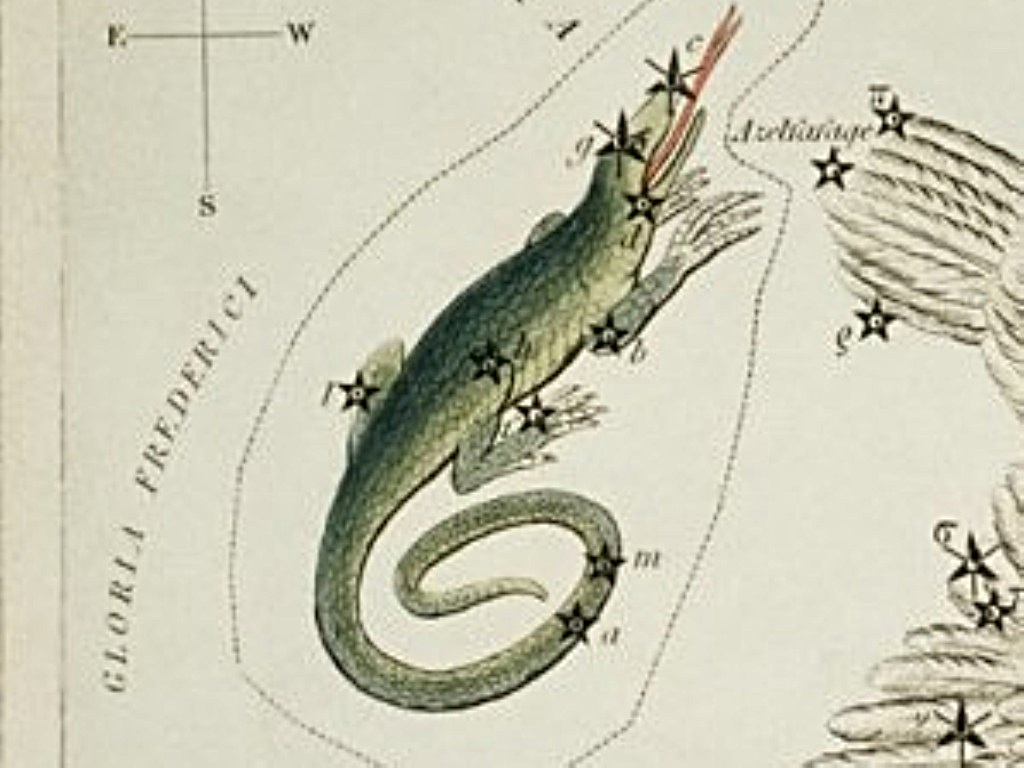
Lacerta constellation map courtesy of Openverse
Lacerta, “The Lizard” – The Lacerta minor constellation is located in the northern hemisphere, and symbolizes “the lizard.” Lacerta is relatively dim and is situated within the dense area of the Milky Way’s luminous band, positioned between the more prominent constellations of Andromeda, Cassiopeia, Pegasus, and Cygnus. Lacerta is occasionally referred to as Little Cassiopeia due to its brightest stars forming a “W” shape, similar to the bright stars of the larger Cassiopeia. Lacerta does not belong to the 48 ancient constellations listed by Ptolemy and lacks any mythological associations. It was established by the Polish astronomer Johannes Hevelius in 1687.

Image courtesy of Openverse
Key points regarding Lacerta:
- Meaning: The term “Lacerta” translates to “The Lizard” in Greek. The constellation Lacerta exhibits at most a fourth magnitude brightness, making them less prominent in the night sky. Among the notable stars in this constellation are the nearby red dwarf EV Lacertae, the variable red supergiant V424 Lacertae, the substantial blue star 10 Lacertae, and Babcock’s Magnetic Star (HD 215441). The Lizard constellation contains several relatively bright open clusters, such as NGC 7243 (Caldwell 16), NGC 7209, and NGC 7296. Additionally, it is the location of the Great Lacerta Nebula, a large yet faint emission nebula that is ionized by 10 Lacertae, the Gecko Nebula (LBN 437), and BL Lacertae, a blazar that acts as the prototype for a category of deep sky objects referred to as the BL Lacertae objects.
- Notable stars: The constellation Lacerta has five main stars: Alpha, Beta, 1, 5, and 6 Lacertae, arranged in a zig-zag pattern similar to Cassiopeia. Alpha Lacertae, the brightest at magnitude 3.76, is 102.6 light-years away and was named Stellio in 2024. It is a fast-spinning A-type star with a mass over twice that of the Sun. 1 Lacertae, the second brightest, is an orange giant located around 680 light-years away. The third, 5 Lacertae, is a binary system 2,170 light-years away. Other notable stars include Beta Lacertae, a yellow giant 170 light-years away, and HD 211073, a triple star system with varying brightness, located 580 light-years away. 2 Lacertae is a binary system of two blue stars, and 4 Lacertae, a blue supergiant, is expected to explode as a supernova. EV Lacertae is a red dwarf 16.5 light-years away, known for strong flares. HAT-P-40, an F-type star, hosts the gas giant exoplanet Vytis. U Lacertae is a binary system with a red supergiant. AR Lacertae is a triple star system with brightness variations. Babcock’s Star is a variable star with a strong magnetic field. Finally, Roe 47 is a five-component star system, and ADS 16402 is a binary system that hosts a hot Jupiter exoplanet, HAT-P-1b.
- Other features: Lacerta contains a few deep sky objects, notably the open cluster NGC 7243, which is also known as Caldwell 16. NGC 7243 is located about 2,800 light-years away and has an apparent magnitude of 6.4, making it visible through small telescopes. It was discovered by Sir William Herschel in 1788 and has an estimated age of over 100 million years. In addition to NGC 7243, Lacerta includes NGC 7209 and NGC 7296, both open clusters listed in the Herschel 400 catalogue. Another noteworthy object is BL Lacertae, a variable extragalactic active galactic nucleus located 0.9 billion light-years away, discovered in 1929 and known as a blazar. NGC 7197 is a spiral galaxy found 190 million light-years away, while NGC 7250 is an irregular galaxy notable for high star formation and the discovery of a fast supernova, SN 2013dy. The Great Lacerta Nebula, located about 1,200 light-years away, exhibits young star formation and is linked to the Lacerta OB1 association. 3C 449 and 3C 452 are additional distant galaxies in Lacerta, characterized by their radio emissions and active galactic nuclei.
- Mythology: The Polish astronomer Johannes Hevelius created the constellation Lacerta in his star atlas published in 1687, originally naming it Stellio after a lizard. This name did not gain popularity. Hevelius also introduced six other constellations: Canes Venatici, Leo Minor, Lynx, Scutum, Sextans, and Vulpecula. Later, English astronomer John Flamsteed added stars from Lacerta that belonged to the constellation Cepheus. The name Lacerta is not mythological, as ancient observers did not see a constellation here. Some stars were once part of now-obsolete constellations created to honor kings, but Lacerta remains one of the modern constellations defined in the early 20th century.
- Visibility: Lacerta is the 68th largest constellation, covering 201 square degrees in the northern sky. It is found in the fourth quadrant of the northern hemisphere and can be seen from latitudes between +90° and -40°. Neighboring constellations include Andromeda, Cassiopeia, and Pegasus. The name Lacerta means “lizard” in Latin. The constellation has 12 stars with known planets, with Stellio (Alpha Lacertae) being the brightest. It features three officially named stars but has no Messier objects or associated meteor showers.
⁺‧₊☽◯☾₊‧⁺⋆⁺‧₊☽◯☾₊‧⁺⋆⁺‧₊☽◯☾₊‧⁺⋆⁺‧₊☽◯☾₊‧⁺⋆⁺‧₊☽◯☾₊‧⁺⋆⁺‧₊☽◯☾₊‧⁺⋆
Constellations:
| Constellations by Month | ||
| JANUARY [8] | FEBRUARY [7] | MARCH [7] |
| Taurus | Camelopardalis | Ursa Major |
| Orion | Auriga | Cancer |
| Lepus | Gemini | Canis Minor |
| Caelum | Monoceros | Pyxis |
| Reticulum | Canis Major | Vela |
| Dorado | Columba | Carina |
| Pictor | Puppis | Volans |
| Mensa | ||
| APRIL [8] | MAY [7] | JUNE [6] |
| Ursa Major | Canes Venatici | Ursa Minor |
| Leo Minor | Coma Berenices | Boötes |
| Leo | Virgo | Libra |
| Sextans | Corvus | Lupus |
| Crater | Centaurus | Circinus |
| Hydra | Crux | Apus |
| Antlia | Musca | |
| Chamaeleon | ||
| JULY [9] | AUGUST [9] | SEPTEMBER [6] |
| Draco | Lyra | Cygnus |
| Corona Borealis | Vulpecula | Delphinus |
| Hercules | Sagitta | Equuleus |
| Serpens | Aquila | Capricornus |
| Ophiuchus | Scutum | Microscopium |
| Scorpius | Sagittarius | Indus |
| Norma | Corona Australis | |
| Ara | Telescopium | |
| Triangulum Australe | Pavo | |
| OCTOBER [7] | NOVEMBER [8] | DECEMBER [6] |
| Cepheus | Cassiopeia | Perseus |
| Lacerta | Andromeda | Triangulum |
| Pegasus | Pisces | Aries |
| Aquarius | Cetus | Eridanus |
| Piscis Austrinus | Sculptor | Fornax |
| Grus | Phoenix | Horologium |
| Octans | Tucana | |
| Hydrus | ||

Sidney Hall’s (1831) astronomical chart illustration of the Lacerta, Cygnus, Lyra, Vulpecula and the Anser. Original from Library of Congress. Digitally enhanced by rawpixel. courtesy of Openverse
Constellations of the Month:
October – Lacerta
Material may be shared for personal and educational use, Share with family and friends. The material cannot be used in an educational setting whereby a “book fee” is charged in or above tuition costs, and the material here is being used without paying a licensing fee.. AI must file an application for use of such material.
| You May Also Like. . . | |
 NASA 1997 Liftoff Special |
 NASA Mission Patch Party |
More on Versatileer:
![California_I-5 Mountains__Fujicolor 400.png]()
Photo of the Day: 12/12/19 – Best of California: Color Corrected – Pacific Ocean From Famous Scenic ...
12/12/2019![20250806_03_00__two_atl_2d0__Dexter_.jpg]()
From the Satellite...Atlantic Tropical Storm Dexter on .GIPHY & Video + 2025 Season Info
09/30/2025![Teacher-Tuesday-September-2023.png]()
Ends 09-11 – Teacher Tuesday - September 5th
09/05/2023![Ends 06-28 – The Springfest Sprint by Georgie Monroe Book Blitz + $25 Amazon Gift Card Giveaway]()
Ends 06-28 – The Springfest Sprint by Georgie Monroe Book Blitz + $25 Amazon Gift Card Giveaway
06/23/2023![woman standing near projector screen.jpg]()
National Employee Benefits Day – 2025
04/07/2025






























wonderful! thanks for sharing!