Constellations of the Month: September – Cygnus:
We start September with the first constellation of the month, Cygnus, “The Swan.”

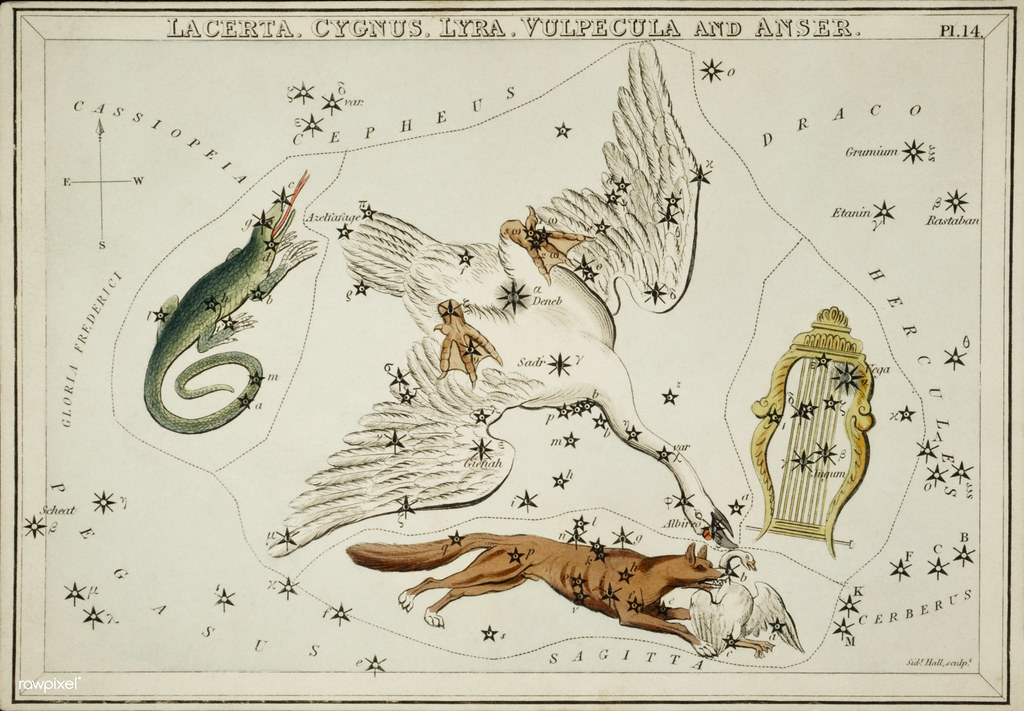
Cygnus constellation map courtesy of Openverse
Cygnus, “The Swan” – The Cygnus constellation is located in the northern hemisphere, and symbolizes “the swan.” Cygnus is linked to the myth of Zeus and Leda in Greek mythology. This constellation is easily identifiable in the night sky due to its prominent asterism known as the Northern Cross. The Greek astronomer Ptolemy first catalogued Cygnus in the 2nd century. Among the significant objects within this constellation are Cygnus X-1, a well-known x-ray source, the luminous stars Deneb and Albireo, the yellow dwarf Kepler-22, which is home to the exoplanet Kepler-22b, the Fireworks Galaxy (NGC 6946), and several notable nebulae: the Blinking Planetary Nebula (NGC 6826), the Cocoon Nebula (IC 5146), the Jewel Bug Nebula (NGC 7027), the Pelican Nebula (IC 5070), the North America Nebula (NGC 7000), the Crescent Nebula (NGC 6888), the Sadr Region (IC 1318), and the Veil Nebula (NGC 6960, 6962, 6979, 6992, and 6995). The five stars that constitute the Northern Cross are Deneb (Alpha Cygni), Fawaris (Delta Cygni), Albireo (Beta Cygni), Aljanah (Epsilon Cygni), and Sadr (Gamma Cygni) located at the center. Alxo, the Summer Triangle is made up of the most luminous stars from three constellations, featuring Deneb, which links to Vega in Lyra and Altair in Aquila.
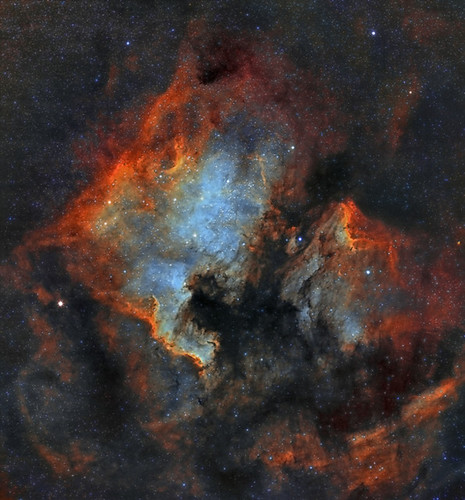
NGC 7000: the North America Nebula courtesy of Openverse
Key points regarding Cygnus:
- Meaning: The term “Cygnus” translates to “The Swan” in Latin. The constellation Cygnus comprises 10 stars that have known planets and includes two Messier objects: Messier 29 (NGC 6913) and Messier 39 (NGC 7092). The most luminous star in this constellation is Deneb, Alpha Cygni, which ranks as the 19th brightest star in the sky, exhibiting an apparent magnitude of 1.25. Additionally, there are two meteor showers linked to the constellation: the October Cygnids and the Kappa Cygnids. Cygnus is home to six named stars. The official names of the stars that have received approval from the International Astronomical Union (IAU) are Albireo, Aljanah, Azelfafage, Deneb, Fawaris, and Sadr.
- Notable stars: Deneb is a blue-white supergiant star located around 1,400 light years from Earth. It is the brightest star in the constellation Cygnus and is very luminous, about 60,000 times brighter than the Sun. Deneb has stopped hydrogen fusion in its core and is expected to end its life in a supernova in the next few million years. The name Deneb means “tail” in Arabic, relating to its position in the constellation. Gamma Cygni, known as Sadr, is about 1,800 light years away and has a bright apparent magnitude of 2.23. It is surrounded by the IC 1318 nebula. Epsilon Cygni, or Aljanah, is an orange giant star 72.7 light years away, known for its brightness, being 62 times more luminous than the Sun. Delta Cygni is a triple star system set to become the North Star around 11,250. Albireo, or Beta Cygni, is a binary system with a yellow star and a blue companion, located approximately 380 light years away. Zeta Cygni and Tau Cygni are also notable stars within the constellation, while Kappa Cygni marks the tip of the swan’s wing. Pi Cygni consists of two systems, with Pi-1 being 1,680 light years away and very luminous. 61 Cygni is a nearby double star system with two dwarf stars, located 11.41 light years away. P Cygni is a variable hypergiant star about 6,000 light years from Earth. Other stars like 39 Cygni, Theta Cygni, and 16 Cygni also contribute to the rich diversity of the Cygnus constellation as they represent different classes and symbolize significant astronomical features.
- Other features: Messier 29 is an open star cluster about 4,000 light years away with a magnitude of 7.1, discovered by Charles Messier in 1764. Its age is estimated at 10 million years, with the brightest star having a magnitude of 8.59. Messier 39, another open cluster by Messier, is 800 light years away and between 200 and 300 million years old, featuring a brightest star of magnitude 6.83. The Fireworks Galaxy (NGC 6946) is a spiral galaxy approximately 22.5 million light years distant, discovered in 1798, known for nine observed supernovae. Cygnus X-1 is a strong X-ray source and black hole candidate located 6,100 light years away. The North America Nebula (NGC 7000) resembles the continent and is about 1,600 light years distant. It was discovered in 1786, containing active star formation. The Pelican Nebula is nearby, about 1,800 light years away, and associated with star formation. IC 1318 and the Crescent Nebula are also in this region. The Cygnus Loop is a supernova remnant about 1,470 light years away, including the visually stunning Veil Nebula.
- Mythology: Cygnus is linked to various myths. One prominent story is about Leda, the Queen of Sparta, who gave birth to two sets of twins after Zeus, transformed into a swan, seduced her. The immortal twins, Pollux and Helen, were fathered by Zeus, while the mortal twins, Castor and Clytemnestra, were fathered by Leda’s husband, King Tyndareus. Castor and Pollux are represented by the constellation Gemini. Another tale connects Cygnus to Orpheus, a Greek hero killed by the Maenads for not honoring Dionysus. After his death, Orpheus became a swan and was placed in the sky next to his lyre, represented by the nearby constellation Lyra. Additionally, Cygnus is associated with several characters named Cycnus in Greek mythology. The most notable story involves Cycnus and his friend Phaeton, who raced each other across the sky and fell to Earth. Unable to recover Phaeton’s body from the river, Cycnus made a deal with Zeus for a swan’s body to retrieve it. Zeus honored Cycnus’ sacrifice by placing him in the sky. In Chinese mythology, the constellation is related to the story of the “magpie bridge,” Que Qiao, representing the efforts of magpies to reunite lovers Niu Lang and Zhi Nu, separated by the Goddess of Heaven.
- Visibility: Cygnus is the 52nd largest constellation, covering 804 square degrees. It is located in the fourth quadrant of the northern hemisphere (NQ4) and is visible at latitudes ranging from +90° to -40°. The constellations that border it include Cepheus, Draco, Lacerta, Lyra, Pegasus, and Vulpecula. The name Cygnus is pronounced /ˈsɪɡnəs/. In English, this constellation is referred to as the Swan. The genitive form of Cygnus, which is utilized in the naming of stars, is Cygni (pronunciation: /ˈsɪɡnaɪ/). The three-letter abbreviation, which was officially adopted by the International Astronomical Union (IAU) in 1922, is Cyg. Cygnus is part of the Hercules family of constellations, which also includes Aquila, Ara, Centaurus, Corona Australis, Corvus, Crater, Crux, Hercules, Hydra, Lupus, Lyra, Ophiuchus, Sagitta, Scutum, Sextans, Serpens, Triangulum Australe, and Vulpecula.
⁺‧₊☽◯☾₊‧⁺⋆⁺‧₊☽◯☾₊‧⁺⋆⁺‧₊☽◯☾₊‧⁺⋆⁺‧₊☽◯☾₊‧⁺⋆⁺‧₊☽◯☾₊‧⁺⋆⁺‧₊☽◯☾₊‧⁺⋆
Constellations:
| Constellations by Month | ||
| JANUARY [8] | FEBRUARY [7] | MARCH [7] |
| Taurus | Camelopardalis | Ursa Major |
| Orion | Auriga | Cancer |
| Lepus | Gemini | Canis Minor |
| Caelum | Monoceros | Pyxis |
| Reticulum | Canis Major | Vela |
| Dorado | Columba | Carina |
| Pictor | Puppis | Volans |
| Mensa | ||
| APRIL [8] | MAY [7] | JUNE [6] |
| Ursa Major | Canes Venatici | Ursa Minor |
| Leo Minor | Coma Berenices | Boötes |
| Leo | Virgo | Libra |
| Sextans | Corvus | Lupus |
| Crater | Centaurus | Circinus |
| Hydra | Crux | Apus |
| Antlia | Musca | |
| Chamaeleon | ||
| JULY [9] | AUGUST [9] | SEPTEMBER [6] |
| Draco | Lyra | Cygnus |
| Corona Borealis | Vulpecula | Delphinus |
| Hercules | Sagitta | Equuleus |
| Serpens | Aquila | Capricornus |
| Ophiuchus | Scutum | Microscopium |
| Scorpius | Sagittarius | Indus |
| Norma | Corona Australis | |
| Ara | Telescopium | |
| Triangulum Australe | Pavo | |
| OCTOBER [7] | NOVEMBER [8] | DECEMBER [6] |
| Cepheus | Cassiopeia | Perseus |
| Lacerta | Andromeda | Triangulum |
| Pegasus | Pisces | Aries |
| Aquarius | Cetus | Eridanus |
| Piscis Austrinus | Sculptor | Fornax |
| Grus | Phoenix | Horologium |
| Octans | Tucana | |
| Hydrus | ||

Sidney Hall’s (1831) astronomical chart illustration of the Lacerta, Cygnus, Lyra, Vulpecula and the Anser. Original from Library of Congress. Digitally enhanced by rawpixel. courtesy of Openverse
Constellations of the Month:
September – Cygnus
Material may be shared for personal and educational use, Share with family and friends. The material cannot be used in an educational setting whereby a “book fee” is charged in or above tuition costs, and the material here is being used without paying a licensing fee.. AI must file an application for use of such material.
| You May Also Like. . . | |
 NASA 1997 Liftoff Special |
 NASA Mission Patch Party |