Constellations of the Month: August – Aquila:
We continue August with the next constellation of the month, Aquila, “The Eagle.”
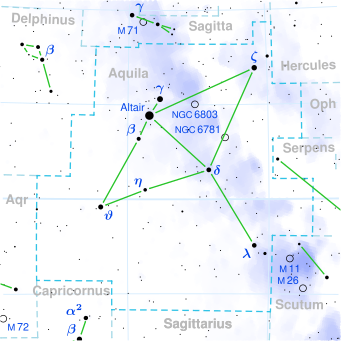
Aquila constellation map courtesy of Openverse
Aquila, “The Eagle” – The Aquila constellation is located mostly in the northern hemisphere but is equatorial, and symbolizes “the eagle.” Aquila is situated mostly in the northern sky, straddling the celestial equator. Its name translates to “the eagle” in Latin. This constellation symbolizes the eagle associated with the Roman god Jupiter in mythology. It was initially catalogued by the Greek astronomer Ptolemy during the 2nd century CE. The Eagle constellation is readily identifiable, positioned opposite the celestial Swan (Cygnus). Altair, the brightest star within this constellation, forms a notable asterism known as the Summer Triangle alongside the stars Deneb from Cygnus and Vega from Lyra. Aquila features Altair, which ranks as the 12th brightest star in the night sky and is one of our closest bright stellar neighbors, along with Tarazed (Gamma Aquilae), an orange bright giant, and Eta Aquilae, a variable white supergiant. Additionally, the constellation hosts several intriguing deep sky objects, including the planetary nebulae NGC 6803 and NGC 6804, the Snowglobe Nebula (NGC 6781), the Glowing Eye Nebula (NGC 6751), and the Phantom Streak Nebula (NGC 6741), as well as the protoplanetary Starfish Nebula (IRAS 19024+0044), the extensive supernova remnant Westerhout 50 (also known as the Manatee Nebula), the open clusters NGC 6709 and NGC 6755, and the dark nebula B143-4.
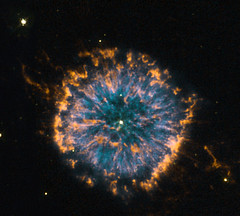
NGC 6751 courtesy of Openverse
Key points regarding Aquila:
- Meaning: The term “Aquila” translates to “The Eagle” in Latin. Aquila is a constellation with over a dozen stars known to have orbiting planets. The stars HD 176986 and HD 183263 each host two exoplanets. Other stars with confirmed planets include Libertas (Xi Aquilae) with Fortitudo, Chechia (HD 192699) with Khomsa, and HD 179079. Notable orange dwarfs like Phoenicia (HD 192263) and Petra (WASP-80) also have planets, with Petra hosting a hot Jupiter. Aquila contains ten officially named stars, such as Alshain, Altair, and Tarazed. It does not have any Messier objects and is associated with two meteor showers: the June Aquilids and the Epsilon Aquilids. The best time to observe Aquila is in August at around 9 pm, as it is visible from most locations throughout the year.
- Notable stars: Altair is the 12th brightest star, an A-type main sequence star located 16.8 light-years from Earth. It has an apparent magnitude of 0.77 and is known for its fast rotation, causing it to be flattened at the poles. Altair is part of the Summer Triangle along with Deneb and Vega. Alshain, the seventh brightest star in Aquila, is a G-type subgiant 44.7 light-years away, with an apparent magnitude of 3.71 and a companion star. Tarazed is the second brightest star in Aquila, a K-type giant around 461 light-years distant, with an apparent magnitude of 2.72 and known for its high luminosity. Epsilon Aquilae is a triple star system approximately 154 light-years away, with an orange giant as its brightest component. Zeta Aquilae, a triple system 83.2 light-years away, features a primary A-type star. Eta Aquilae, a Cepheid variable supergiant 1200 light-years distant, has an apparent magnitude ranging from 3.5 to 4.4. Theta Aquilae is a binary system about 286 light-years away, recently named Antinous. Iota and Lambda Aquilae are blue-white B-type stars, both notable in the constellation. Tau Aquilae, an orange giant 549 light-years away, has been named Tianfu by the IAU.
- Other features: NGC 6741 is a planetary nebula, discovered in 1882, located 7000 light years away with an apparent magnitude of 11. NGC 6709 is an open star cluster first seen by William Herschel in 1828, five degrees from Zeta Aquilae. The E Nebula, or Barnard’s E, features two dark nebulae near Tarazed. NGC 6755 is an open cluster visible 4.5 degrees west of Delta Aquilae. NGC 6781, another planetary nebula similar to the Owl Nebula, was discovered in 1788, while NGC 6803, also found in 1882, has a visual magnitude of 11.4. NGC 6804, known for its central star’s magnitude of 14.4, is located near Aquila. NGC 6751, or the Glowing Eye Nebula, has a magnitude of 11.9 and is 6,500 light years away. NGC 6760 and NGC 6749 are globular clusters at distances of 24,100 light years and nearby. NGC 6778, a bipolar nebula discovered in 1825, has the visual magnitude of 12.3. IC 1298 is an open cluster found in 1889, and NGC 6772 is another planetary nebula discovered in 1784, located near NGC 6778.
- Mythology: In Greek mythology, Aquila is recognized as the eagle that transported Zeus’ thunderbolts and was once sent by the deity to bring Ganymede, the young Trojan boy whom Zeus coveted, to Olympus to serve as the cup bearer for the gods. Ganymede is symbolized by the adjacent constellation Aquarius. In another tale, the eagle is depicted as guarding the arrow of Eros (symbolized by the constellation Sagitta), which struck Zeus and caused him to fall in love. In yet another legend, Aquila embodies Aphrodite in the guise of an eagle, feigning a pursuit of Zeus who had transformed into a swan, so that Zeus’ romantic interest, the goddess Nemesis, would provide him refuge. In this narrative, Zeus subsequently placed the representations of the eagle and the swan among the stars to honor the occurrence. The name of the brightest star in the constellation, Altair, originates from the Arabic al-nasr al-ta’ir, which translates to “flying eagle” or “vulture.” Ptolemy referred to the star as Aetus, which is Latin for “eagle.” Likewise, both the Babylonians and Sumerians designated Altair as “the eagle star.”
- Visibility: Aquila is the 22nd largest constellation, covering 652 square degrees in the fourth quadrant of the northern hemisphere (NQ4). This entire constellation is visible from locations situated between the latitudes of +90° and -75°. The constellations that border Aquila include Aquarius, Capricornus, Delphinus, Hercules, Ophiuchus, Sagitta, Sagittarius, Scutum, and Serpens Cauda. The name Aquila is pronounced /ˈækwɪlə/. In English, it is referred to as the Eagle. The genitive form of Aquila, which is utilized in the naming of stars, is Aquilae (pronunciation: /ˈækwɪliː/). The three-letter abbreviation, which was established by the International Astronomical Union (IAU) in 1922, is Aql. Aquila is classified as one of the 15 equatorial constellations. It contains three stars that are brighter than magnitude 3.00 and two stars that are located within 10 parsecs (32.6 light years) of Earth. The most luminous star in this constellation is Altair, designated as Alpha Aquilae (spectral class A7 Vn). With an apparent magnitude of 0.76, Altair is recognized as the 12th brightest star in the sky. Additionally, Altair is the closest star in Aquila, situated at a distance of merely 16.73 light-years from Earth.
⁺‧₊☽◯☾₊‧⁺⋆⁺‧₊☽◯☾₊‧⁺⋆⁺‧₊☽◯☾₊‧⁺⋆⁺‧₊☽◯☾₊‧⁺⋆⁺‧₊☽◯☾₊‧⁺⋆⁺‧₊☽◯☾₊‧⁺⋆
Constellations:
| Constellations by Month | ||
| JANUARY [8] | FEBRUARY [7] | MARCH [7] |
| Taurus | Camelopardalis | Ursa Major |
| Orion | Auriga | Cancer |
| Lepus | Gemini | Canis Minor |
| Caelum | Monoceros | Pyxis |
| Reticulum | Canis Major | Vela |
| Dorado | Columba | Carina |
| Pictor | Puppis | Volans |
| Mensa | ||
| APRIL [8] | MAY [7] | JUNE [6] |
| Ursa Major | Canes Venatici | Ursa Minor |
| Leo Minor | Coma Berenices | Boötes |
| Leo | Virgo | Libra |
| Sextans | Corvus | Lupus |
| Crater | Centaurus | Circinus |
| Hydra | Crux | Apus |
| Antlia | Musca | |
| Chamaeleon | ||
| JULY [9] | AUGUST [9] | SEPTEMBER [6] |
| Draco | Lyra | Cygnus |
| Corona Borealis | Vulpecula | Delphinus |
| Hercules | Sagitta | Equuleus |
| Serpens | Aquila | Capricornus |
| Ophiuchus | Scutum | Microscopium |
| Scorpius | Sagittarius | Indus |
| Norma | Corona Australis | |
| Ara | Telescopium | |
| Triangulum Australe | Pavo | |
| OCTOBER [7] | NOVEMBER [8] | DECEMBER [6] |
| Cepheus | Cassiopeia | Perseus |
| Lacerta | Andromeda | Triangulum |
| Pegasus | Pisces | Aries |
| Aquarius | Cetus | Eridanus |
| Piscis Austrinus | Sculptor | Fornax |
| Grus | Phoenix | Horologium |
| Octans | Tucana | |
| Hydrus | ||

Sidney Hall’s (1831) astronomical chart illustration of the Delphinus, Sagitta, Aquila, and the Antinous. Original from Library of Congress. Digitally enhanced by rawpixel. courtesy of Openverse
Constellations of the Month:
August – Aquila
Material may be shared for personal and educational use, Share with family and friends. The material cannot be used in an educational setting whereby a “book fee” is charged in or above tuition costs, and the material here is being used without paying a licensing fee.. AI must file an application for use of such material.
| You May Also Like. . . | |
 NASA 1997 Liftoff Special |
 NASA Mission Patch Party |
More on Versatileer:
![wp-17607634648451586911698680702895.jpg]()
Featured Photos & Video: The 31 Days of Halloween – Day 18: Scare at Bones on Benton, Frankfort
10/18/2025![wp-17547906747367208243148859383404.jpg]()
Featured Photo: Flower Bouquet Photo of the Day – The 4th Week of August '25
08/29/2025![Reasons Why Not to Date the Best Friend__button.jpg]()
Ends 07-05 – Reasons Why Not to Date the Best Friend by Melanie Munton Book Blitz + $25 Amazon Gift ...
06/28/2023![INSTA_AHollywoopdEnding.png]()
Ends 08-16 – A Hollywood Ending by Melanie Summers Book Blitz + $100 Amazon Gift Card & Signed Copy ...
08/10/2023![20241005_23_00__two_atl_2d0__Kirk.jpg]()
From the Satellite...Atlantic Category 4 Hurricane Kirk on .GIPHY & Video + 2024 Season Info
11/19/2024