Constellations of the Month: August – Lyra:
We start August with the first constellation of the month, Lyra, “The Harp/Lyre.”

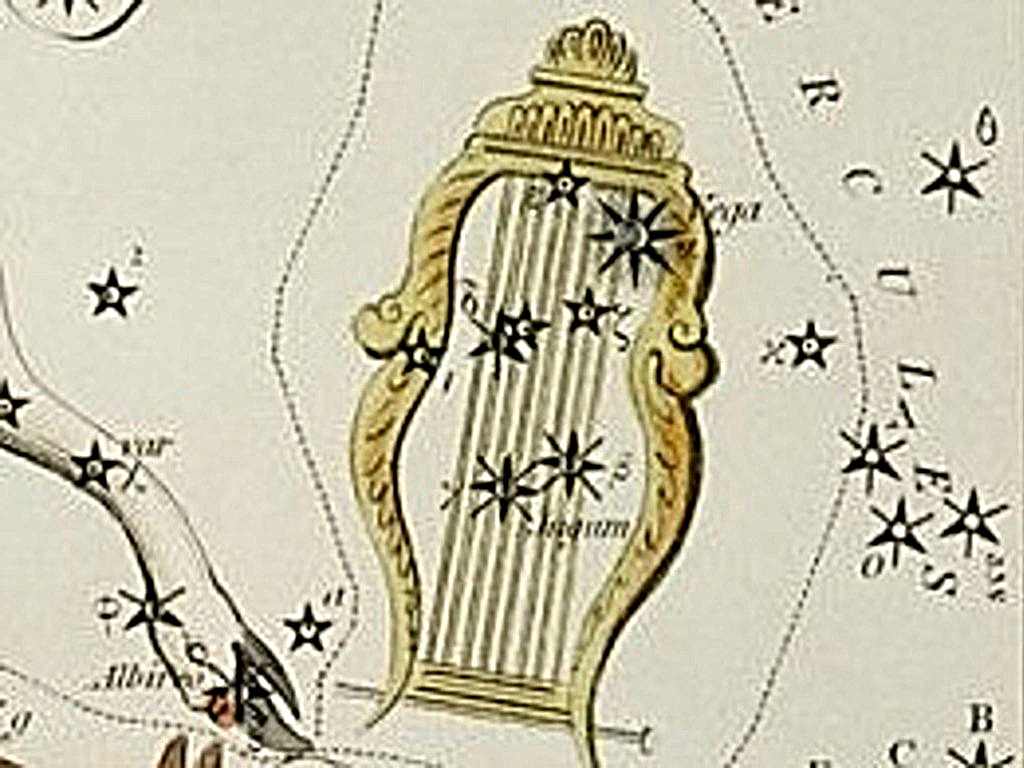
Lyra constellation map courtesy of Openverse
Lyra, “The Harp/Lyre” – The Lyra constellation is located in the northern hemisphere, and symbolizes “the harp or lyre.” Lyra symbolizes the lyre, a stringed musical instrument that was utilized in ancient and later periods. This constellation is linked to the legend of the Greek musician and poet Orpheus. It was initially catalogued by the astronomer Ptolemy during the 2nd century. Lyra features Vega, which is the fifth brightest star in the sky and the second brightest star in the northern hemisphere, along with the well-known variable star RR Lyrae. Additionally, it hosts several remarkable deep sky objects, such as the globular cluster Messier 56, the planetary nebula Messier 57 (commonly known as the Ring Nebula), the merging triplet of galaxies NGC 6745, and the open cluster NGC 6791.

Photo by NASA Hubble Space Telescope on Unsplash
Key points regarding Lyra:
- Meaning: The term “Lyra” translates to “The Harp/Lyre” in Latin. The constellation Lyra contains Vega, designated as Alpha Lyrae, which ranks as the 5th brightest star in the night sky, exhibiting an apparent magnitude of 0.03. This constellation comprises six stars that have been formally named. The names of the stars that have received approval from the International Astronomical Union (IAU) include Aladfar, Sheliak, Sulafat, Vega, Xihe, and Chasoň. Lyra is home to two Messier objects – Messier 56 (M56, NGC 6779) and Messier 57 (M57, NGC 6720, known as the Ring Nebula) – and features nine stars that are known to have planets. Additionally, there are three meteor showers linked to this constellation: the Lyrids, which reach their peak around April 21-22 each year, the June Lyrids, and the Alpha Lyrids.
- Notable stars: Vega, the brightest star in the Lyra constellation, has an apparent magnitude of 0.03, making it the fifth brightest star in the night sky. It is 25.04 light years away and was the first star outside the Sun to be photographed. Vega is a white dwarf, about 455 million years old, and could have a Jupiter-sized planet. Gamma Lyrae, with an apparent magnitude of 3.261, is the second brightest in the constellation, while Beta Lyrae is a variable double star system with an apparent magnitude of 3.52. R Lyrae is a red giant, and Delta Lyrae consists of a binary star system and a red bright giant. Epsilon Lyrae, known as the Double Double, is a multiple star system that appears as two stars and can form into pairs when observed closely. RR Lyrae is a variable star in the Lyra constellation known as a prototype for RR Lyrae variables, which are used to measure galactic distances due to their periodic pulsations. It is about 860 light years away and has an average apparent magnitude of 7.195. DM Lyrae is a dwarf nova with periodic outbursts, the last significant one in 1996. Kappa Lyrae is an orange giant located 238 light years away, while Mu Lyrae is a white subgiant about 439 light years distant. Gliese 758, a yellow dwarf similar to the Sun, is 51.4 light years away and has a substellar companion. Gliese 747AB consists of two red dwarfs located 26.5 light years from the Sun.
- Other features: Messier 56 is a globular cluster in Lyra, located around 32,900 light years from Earth, with an apparent magnitude of 8.3. Discovered by Charles Messier in 1779, it spans about 84 light years and contains stars mostly of 13th magnitude. The Ring Nebula, or Messier 57, is a well-known planetary nebula also in Lyra, approximately 2,300 light years away. It formed from a red giant star and is popular with amateur astronomers. NGC 6791 is an open cluster about 13,300 light years distant and is roughly 8 billion years old. NGC 6745 is an irregular galaxy composed of colliding galaxies, while IC 1296 is a barred spiral galaxy, 221 million light years away.
- Mythology: Lyra represents the lyre of Orpheus, a musician and poet from Greek mythology, who was killed by the Bacchantes. After his death, his lyre was thrown into a river, and Zeus sent an eagle to retrieve it, placing them both in the sky. Orpheus was the son of King Oeagrus and the muse Calliope. Apollo gifted him a golden lyre, while his mother taught him to write poetry. He was famous for his enchanting music, his journey to save his wife Eurydice from the underworld, and for being the harpist of Jason and the Argonauts. His music helped the Argonauts escape danger from the Sirens, who lured sailors to their doom. Eurydice died after being bitten by vipers while escaping a satyr. Grief-stricken, Orpheus played music that moved the gods, who advised him to retrieve her from the underworld. Hades and Persephone agreed to release her on the condition that he did not look back until they reached the surface. Tragically, he turned too soon, and Eurydice vanished forever. Orpheus was ultimately killed by the Maenads for not honoring Dionysus. His lyre became part of the constellation Lyra, often shown as a vulture or eagle carrying the lyre. In Wales, this constellation is known as King Arthur’s Harp or King David’s Harp.
- Visibility: Lyra is the 52nd largest constellation, covering 286 square degrees. It is situated in the fourth quadrant of the northern hemisphere (NQ4) and is visible at latitudes ranging from +90° to -40°. The constellations that border it include Cygnus, Draco, Hercules, and Vulpecula. The name of the constellation, Lyra, is pronounced /ˈlaɪrə/. In English, it is referred to as the Lyre. The genitive form of Lyra, which is utilized in the naming of stars, is Lyrae (pronunciation: /ˈlaɪriː/). The three-letter abbreviation, which was established by the International Astronomical Union (IAU) in 1922, is Lyr. Lyra is part of the Hercules family of constellations, which also includes Aquila, Ara, Centaurus, Corona Australis, Corvus, Crater, Crux, Cygnus, Hercules, Hydra, Lupus, Ophiuchus, Sagitta, Scutum, Sextans, Serpens, Triangulum Australe, and Vulpecula.
⁺‧₊☽◯☾₊‧⁺⋆⁺‧₊☽◯☾₊‧⁺⋆⁺‧₊☽◯☾₊‧⁺⋆⁺‧₊☽◯☾₊‧⁺⋆⁺‧₊☽◯☾₊‧⁺⋆⁺‧₊☽◯☾₊‧⁺⋆
Constellations:
| Constellations by Month | ||
| JANUARY [8] | FEBRUARY [7] | MARCH [7] |
| Taurus | Camelopardalis | Ursa Major |
| Orion | Auriga | Cancer |
| Lepus | Gemini | Canis Minor |
| Caelum | Monoceros | Pyxis |
| Reticulum | Canis Major | Vela |
| Dorado | Columba | Carina |
| Pictor | Puppis | Volans |
| Mensa | ||
| APRIL [8] | MAY [7] | JUNE [6] |
| Ursa Major | Canes Venatici | Ursa Minor |
| Leo Minor | Coma Berenices | Boötes |
| Leo | Virgo | Libra |
| Sextans | Corvus | Lupus |
| Crater | Centaurus | Circinus |
| Hydra | Crux | Apus |
| Antlia | Musca | |
| Chamaeleon | ||
| JULY [9] | AUGUST [9] | SEPTEMBER [6] |
| Draco | Lyra | Cygnus |
| Corona Borealis | Vulpecula | Delphinus |
| Hercules | Sagitta | Equuleus |
| Serpens | Aquila | Capricornus |
| Ophiuchus | Scutum | Microscopium |
| Scorpius | Sagittarius | Indus |
| Norma | Corona Australis | |
| Ara | Telescopium | |
| Triangulum Australe | Pavo | |
| OCTOBER [7] | NOVEMBER [8] | DECEMBER [6] |
| Cepheus | Cassiopeia | Perseus |
| Lacerta | Andromeda | Triangulum |
| Pegasus | Pisces | Aries |
| Aquarius | Cetus | Eridanus |
| Piscis Austrinus | Sculptor | Fornax |
| Grus | Phoenix | Horologium |
| Octans | Tucana | |
| Hydrus | ||

Lyra from Sidney Hall’s (1831) astronomical chart illustration of the Lacerta, Cygnus, Lyra, Vulpecula and the Anser. Original from Library of Congress. Digitally enhanced by rawpixel.
Constellations of the Month:
August – Lyra
Material may be shared for personal and educational use, Share with family and friends. The material cannot be used in an educational setting whereby a “book fee” is charged in or above tuition costs, and the material here is being used without paying a licensing fee.. AI must file an application for use of such material.
| You May Also Like. . . | |
 NASA 1997 Liftoff Special |
 NASA Mission Patch Party |
More on Versatileer:
![National Women's Day '23.jpg]()
International Women's Day Celebration – 2023
03/09/2023![Never Forget...The Massive Oak Lawn Tornado – Peak of the Tornado Season is Now]()
Never Forget...The Massive Oak Lawn Tornado – Peak of the Tornado Season is Now
04/22/2021![Play, Create, Connect Hobbies That Make Ordinary Days Better.jpg]()
Play, Create, Connect: Hobbies That Make Ordinary Days Better
12/30/2025![INSTA_HerFakeBoyfriend.png]()
Ends 07-31 – Her Fake Boyfriend by Heatherly Bell Book Blitz + $25 Amazon Gift Card Giveaway
07/22/2024![wp-17649764535907006471528994320458.jpg]()
Featured Photo + Video: The 25 Days of Christmas – Day 3: Yuletide at Arrowhead Drive, Orland Park
12/05/2025