Constellations of the Month: July – Ophiuchus:
We continue July with the next constellation of the month, Ophiuchus, “The Serpent Bearer.”

Ophiuchus constellation map courtesy of Openverse
Ophiuchus, “The Serpent Bearer” – Ophiuchus is and equatorial constellation located in both the northern and southern hemisphere, and symbolizes “the serpent bearer.” The constellation is linked to the figure of Asclepius, the renowned healer from Greek mythology. It was among the constellations initially catalogued by the Greek astronomer Ptolemy in the 2nd century. Occasionally, it is referred to by its Latin name, Serpentarius. Ophiuchus is typically illustrated as a man grasping a snake, which is represented by the adjacent constellation Serpens, divided into two sections by Ophiuchus: Serpens Caput, the head of the snake, and Serpens Cauda, the tail of the snake. The snake is often shown coiled around his waist. Despite Ophiuchus being one of the constellations that intersect the ecliptic and various efforts to classify it among the zodiac signs, it does not belong to the Zodiac family but rather to the Hercules family of constellations.
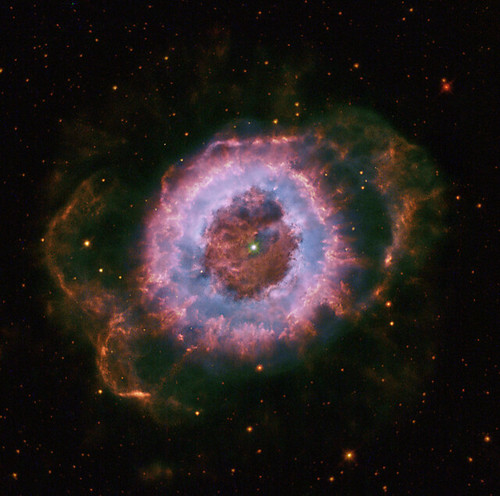
NGC 6369 ‘Little Ghost’ courtesy of Openverse
Key points regarding Ophiuchus:
- Meaning: The term “Ophiuchus” translates to “The Serpent Bearer” in Greek. The constellation Ophiuchus is home to many notable stars, including Rasalhague and Barnard’s Star, as well as deep sky objects like Kepler’s Supernova and various nebulae and globular clusters such as Messier 9 and Messier 10. The brightest star in Ophiuchus is Rasalhague, with a magnitude of 2.08. The constellation has four meteor showers: the Ophiuchids, Northern May Ophiuchids, Southern May Ophiuchids, and Theta Ophiuchids. Ophiuchus includes seven Messier objects and contains 13 named stars, with names recognized by the International Astronomical Union.
- Notable stars: Rasalhague is the brightest star in the constellation Ophiuchus, with an apparent magnitude of 2.07 and located about 48.6 light years from Earth. It is a binary system with a white giant primary star and an orange dwarf companion. The name Rasalhague means “the head of the serpent collector” in Arabic. The second brightest star, Sabik or Eta Ophiuchi, has a magnitude of 2.43 and is about 88 light years away. It is a binary star system composed of two white dwarfs. Zeta Ophiuchi, the third brightest, is a large blue main sequence star located roughly 366 light years from Earth and is predicted to eventually explode as a supernova. Delta Ophiuchi is the fourth brightest star, a red giant located approximately 171 light years away. Beta Ophiuchi, or Cebalrai, is the fifth brightest and an orange giant with a brightness of about 2.75. Kappa Ophiuchi is another orange giant and possibly a variable star, while Epsilon Ophiuchi is a yellow giant. Theta Ophiuchi is a multiple star system, and Marfik, or Lambda Ophiuchi, is a triple star system around 170 light years away. 67 Ophiuchi is a blue-white supergiant star, and 70 Ophiuchi is a binary system only 16.58 light years from the Sun. Chi Ophiuchi is a Be star with variations in brightness, while 36 Ophiuchi is a nearby triple system. Barnard’s Star is a nearby red dwarf, and GJ 1214 is another red dwarf hosting an extrasolar planet. RS Ophiuchi is a recurrent nova system, and COROT-6 is a yellow-white main sequence dwarf with a confirmed planet.
- Other features: Messier 9 is a globular cluster located about 25,800 light years from Earth, with an apparent magnitude of 8.42, first discovered by Charles Messier in 1764. Messier 10, also discovered in 1764, is around 14,300 light years away and has a brighter magnitude of 6.4, completing an orbit around the Milky Way every 140 years. Messier 12, another cluster from the same year, is 15,700 light years away with a magnitude of 7.68. Messier 14 spans about 100 light years and has a visual magnitude of 8.32, containing many stars. Messier 19, discovered in June 1764, is 28,700 light years away with a magnitude of 7.47. Messier 62 and Messier 107, discovered in 1771 and 1782 respectively, are also noted for their distances and magnitudes. Kepler’s Supernova was observed in 1604 at a distance of 20,000 light years. Other notable objects include the ultraluminous Starfish Galaxy, dark molecular cloud Barnard 68, and various nebulae like the Emerald Nebula and Little Ghost Nebula. The Dark Horse Nebula and Pipe Nebula are large dark regions in the sky, while the Snake Nebula is an S-shaped feature within it. M2-9, or the Twin Jet nebula, is a planetary nebula featuring twin lobes, and the Rho Ophiuchi cloud complex is important for star formation. NGC 6633 and Palomar 6 are mentioned as open clusters and globular clusters of interest.
- Mythology: Ophiuchus is linked to Asclepius, a character from Greek mythology who could revive the dead with his healing powers. This ability came from observing a snake that brought a healing herb to another snake, which was then used to resurrect Glaucus, the son of King Minos of Crete, after he drowned. Asclepius was raised by Chiron, a wise centaur, who taught him healing skills. He also received special blood from the Gorgon Medusa, capable of bringing the dead back to life. Asclepius once resurrected Hippolytus, the son of Theseus, who had died in an accident. However, Zeus killed Asclepius out of fear that humanity would become immortal through his healing. Following his death, Zeus honored him by placing his image in the sky as the constellation Ophiuchus, the Serpent Bearer. Ophiuchus may have origins linked to a Babylonian serpent-god, though this is not confirmed. The constellation is mentioned in John Milton’s “Paradise Lost. “
- Visibility: Ophiuchus is the 11th largest constellation, covering 948 square degrees. It is classified among the 15 equatorial constellations. Positioned in the third quadrant of the southern hemisphere (SQ3), it is observable at latitudes ranging from +80° to -80°. The constellations that border it include Aquila, Hercules, Libra, Sagittarius, Scorpius, and Serpens. Ophiuchus is pronounced /ˌɒfiːˈjuːkəs/ (off-ee-YOO-cuss). In the English language, this constellation is referred to as the Serpent Bearer. The genitive form of Ophiuchus, which is utilized in the naming of stars, is Ophiuchi (pronunciation: /ˌɒfiˈjuːkaɪ/). The three-letter abbreviation, which was officially adopted by the International Astronomical Union (IAU) in 1922, is Oph.
⁺‧₊☽◯☾₊‧⁺⋆⁺‧₊☽◯☾₊‧⁺⋆⁺‧₊☽◯☾₊‧⁺⋆⁺‧₊☽◯☾₊‧⁺⋆⁺‧₊☽◯☾₊‧⁺⋆⁺‧₊☽◯☾₊‧⁺⋆
Constellations:
| Constellations by Month | ||
| JANUARY [8] | FEBRUARY [7] | MARCH [7] |
| Taurus | Camelopardalis | Ursa Major |
| Orion | Auriga | Cancer |
| Lepus | Gemini | Canis Minor |
| Caelum | Monoceros | Pyxis |
| Reticulum | Canis Major | Vela |
| Dorado | Columba | Carina |
| Pictor | Puppis | Volans |
| Mensa | ||
| APRIL [8] | MAY [7] | JUNE [6] |
| Ursa Major | Canes Venatici | Ursa Minor |
| Leo Minor | Coma Berenices | Boötes |
| Leo | Virgo | Libra |
| Sextans | Corvus | Lupus |
| Crater | Centaurus | Circinus |
| Hydra | Crux | Apus |
| Antlia | Musca | |
| Chamaeleon | ||
| JULY [9] | AUGUST [9] | SEPTEMBER [6] |
| Draco | Lyra | Cygnus |
| Corona Borealis | Vulpecula | Delphinus |
| Hercules | Sagitta | Equuleus |
| Serpens | Aquila | Capricornus |
| Ophiuchus | Scutum | Microscopium |
| Scorpius | Sagittarius | Indus |
| Norma | Corona Australis | |
| Ara | Telescopium | |
| Triangulum Australe | Pavo | |
| OCTOBER [7] | NOVEMBER [8] | DECEMBER [6] |
| Cepheus | Cassiopeia | Perseus |
| Lacerta | Andromeda | Triangulum |
| Pegasus | Pisces | Aries |
| Aquarius | Cetus | Eridanus |
| Piscis Austrinus | Sculptor | Fornax |
| Grus | Phoenix | Horologium |
| Octans | Tucana | |
| Hydrus | ||

ophiuchus courtesy of Openverse
Constellations of the Month:
July – Ophiuchus
Material may be shared for personal and educational use, Share with family and friends. The material cannot be used in an educational setting whereby a “book fee” is charged in or above tuition costs, and the material here is being used without paying a licensing fee.. AI must file an application for use of such material.
| You May Also Like. . . | |
 NASA 1997 Liftoff Special |
 NASA Mission Patch Party |
More on Versatileer:
![20251106_061903_.jpg]()
Photos: Full Beaver Super Moon on November 5th
11/23/2025![Memorial Day Ceremony - North Africa American Cemetery and Memorial - May 31, 2010.jpg]()
Happy Memorial Day – 2025
05/26/2025![wp-17064041730071560965252650940995.jpg]()
Featured Photo: Valentine's Flower of the Day '24 – Bouquet #2
02/03/2024![close-up-of-dark-raisins-12945019 raisin_1679804570.jpeg Oleksandr Pidvalnyi at Pexels]()
Happy National Chocolate Covered Raisin Day – 2023
03/25/2023![Image 2 Professor Cane.jpg]()
Ends 11-22 – Professor Cane by Aurelia Yates Book Blitz + $10 Amazon Gift Card Giveaway
11/19/2023