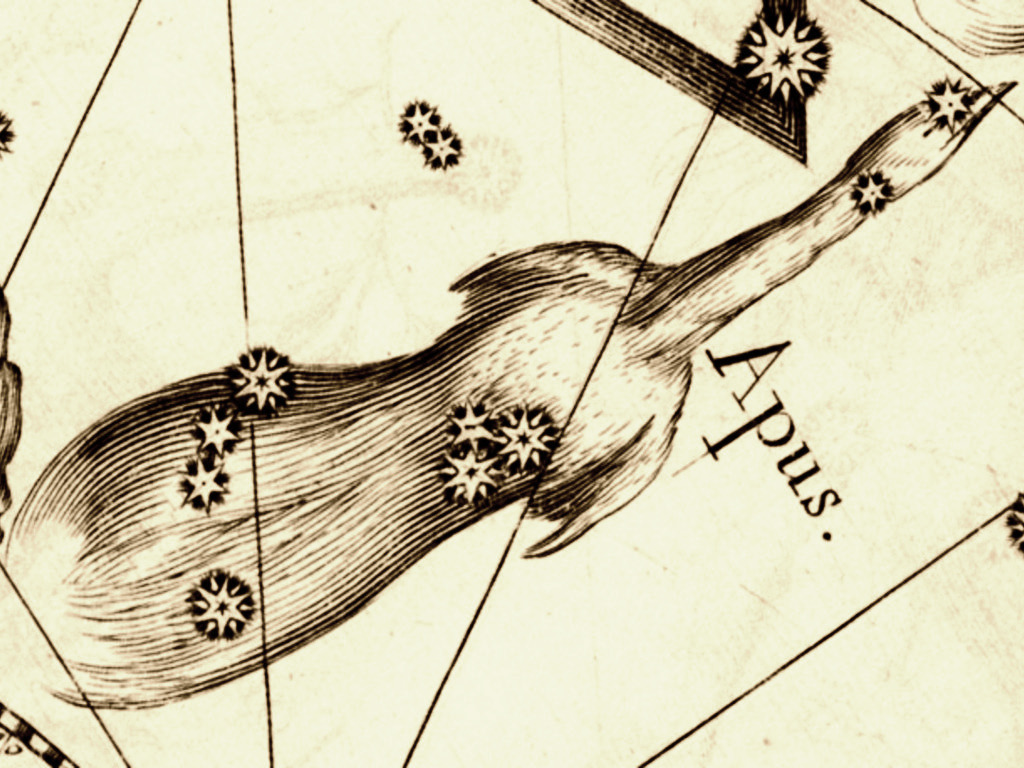
Constellations of the Month: June – Apus:
We continue June with the last constellation of the month, Apus, “Footless Bird of Paradise.”
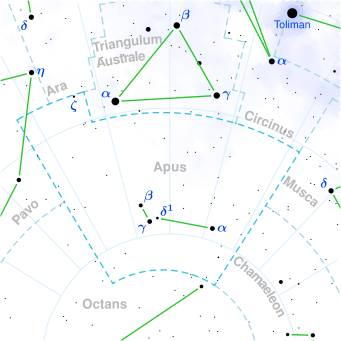
Apus constellation map courtesy of Openverse
Apus, “Footless Bird of Paradise” – The Apus constellation is located in the southern hemisphere, and symbolizes “footless bird of paradise.” The name of the constellation is derived from the Greek word apous, which means “footless.” Birds of paradise were once believed to lack feet. The constellation Apus was created by the Dutch astronomer and cartographer Petrus Plancius based on the observations of Dutch navigators Pieter Dirkszoon Keyser and Frederick de Houtman. It first appeared on a 1598 celestial globe published by Plancius and the cartographer Jodocus Hondius in Amsterdam. Apus is home to two notable deep sky objects: the globular clusters NGC 6101 and IC 4499. The constellation also contains the faint galaxies IC 4633 and IC 4635, and it hosts the gravitationally lensed Sunburst Arc galaxy, the home of the Godzilla star.

Hen 2-131 courtesy of Openverse
Key points regarding Apus:
- Meaning: The term “Apus” translates to “Footless Bird of Paradise” in Greek. The constellation Apus has two stars with known exoplanets: HD 134606, which has five orbiting planets, and HD 137388, also called Karaka, which has one. The brightest star in Apus is Paradys (Alpha Apodis) with a magnitude of 3.825. The nearest star is HD 128400, located 66.36 light years away. There are no stars in Apus brighter than magnitude 3.00 or within 10 parsecs of Earth. Apus is part of a group of constellations created in the late 16th century and has no Messier objects or meteor showers. The best time to see Apus is in July around 9 pm.
- Notable stars: Apus contains 39 stars, all dimmer than magnitude 6.5, with Alpha Apodis being the brightest at magnitude 3.825, located 430 light-years away and recently named Paradys. It is a K-type orange giant, much larger and brighter than the Sun. Gamma Apodis is the second brightest, a yellow giant found 150 light-years away, known for emitting strong X-rays. Beta Apodis is a K-type giant at 149 light-years with a magnitude of 4.24. Delta Apodis includes two stars, Delta1 and Delta2, which vary in brightness and can be seen with the naked eye. Zeta Apodis is another orange giant shining at magnitude 4.78 and is close to the Southern Triangle star Atria. Eta Apodis is a young A-type star with a dusty disk, and Epsilon Apodis is a hot blue star 640 light-years away. Other notable stars include R Apodis, a constant brightness orange giant, Iota Apodis, a binary star system, Kappa Apodis, which includes two star systems, and Theta Apodis, a variable red giant. S Apodis is a distant carbon star, while HD 137388 and HD 134606 host exoplanets. Godzilla is a recently discovered variable star, thought to be the most luminous ever observed.
- Other features: Apus does not have any bright deep sky objects visible with binoculars and lacks items from the Messier and Caldwell catalogues. It contains one object from the Herschel 400 catalogue, the globular cluster NGC 6101, located 47,600 light-years away. NGC 6101 has an apparent magnitude of 9 and is best viewed with larger telescopes. It is loosely packed with stars and does not show mass segregation, suggesting it is less evolved than typical globular clusters. It was discovered in 1826 and has an estimated age of 12.54 billion years. IC 4499, another globular cluster, is located 50,000 light-years away and is 7.6 arcminutes across with a magnitude of 9.76. This cluster is the closest to the south celestial pole and has an age of 12 billion years. IC 4633 and IC 4635 are faint spiral galaxies discovered in 1900. NGC 6392, also a spiral galaxy, is found about 175 million light-years away. The Sunburst Galaxy, at 10.9 billion light-years, is gravitationally lensed and shows multiple images. Lastly, Henize 2-131 is a planetary nebula discovered in 1950, located 7,176 light-years away, resembling the Spirograph Nebula.
- Mythology: There are no myths associated with the constellation. Apus is a faint constellation in the southern sky, mostly unseen by those in the northern hemisphere. It was unknown to European explorers until the Age of Discovery when navigators began mapping the southern region. The constellation was derived from observations made by Dutch explorers Pieter Dirkszoon Keyser and Frederick de Houtman during their expeditions in the late 16th century. Keyser began mapping the southern skies but did not survive his journey. De Houtman returned with star charts and made additional observations during his captivity in Sumatra. Initially named De Paradijs Voghel, the name evolved through various languages and translations. Despite confusion regarding its name, Apus was officially adopted by astronomer Nicolas Louis de Lacaille in 1763. The constellation is also linked to other celestial figures like the fly and octant.
- Visibility: Apus is the 67th largest constellation, covering 206 square degrees in the distant southern sky. It is positioned in the third quadrant of the southern hemisphere (SQ3) and is observable from locations situated between the latitudes of +5° and -90°. The constellations that border Apus include Ara, Chamaeleon, Circinus, Musca, Octans, Pavo, and Triangulum Australe. The name of the constellation, Apus, is pronounced /ˈeɪpəs/. The genitive form of Apus, which is utilized in the naming of stars, is Apodis (pronunciation: /ˈæpoʊdɪs/). The three-letter abbreviation, which was officially adopted by the International Astronomical Union (IAU) in 1922, is Aps.
⁺‧₊☽◯☾₊‧⁺⋆⁺‧₊☽◯☾₊‧⁺⋆⁺‧₊☽◯☾₊‧⁺⋆⁺‧₊☽◯☾₊‧⁺⋆⁺‧₊☽◯☾₊‧⁺⋆⁺‧₊☽◯☾₊‧⁺⋆
Constellations:
| Constellations by Month | ||
| JANUARY [8] | FEBRUARY [7] | MARCH [7] |
| Taurus | Camelopardalis | Ursa Major |
| Orion | Auriga | Cancer |
| Lepus | Gemini | Canis Minor |
| Caelum | Monoceros | Pyxis |
| Reticulum | Canis Major | Vela |
| Dorado | Columba | Carina |
| Pictor | Puppis | Volans |
| Mensa | ||
| APRIL [8] | MAY [7] | JUNE [6] |
| Ursa Major | Canes Venatici | Ursa Minor |
| Leo Minor | Coma Berenices | Boötes |
| Leo | Virgo | Libra |
| Sextans | Corvus | Lupus |
| Crater | Centaurus | Circinus |
| Hydra | Crux | Apus |
| Antlia | Musca | |
| Chamaeleon | ||
| JULY [9] | AUGUST [9] | SEPTEMBER [6] |
| Draco | Lyra | Cygnus |
| Corona Borealis | Vulpecula | Delphinus |
| Hercules | Sagitta | Equuleus |
| Serpens | Aquila | Capricornus |
| Ophiuchus | Scutum | Microscopium |
| Scorpius | Sagittarius | Indus |
| Norma | Corona Australis | |
| Ara | Telescopium | |
| Triangulum Australe | Pavo | |
| OCTOBER [7] | NOVEMBER [8] | DECEMBER [6] |
| Cepheus | Cassiopeia | Perseus |
| Lacerta | Andromeda | Triangulum |
| Pegasus | Pisces | Aries |
| Aquarius | Cetus | Eridanus |
| Piscis Austrinus | Sculptor | Fornax |
| Grus | Phoenix | Horologium |
| Octans | Tucana | |
| Hydrus | ||
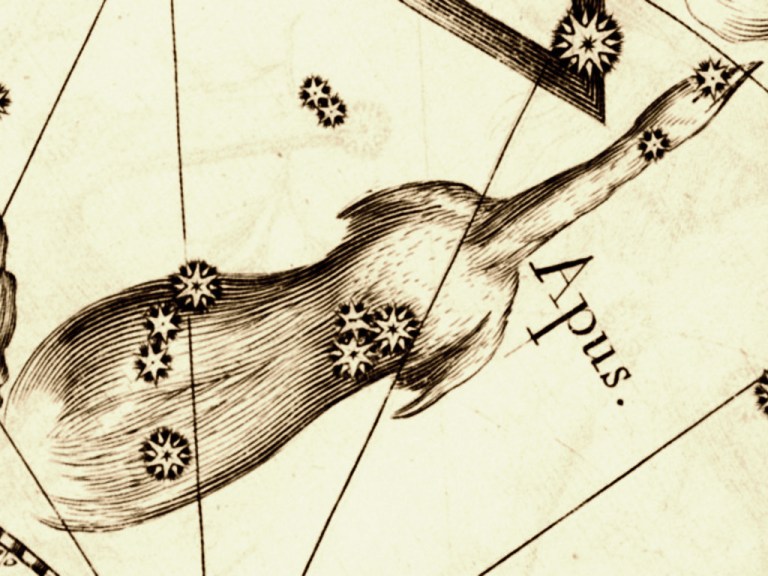
Apus constellation map courtesy of Openverse
Constellations of the Month:
June – Apus
Material may be shared for personal and educational use, Share with family and friends. The material cannot be used in an educational setting whereby a “book fee” is charged in or above tuition costs, and the material here is being used without paying a licensing fee.. AI must file an application for use of such material.
| You May Also Like. . . | |
 NASA 1997 Liftoff Special |
 NASA Mission Patch Party |