Constellations of the Month: May – Virgo:
We continue May with the next constellation of the month, Virgo, “The Virgin.”
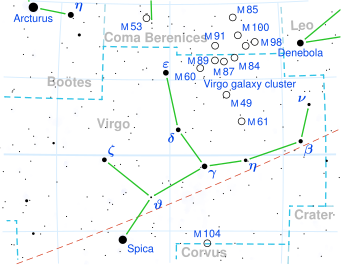
Virgo constellation map courtesy of Openverse
Virgo, “The Virgin” – Virgo is an equatorial constellation located in both the northern and southern hemispheres, and symbolizes “the virgin.” Virgo is represented by the symbol ♍ and is one of the 12 zodiac constellations. The Greek astronomer Ptolemy first catalogued it in the 2nd century. Virgo contains Spica, one of the brightest stars, and the autumn equinox point near Beta Virginis. It is the second largest constellation, with only Hydra being larger. Notable deep sky objects in Virgo include Messier 49, Messier 58, Messier 59, Messier 60, Messier 87, the Sombrero Galaxy, the Eyes Galaxies, the Siamese Twins, and the quasar 3C 273.

Messier 90 – HST courtesy of Openverse
Key points regarding Virgo:
- Meaning: The term “Virgo” translates to “The Virgin” in Latin. The constellation Virgo has 20 stars with known planets, the most of any constellation. Its brightest star is Spica, Alpha Virginis, with a magnitude of 0.98. The constellation has 17 named stars officially recognized by the International Astronomical Union, including Elgafar, Flegetonte, and Zaniah. There are also two meteor showers linked to Virgo: the Virginids and the Mu Virginids.
- Notable stars: Spica is the brightest star in Virgo and the 15th brightest star in the sky, with an apparent magnitude of 1.04. It is a rotating ellipsoidal variable star in a close binary system where the stars do not eclipse each other. The name Spica means “Virgo’s ear of grain” in Latin and it is located approximately 260 light years away. Spica is a blue giant star, with the primary star being about 12,100 times brighter than the Sun. It experiences spectral line shifts due to the Struve-Sahade effect and is also a Beta Cephei type variable star, changing brightness due to pulsations. To locate Spica, find the Big Dipper and follow its handle and “arc” to Arcturus in the constellation Boötes, then continue the same “arc” or “spike” to Spica. Zavijava, or Beta Virginis, is a star 35.65 light years away, translated as “the corner of the barking dog.” Porrima, or Gamma Virginis, is a binary star about 38.1 light years away, connected to prophecies, and is part of the Barker asterism. Delta Virginis, a red giant about 198 light years away, is a high-velocity star that fluctuates in brightness. Epsilon Virginis, or Vindemiatrix, is the third brightest in Virgo at a distance of 109.6 light years. Other notable stars include Zeta Virginis, Eta Virginis, Iota Virginis, Mu Virginis, and Chi Virginis, each with their own distances and magnitudes. Each star has unique characteristics, including potential planets in their orbits.
- Other features: The Virgo Cluster is a galaxy cluster located about 53. 8 million light years from Earth, in the constellations Coma Berenices and Virgo. It contains around 1300 to 2000 galaxies. The brightest galaxy, Messier 49, was discovered in 1771 and features a supermassive black hole. Other notable galaxies include Messier 58, 59, 60, 61, 84, and 86. Each galaxy has distinct characteristics, such as supernova discoveries and variations in distance and brightness. Messier 87 is a supergiant elliptical galaxy in the Virgo Cluster, discovered in 1781. It is 53. 5 million light years away and has a visual magnitude of 9. 59. M87 is notable for its supermassive black hole, named Pōwehi, which was the first black hole to be directly imaged in 2017. Messier 89, another elliptical galaxy, is about 50 million light years distant with a visual magnitude of 10. 73 and has many globular clusters. Messier 90, a spiral galaxy about 58. 7 million light years away, appears anemic due to its environment. Other galaxies mentioned include Messier 104, the Eyes Galaxies, NGC 4216, NGC 4567 and NGC 4568, NGC 4526, NGC 4261, and 3C 273, each with unique characteristics and distances within the Virgo Cluster.
- Mythology: The constellation Virgo is linked to the Greek goddess of justice, Dike, who is the daughter of Zeus and the Titaness Themis. She is often shown with angel-like wings and an ear of wheat in her left hand, alongside the bright star Spica. Virgo is next to Libra, which symbolizes justice. Dike, also known as Astraeia, lived during the Golden Age, a time of peace and prosperity for humans. After Zeus’s rise, the Silver Age began, leading to a decline in human values. Dike warned humans of their path and eventually left Earth for the heavens as conflict arose. Virgo is also related to other figures like Demeter and Tyche; Spica translates to “the ear of grain” in Latin, representing Dike’s connection to agriculture.
- Visibility: Virgo is the 2nd largest constellation, covering 1294 square degrees. It is one of 15 equatorial constellations, and visible between latitudes +80° and -80°. Neighboring constellations include Boötes, Coma Berenices, and others. The name Virgo is pronounced /ˈvɜːrɡoʊ/, translating to the Maiden in English, and its genitive form is Virginis. The IAU standardized the three-letter abbreviation as Vir. Virgo is part of the Zodiac family and contains eleven Messier objects, including Messier 49, Messier 58, and the Sombrero Galaxy (M104).
⁺‧₊☽◯☾₊‧⁺⋆⁺‧₊☽◯☾₊‧⁺⋆⁺‧₊☽◯☾₊‧⁺⋆⁺‧₊☽◯☾₊‧⁺⋆⁺‧₊☽◯☾₊‧⁺⋆⁺‧₊☽◯☾₊‧⁺⋆
Constellations:
| Constellations by Month | ||
| JANUARY [8] | FEBRUARY [7] | MARCH [7] |
| Taurus | Camelopardalis | Ursa Major |
| Orion | Auriga | Cancer |
| Lepus | Gemini | Canis Minor |
| Caelum | Monoceros | Pyxis |
| Reticulum | Canis Major | Vela |
| Dorado | Columba | Carina |
| Pictor | Puppis | Volans |
| Mensa | ||
| APRIL [8] | MAY [7] | JUNE [6] |
| Ursa Major | Canes Venatici | Ursa Minor |
| Leo Minor | Coma Berenices | Boötes |
| Leo | Virgo | Libra |
| Sextans | Corvus | Lupus |
| Crater | Centaurus | Circinus |
| Hydra | Crux | Apus |
| Antlia | Musca | |
| Chamaeleon | ||
| JULY [9] | AUGUST [9] | SEPTEMBER [6] |
| Draco | Lyra | Cygnus |
| Corona Borealis | Vulpecula | Delphinus |
| Hercules | Sagitta | Equuleus |
| Serpens | Aquila | Capricornus |
| Ophiuchus | Scutum | Microscopium |
| Scorpius | Sagittarius | Indus |
| Norma | Corona Australis | |
| Ara | Telescopium | |
| Triangulum Australe | Pavo | |
| OCTOBER [7] | NOVEMBER [8] | DECEMBER [6] |
| Cepheus | Cassiopeia | Perseus |
| Lacerta | Andromeda | Triangulum |
| Pegasus | Pisces | Aries |
| Aquarius | Cetus | Eridanus |
| Piscis Austrinus | Sculptor | Fornax |
| Grus | Phoenix | Horologium |
| Octans | Tucana | |
| Hydrus | ||

Sidney Hall’s (1831) astronomical chart illustration of the Virgo. Original from Library of Congress. Digitally enhanced by rawpixel. courtesy of Openverse
Constellations of the Month:
May – Virgo
Material may be shared for personal and educational use, Share with family and friends. The material cannot be used in an educational setting whereby a “book fee” is charged in or above tuition costs, and the material here is being used without paying a licensing fee.. AI must file an application for use of such material.
| You May Also Like. . . | |
 NASA 1997 Liftoff Special |
 NASA Mission Patch Party |
More on Versatileer:
![20231010_15_00__two_pac_2d0__Lidia.jpg]()
From the Satellite...Pacific Hurricane Category 4 Lidia on .GIPHY & Video + 2023 Season Info
05/05/2024![20231121_183734.jpg]()
Featured Photo: Happy Thanksgiving Day Photo 4: Gobble of a Children's Art Display of a Turkey and t...
11/23/2023![Adams Street Drawbridge Tower 1981]()
Featured Photo: Architecture, Part 3 – The Buildings of Chicago, Illinois – Adams Street Drawbridge ...
07/09/2021![Artemis I on Launch Pad.jpg]()
Successful Launch of Artemis I Mission to Moon – Cape Canaveral, Florida
11/16/2022![1672636016364.jpg]()
Featured Photo: The After Days of Christmas – Photo 6: Twofer: Yuletide Night turns to Day on 158th ...
01/01/2023