Constellations of the Month: March – Volans:
We continue March with the last constellation of the month, Volans, “The Flying Fish.”
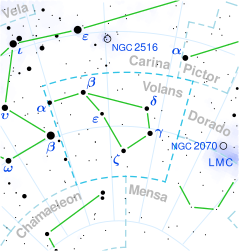
Volans constellation map courtesy of Openverse
Volans, “The Flying Fish” – Volans is a constellation in the southern sky that symbolizes “the flying fish” in Latin. It is one of the smallest constellations, symbolizing the flying fish. It has no myths associated with it and was established by Dutch astronomer Petrus Plancius in the late 16th century. Initially named Piscis Volans, it was later shortened to Volans. It includes notable deep sky objects, such as the Lindsay-Shapley Ring, the Meathook Galaxy, NGC 2397, and the galaxy cluster SMACS 0723.

Photo by NASA Hubble Space Telescope on Unsplash
Key points regarding Volans:
- Meaning: The term “Volans” translates to “The Flying Fish” in Latin. It is near the constellations Carina, Chamaeleon, Dorado, Mensa, and Pictor. Known as the Flying Fish, its name is pronounced /ˈvoʊlænz/, and its genitive form is Volantis. The brightest star is Beta Volantis, with a magnitude of 3.77, and Volans has one named star, Maru. It contains two stars with confirmed planets but no Messier objects or meteor showers.
- Notable stars: Beta Volantis is the brightest star in the Volans constellation, 107.5 light years from the Sun, with a magnitude of 3.77. Gamma Volantis is a binary star system about 142 light years away, with an orange giant and a yellow-white main sequence star. Zeta Volantis, another binary, is approximately 134 light years distant. Delta Volantis is a bright giant star at 660 light years away. Alpha Volantis is a chemically peculiar Am star, 125 light years away. Epsilon Volantis is a triple star system about 642 light years away. Theta Volantis is a white main sequence star at 239 light years. Eta Volantis is another triple system, around 356 light years distant. Kappa Volantis is about 393 light years away and consists of a blue-white giant and a white subgiant. Iota Volantis is a blue-white subgiant star at 558 light years. HD 76700 is a yellow dwarf, 194.6 light years from Earth, with a newly discovered planet.
- Other features: NGC 2397 is a spiral galaxy located 60 million light years away, with a magnitude of 12.68. It has old red and yellow stars in its center and new stars in its outer arms. Discovered by John Herschel in 1835, it hosted supernova SN 2006bc in 2006. AM0644-741 is an unbarred lenticular galaxy, 300 million light years away, with a magnitude of 13. 96. Its nucleus has a ring from a collision with another galaxy, featuring many hot blue stars. Discovered in 1960, it is known as Graham’s Ring Galaxy. NGC 2442 is an intermediate spiral galaxy about 50 million light years away, also discovered by John Herschel, with distortions likely from another galaxy. SMACS 0723 is a massive galaxy cluster, 4.24 billion light years away, acting as a gravitational lens for distant galaxies, observed by the James Webb Space Telescope. NGC 2434 is an elliptical galaxy in Volans, discovered by John Herschel in 1834, with a magnitude of 11.3.
- Mythology: Volans is one of the 12 constellations introduced by Dutch navigators Pieter Dirkszoon Keyser and Frederick de Houtman in the late 16th century. It first appeared on Petrus Plancius’ globe in 1598, where it was called Vliegendenvis. In 1603, Johann Bayer named it Piscis Volans in his star atlas, a name used until the mid-19th century when John Herschel suggested shortening it to Volans. In 1845, Francis Baily confirmed the name Volans in his catalogue. Volans represents a flying fish that can glide through the air and is depicted as being chased by the Dorado constellation.
- Visibility: Volans is the 76th largest constellation, covering 141 square degrees in the southern sky and visible between latitudes +15° and -90°.
⁺‧₊☽◯☾₊‧⁺⋆⁺‧₊☽◯☾₊‧⁺⋆⁺‧₊☽◯☾₊‧⁺⋆⁺‧₊☽◯☾₊‧⁺⋆⁺‧₊☽◯☾₊‧⁺⋆⁺‧₊☽◯☾₊‧⁺⋆
Constellations:
| Constellations by Month | ||
| JANUARY [8] | FEBRUARY [7] | MARCH [7] |
| Taurus | Camelopardalis | Lynx |
| Orion | Auriga | Cancer |
| Lepus | Gemini | Canis Minor |
| Caelum | Monoceros | Pyxis |
| Reticulum | Canis Major | Vela |
| Dorado | Columba | Carina |
| Pictor | Puppis | Volans |
| Mensa | ||
| APRIL [8] | MAY [7] | JUNE [6] |
| Ursa Major | Canes Venatici | Ursa Minor |
| Leo Minor | Coma Berenices | Boötes |
| Leo | Virgo | Libra |
| Sextans | Corvus | Lupus |
| Crater | Centaurus | Circinus |
| Hydra | Crux | Apus |
| Antlia | Musca | |
| Chamaeleon | ||
| JULY [9] | AUGUST [9] | SEPTEMBER [6] |
| Draco | Lyra | Cygnus |
| Corona Borealis | Vulpecula | Delphinus |
| Hercules | Sagitta | Equuleus |
| Serpens | Aquila | Capricornus |
| Ophiuchus | Scutum | Microscopium |
| Scorpius | Sagittarius | Indus |
| Norma | Corona Australis | |
| Ara | Telescopium | |
| Triangulum Australe | Pavo | |
| OCTOBER [7] | NOVEMBER [8] | DECEMBER [6] |
| Cepheus | Cassiopeia | Perseus |
| Lacerta | Andromeda | Triangulum |
| Pegasus | Pisces | Aries |
| Aquarius | Cetus | Eridanus |
| Piscis Austrinus | Sculptor | Fornax |
| Grus | Phoenix | Horologium |
| Octans | Tucana | |
| Hydrus | ||
Constellations of the Month:
March –

volans courtesy of Openverse
Material may be shared for personal and educational use, Share with family and friends. The material cannot be used in an educational setting whereby a “book fee” is charged in or above tuition costs, and the material here is being used without paying a licensing fee.. AI must file an application for use of such material.
| You May Also Like. . . | |
 NASA 1997 Liftoff Special |
 NASA Mission Patch Party |




























I love learning about the stars.
Very interesting.. . so many wonders.