Constellations of the Month: March – Vela:
We continue March with the next constellation of the month, Vela, “The Sails.”
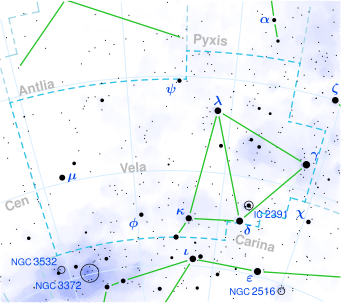
Vela constellation map courtesy of Openverse
Vela, “The Sails” – Vela is a constellation in the southern sky that symbolizes a sails. It represents the sails of the Argo Navis, the ship of Jason and the Argonauts on their quest for the Golden Fleece. It was part of the larger constellation Argo Navis, which was split into three smaller parts: Vela, Carina, and Puppis by Nicolas Louis de Lacaille in the 1750s. Vela includes many notable stars and deep sky objects like the Southern Ring Nebula and the Vela Supernova Remnant.
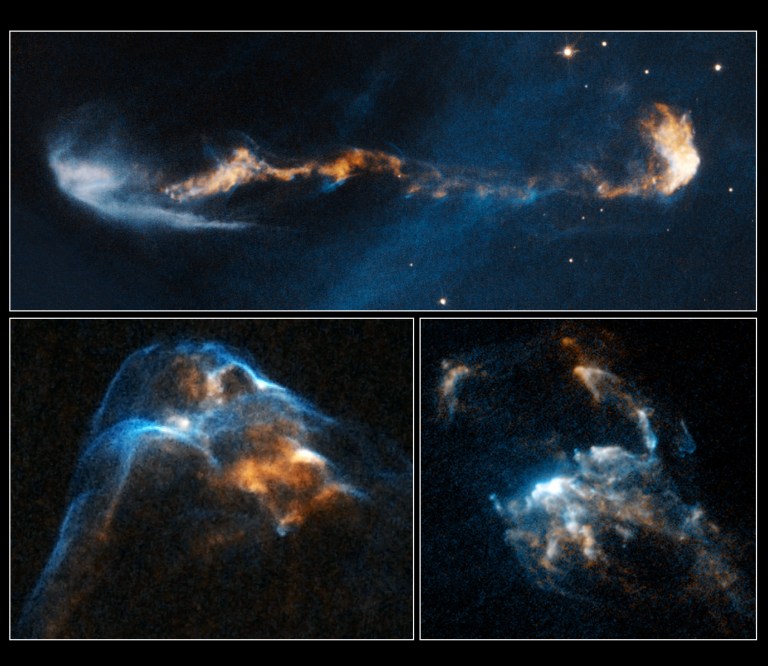
File:HH 47 HH 34 and HH 2 courtesy of Openverse
Key points regarding Vela:
- Meaning: The term “Vela” translates to “The Sails” in Latin. Vela is the 32nd largest constellation, spanning 500 square degrees, and is found in the second quadrant of the southern hemisphere. It can be seen at latitudes from +30° to -90° and is bordered by Antlia, Carina, Centaurus, Puppis, and Pyxis. Pronounced /ˈviːlə/, Vela translates to “the Sails” in English, with its genitive form being Velorum. The official abbreviation is Vel. Vela is part of the Heavenly Waters family of constellations. It has seven stars with known planets and no Messier objects, with Gamma Velorum as the brightest star. Vela has three meteor showers: Delta Velids, Gamma Velids, and Puppid-Velids. There are seven named stars in Vela, including Alsephina, Añañuca, Kalausi, Markeb, Natasha, Suhail, and Wattle.
- Notable stars: Gamma Velorum is the brightest star in the Vela constellation, with an apparent magnitude of 1.7. It is a multiple star system made up of at least six stars, located about 336 light years from Earth. Its traditional name, Suhail, means “the glorious (star) of the oath” in Arabic. The main star is a spectroscopic binary of a blue supergiant and a Wolf-Rayet star, which is a candidate for a future supernova. Gamma Velorum A and B are important components, with others being Gamma Velorum C, D, and E. Delta Velorum is the second brightest star, at a distance of 80.6 light years. It consists of two stars with an orbital period of 142 years. Delta Velorum A is a spectroscopic binary as well. Lambda Velorum, the third brightest star, is about 545 light years away and was named Suhail until 2016. It is an orange star and a slow variable.
- Other features: NGC 3132 is a bright planetary nebula in Vela, nearly half a light year wide, with an apparent magnitude of 9.87 and a distance of about 2,000 light years from the Sun. It is also known as the Eight-Burst Nebula due to its shape and the Southern Ring Nebula because it resembles the Ring Nebula. The James Webb Space Telescope first observed it in 2022. The nebula contains a 10th magnitude star and a 16th magnitude white dwarf emitting ultraviolet radiation. The Vela Supernova Remnant is a supernova remnant in Vela, approximately 815 light years away, with an apparent magnitude of 12. It includes the Pencil Nebula and is associated with the Vela Pulsar. NGC 2736, discovered by John Herschel in 1835, is part of the Vela Supernova Remnant. The Gum Nebula, spanning about 40 degrees, is associated with this remnant. Gum 19 is a star-forming region lit by the blue supergiant star V391 Velorum. NGC 2670 is an open cluster of around 50 moderately bright stars, and NGC 2899 is a planetary nebula discovered by John Herschel. NGC 2547 is an open cluster with stars estimated to be 20 to 35 million years old. NGC 3201 is an ancient globular cluster of about 10. 24 billion years, primarily composed of red giants. HH 47 is a Herbig-Haro object caused by a young star’s gas jets, while IC 2391 is a young open cluster visible without binoculars.
- Mythology: In mythology, Vela represents the sails of the Argo Navis, the ship Jason and the Argonauts used to find the Golden Fleece. The ship was named after Argus, its builder, and was said to be made with help from the goddess Athena. After their successful journey, Argo was dedicated to Poseidon and became a constellation. Vela was once part of the larger constellation Argo Navis, which included Puppis and Carina. In 1752, astronomer Nicolas Louis de Lacaille divided Argo Navis into these three constellations. Lacaille used one set of Greek letters for all, so Vela lacks Alpha or Beta stars, which are now in Carina.
- Visibility: The False Cross is an asterism created by the stars Alsephina (Delta Velorum), Markeb (Kappa Velorum), Aspidiske (Iota Carinae), and Avior (Epsilon Carinae) within the Carina constellation. It received the name “False Cross” due to its resemblance to the Southern Cross, a constellation commonly utilized in navigation to determine true south.
⁺‧₊☽◯☾₊‧⁺⋆⁺‧₊☽◯☾₊‧⁺⋆⁺‧₊☽◯☾₊‧⁺⋆⁺‧₊☽◯☾₊‧⁺⋆⁺‧₊☽◯☾₊‧⁺⋆⁺‧₊☽◯☾₊‧⁺⋆
Constellations:
| Constellations by Month | ||
| JANUARY [8] | FEBRUARY [7] | MARCH [7] |
| Taurus | Camelopardalis | Lynx |
| Orion | Auriga | Cancer |
| Lepus | Gemini | Canis Minor |
| Caelum | Monoceros | Pyxis |
| Reticulum | Canis Major | Vela |
| Dorado | Columba | Carina |
| Pictor | Puppis | Volans |
| Mensa | ||
| APRIL [8] | MAY [7] | JUNE [6] |
| Ursa Major | Canes Venatici | Ursa Minor |
| Leo Minor | Coma Berenices | Boötes |
| Leo | Virgo | Libra |
| Sextans | Corvus | Lupus |
| Crater | Centaurus | Circinus |
| Hydra | Crux | Apus |
| Antlia | Musca | |
| Chamaeleon | ||
| JULY [9] | AUGUST [9] | SEPTEMBER [6] |
| Draco | Lyra | Cygnus |
| Corona Borealis | Vulpecula | Delphinus |
| Hercules | Sagitta | Equuleus |
| Serpens | Aquila | Capricornus |
| Ophiuchus | Scutum | Microscopium |
| Scorpius | Sagittarius | Indus |
| Norma | Corona Australis | |
| Ara | Telescopium | |
| Triangulum Australe | Pavo | |
| OCTOBER [7] | NOVEMBER [8] | DECEMBER [6] |
| Cepheus | Cassiopeia | Perseus |
| Lacerta | Andromeda | Triangulum |
| Pegasus | Pisces | Aries |
| Aquarius | Cetus | Eridanus |
| Piscis Austrinus | Sculptor | Fornax |
| Grus | Phoenix | Horologium |
| Octans | Tucana | |
| Hydrus | ||

vela courtesy of Openverse
Constellations of the Month:
March – Vela
Material may be shared for personal and educational use, Share with family and friends. The material cannot be used in an educational setting whereby a “book fee” is charged in or above tuition costs, and the material here is being used without paying a licensing fee.. AI must file an application for use of such material.
| You May Also Like. . . | |
 NASA 1997 Liftoff Special |
 NASA Mission Patch Party |
More on Versatileer:
![California_OC 2.png]()
Photo of the Day: 11/29/19 – Scenic Daytime View From Northern View Of The Disneyland Hotel, Orange ...
11/29/2019![Mayflower II.jpg]()
Happy Forefathers' Day – 2024
12/23/2024![Ends 06-07 – Drink Wine and Be Beautiful by Kimberly Sullivan Book Blitz + $25 Amazon Gift Card Give...]()
Ends 06-07 – Drink Wine and Be Beautiful by Kimberly Sullivan Book Blitz + $25 Amazon Gift Card Give...
05/26/2023![Valentine's Day Flower of the Day '23 #4.jpg]()
Featured Photo: Valentine's Flower of the Day – Bouquet #4
02/14/2023![Featured Photo: Flower of the Day – The Nannyberry]()
Featured Photo: Flower of the Day – The Nannyberry
08/08/2022