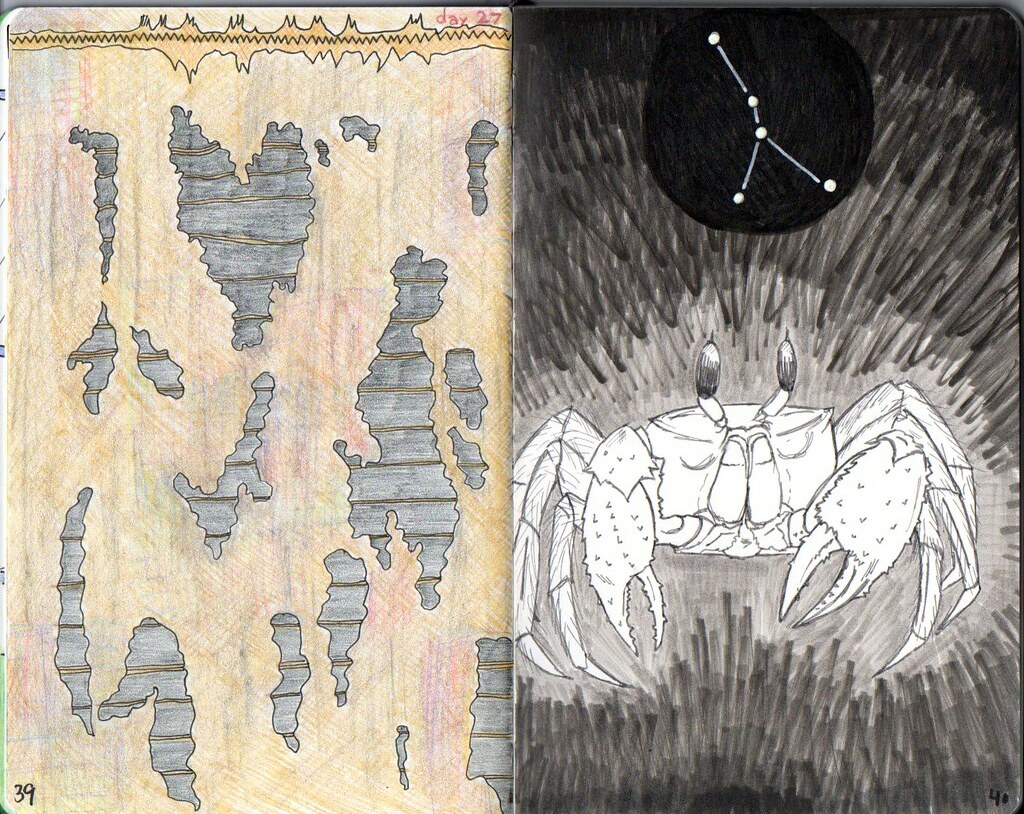
Constellations of the Month: March – Cancer:
We continue March with the next constellation of the month, Cancer, “The Crab.”

Cancer constellation map courtesy of Openverse
Cancer, “The Crab” – The Cancer constellation is located in the northern hemisphere, and symbolizes “the crab” in Latin. It is the faintest of the 12 zodiac constellations and is represented by the symbol ♋. The Greek astronomer Ptolemy first cataloged it in the 2nd century CE. In Greek mythology, Cancer represents the crab that Hera sent to defeat Heracles. The crab was either kicked into the sky or placed among the stars by Hera after being crushed. Cancer also includes notable deep sky objects like the Beehive Cluster and the interacting galaxies NGC 2535 and NGC 2536.
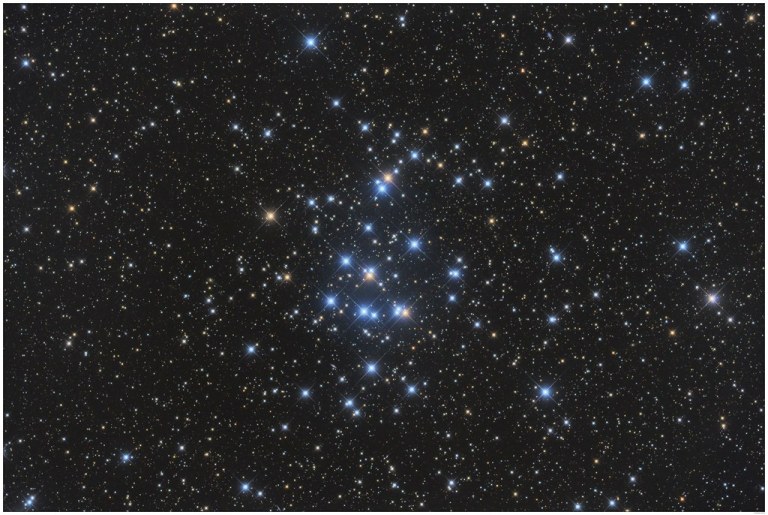
Messier 44 (M44) in Cancer, a northern skies jewel box star cluster courtesy of Openverse
Key points regarding Cancer:
- Meaning: The term “Cancer” translates to “The Crab” in Latin.
- Notable stars: Acubens, or Alpha Cancri, is the fourth brightest star in Cancer with a variable brightness between 4.20 and 4.27. It is a multiple star system about 174 light-years from Earth, with the main star being a white dwarf and having a faint companion. Acubens is part of a binary system itself and is much brighter than the Sun. Beta Cancri is the brightest star in Cancer, a binary system about 290 light years away. It includes an orange giant and a faint companion star, with its name deriving from Arabic meaning “the eye” or “the glance of Leo. ” Delta Cancri is the second brightest, an orange giant marking the Beehive Cluster, with a long Babylonian name meaning “the southeast star in the Crab. ” Gamma Cancri, another A-type star, has a connection to Greek mythology involving donkeys. 55 Cancri is known for having five confirmed exoplanets orbiting its main star. Zeta Cancri is a multiple star system with at least four stars. Lambda Cancri and Xi Cancri are other notable stars in Cancer, with Xi Cancri being a binary system.
- Other features: The Beehive Cluster, also known as Praesepe, is an open star cluster located about 577 light years from Earth. It is one of the closest and largest open clusters to our solar system, with an apparent magnitude of 3.7 and an age of around 600 million years. It can be seen without a telescope and was observed by Ptolemy and later Galileo. The cluster consists of at least a thousand stars, mostly red dwarfs and a significant number of Sun-like stars. Messier 67 is another open cluster and one of the oldest at an age between 3.2 and 5 billion years. Discovered by Johann Gottfried Koehler in 1779, it has an apparent magnitude of 6.1 and contains over 100 Sun-like stars. NGC 2775 is a spiral galaxy, around 55.5 million light years from Earth, with an apparent magnitude of 11. 03 and active star formation in its spiral arms. NGC 2535 and NGC 2536 are two interacting spiral galaxies in Cancer, with apparent magnitudes of 16.9 and 14.6, respectively. NGC 2608 is a barred spiral galaxy that spans 62,000 light years, with an apparent magnitude of 13.01 and is approximately 93 million light years away. Two supernovae were observed there in recent history.
- Mythology: In mythology, Cancer is linked to a crab that appears in the Twelve Labours of Heracles, known as the Hercules constellation. In the story, Hera sends the crab to distract Hercules while he fights the Lernaean Hydra, represented by the Hydra constellation. The crab is kicked by Hercules into the stars. In another version, the crab is crushed, but Hera, who opposes Hercules, puts it in the sky for its attempt. However, it is placed in a dim area without bright stars, as it failed in its task. Cancer has no stars brighter than fourth magnitude.
- Visibility: Cancer is the 31st largest constellation, covering 506 square degrees in the northern hemisphere, visible at latitudes from +90° to -60°. It is bordered by Canis Minor, Gemini, Hydra, Leo, Leo Minor, and Lynx. In English, it is called the Crab, pronounced /ˈkænsər/, and its genitive form is Cancri (/ˈkæŋkraɪ/). Its three-letter abbreviation is Cnc, established by the International Astronomical Union in 1922. Cancer is part of the zodiac and contains two Messier objects, the Beehive Cluster and M67. The brightest star is Al Tarf, Beta Cancri. Cancer features 11 named stars approved by the IAU.
⁺‧₊☽◯☾₊‧⁺⋆⁺‧₊☽◯☾₊‧⁺⋆⁺‧₊☽◯☾₊‧⁺⋆⁺‧₊☽◯☾₊‧⁺⋆⁺‧₊☽◯☾₊‧⁺⋆⁺‧₊☽◯☾₊‧⁺⋆
Constellations:
| Constellations by Month | ||
| JANUARY [8] | FEBRUARY [7] | MARCH [7] |
| Taurus | Camelopardalis | Lynx |
| Orion | Auriga | Cancer |
| Lepus | Gemini | Canis Minor |
| Caelum | Monoceros | Pyxis |
| Reticulum | Canis Major | Vela |
| Dorado | Columba | Carina |
| Pictor | Puppis | Volans |
| Mensa | ||
| APRIL [8] | MAY [7] | JUNE [6] |
| Ursa Major | Canes Venatici | Ursa Minor |
| Leo Minor | Coma Berenices | Boötes |
| Leo | Virgo | Libra |
| Sextans | Corvus | Lupus |
| Crater | Centaurus | Circinus |
| Hydra | Crux | Apus |
| Antlia | Musca | |
| Chamaeleon | ||
| JULY [9] | AUGUST [9] | SEPTEMBER [6] |
| Draco | Lyra | Cygnus |
| Corona Borealis | Vulpecula | Delphinus |
| Hercules | Sagitta | Equuleus |
| Serpens | Aquila | Capricornus |
| Ophiuchus | Scutum | Microscopium |
| Scorpius | Sagittarius | Indus |
| Norma | Corona Australis | |
| Ara | Telescopium | |
| Triangulum Australe | Pavo | |
| OCTOBER [7] | NOVEMBER [8] | DECEMBER [6] |
| Cepheus | Cassiopeia | Perseus |
| Lacerta | Andromeda | Triangulum |
| Pegasus | Pisces | Aries |
| Aquarius | Cetus | Eridanus |
| Piscis Austrinus | Sculptor | Fornax |
| Grus | Phoenix | Horologium |
| Octans | Tucana | |
| Hydrus | ||

pages 39-40 courtesy of Openverse
Constellations of the Month:
March – Cancer
Material may be shared for personal and educational use, Share with family and friends. The material cannot be used in an educational setting whereby a “book fee” is charged in or above tuition costs, and the material here is being used without paying a licensing fee.. AI must file an application for use of such material.
| You May Also Like. . . | |
 NASA 1997 Liftoff Special |
 NASA Mission Patch Party |