
Constellations of the Month: February – Auriga:
We continue February with the next constellation of the month, Auriga, “The Charioteer.”
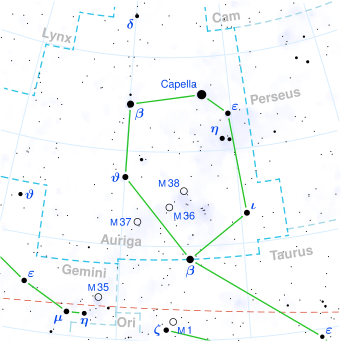
Auriga constellation map courtesy of Openverse
Auriga, “The Charioteer” – The Auriga constellation is located in the northern hemisphere, and has the 6th brightest nighttime star in the sky. The name of this constellation translates to “the charioteer” in Latin. It received this designation due to the arrangement of its prominent stars, which resembles the pointed helmet worn by a charioteer. The constellation Auriga was first documented by the Greek astronomer Ptolemy in his work Almagest during the 2nd century CE. Auriga is home to several notable deep-sky objects, such as the open star clusters Messier 36, Messier 37, and Messier 38, as well as the emission/reflection nebula IC 405, known as the Flaming Star Nebula, and the protoplanetary Westbrook Nebula (CRL 618).

On Course to Auriga courtesy of Openverse
Key points regarding Auriga:
- Meaning: The term “Auriga” translates to “The Charioteer” in Latin.
- Notable stars: The constellation Auriga includes Capella, the sixth brightest star in the sky, located 42. 2 light years away. It is the brightest star in Auriga and is known for being a source of X-rays. The two stars brighter than Capella in the northern hemisphere are Vega and Arcturus. Capella consists of two pairs of stars; one pair are G-type giants and the other are red dwarfs. Capella also marks the left shoulder of the Charioteer in mythology. Menkalinan, another star in Auriga, is an 85 light-year distant triple star system, with two bright white stars and one red dwarf. Mahasim is a double star system located 173 light years away. Iota Aurigae, an orange giant star, is about 512 light years distant. Almaaz is an eclipsing binary star approximately 2,000 light years away, known for its unusual companion. Eta Aurigae and Zeta Aurigae represent the ‘kids’ of the goat that Capella is associated with, while Prijipati is a binary star located 140 light years away. AE Aurigae is a runaway star, 1,460 light years away, believed to have been ejected from a collision of binary star groups in the Orion Nebula, lighting the Flaming Star Nebula nearby.
- Other features: AE Aurigae illuminates the Flaming Star Nebula (IC 405, Caldwell 31, SH 2-229), which is classified as an emission and reflection nebula with a magnitude of 6.0. This nebula is situated in proximity to Iota Aurigae. Messier 36 is a bright open cluster in Auriga, discovered by Giovanni Batista Hodierna in the 17th century and included in Charles Messier’s catalog in 1764. It contains at least 60 stars with an apparent magnitude of 6. 3, located about 4,100 light years away. Messier 37, also discovered by Hodierna, is around 3,600 to 4,700 light years from Earth, has about 500 stars, and is 300 million years old. Messier 38, 2. 5 degrees northwest of M36, is approximately 4,200 light years distant and has an estimated age of 220 million years. The Flaming Star Nebula is near M38 and lies 1,500 light years away. The Tadpole Nebula surrounds the open cluster NGC 1893 and is around 2,200 light years distant. There are two meteor showers linked to Auriga: the Alpha Aurigids and the Delta Aurigids. The name Auriga is pronounced /ɔːˈraɪɡə/ and means Charioteer in English. The genitive form used for star names is Aurigae (pronunciation: /ɔːˈraɪdʒiː/). The abbreviation for Auriga, adopted by the IAU in 1922, is Aur. Auriga contains three Messier objects: M36, M37, and M38, and has eight stars with known planets. The brightest star in this constellation is Capella, Alpha Aurigae, which is the sixth brightest star in the sky.
- Mythology: Auriga is often shown as a charioteer, holding a chariot’s reins and carrying a goat and her kids. Though this image appears in Johann Bode’s Uranographia, stories about Auriga don’t include a goat. In mythology, Auriga is linked to Erichthonius, the king of Athens, who tamed four horses for a chariot, inspired by the Sun god. Another version identifies Auriga with Hephaestus, who built a chariot for easier travel. Additionally, in the tale of Myrtilus, he helped Pelops win a race to marry Hippodamia by sabotaging King Oenomaus’s chariot. The star Capella is associated with the goat that cared for Zeus.
- Visibility: The constellation known as Auriga is pronounced /ɔːˈraɪɡə/. In English, it is referred to as the Charioteer. The genitive form of Auriga, which is utilized in the naming of stars, is Aurigae (pronunciation: /ɔːˈraɪdʒiː/). The three-letter abbreviation, established by the International Astronomical Union (IAU) in 1922, is Aur. Auriga features three Messier objects: M36 (NGC 1960), M37 (NGC 2099), and M38 (NGC 1912), and it includes eight stars that are known to have planets.
⁺‧₊☽◯☾₊‧⁺⋆⁺‧₊☽◯☾₊‧⁺⋆⁺‧₊☽◯☾₊‧⁺⋆⁺‧₊☽◯☾₊‧⁺⋆⁺‧₊☽◯☾₊‧⁺⋆⁺‧₊☽◯☾₊‧⁺⋆
Constellations:
| Constellations by Month | ||
| JANUARY [8] | FEBRUARY [7] | MARCH [7] |
| Taurus | Camelopardalis | Lynx |
| Orion | Auriga | Cancer |
| Lepus | Gemini | Canis Minor |
| Caelum | Monoceros | Pyxis |
| Reticulum | Canis Major | Vela |
| Dorado | Columba | Carina |
| Pictor | Puppis | Volans |
| Mensa | ||
| APRIL [8] | MAY [7] | JUNE [6] |
| Ursa Major | Canes Venatici | Ursa Minor |
| Leo Minor | Coma Berenices | Boötes |
| Leo | Virgo | Libra |
| Sextans | Corvus | Lupus |
| Crater | Centaurus | Circinus |
| Hydra | Crux | Apus |
| Antlia | Musca | |
| Chamaeleon | ||
| JULY [9] | AUGUST [9] | SEPTEMBER [6] |
| Draco | Lyra | Cygnus |
| Corona Borealis | Vulpecula | Delphinus |
| Hercules | Sagitta | Equuleus |
| Serpens | Aquila | Capricornus |
| Ophiuchus | Scutum | Microscopium |
| Scorpius | Sagittarius | Indus |
| Norma | Corona Australis | |
| Ara | Telescopium | |
| Triangulum Australe | Pavo | |
| OCTOBER [7] | NOVEMBER [8] | DECEMBER [6] |
| Cepheus | Cassiopeia | Perseus |
| Lacerta | Andromeda | Triangulum |
| Pegasus | Pisces | Aries |
| Aquarius | Cetus | Eridanus |
| Piscis Austrinus | Sculptor | Fornax |
| Grus | Phoenix | Horologium |
| Octans | Tucana | |
| Hydrus | ||

File:IC405 Flaming Star Nebula from the Mount Lemmon SkyCenter Schulman Telescope courtesy Adam Block courtesy of Openverse
Constellations of the Month:
February – Auriga
Material may be shared for personal and educational use, Share with family and friends. The material cannot be used in an educational setting whereby a “book fee” is charged in or above tuition costs, and the material here is being used without paying a licensing fee.. AI must file an application for use of such material.
| You May Also Like. . . | |
 NASA 1997 Liftoff Special |
 NASA Mission Patch Party |
More on Versatileer:
![California 1991 - Montage_LANDSCAPE.jpg]()
Featured Photos Montage – California: 1991
02/23/2023![Daylight Saving Time.jpg]()
Spring Ahead! Reset Your Clocks Tonight – 2025
03/08/2025![ItMfL 3.jpg]()
Ends 03-12 – In The Market For Love by Shanna Hatfield Book Blitz + $20 Amazon Gift Card Giveaway
03/04/2025![20250614_06_00__two_epac_2d0__Dalila_.jpg]()
From the Satellite...Pacific Tropical Storm Dalila on .GIPHY & Video + 2025 Season Info
06/26/2025![Brilliant Pink Iceberg & Rosa Dusky Maiden Floribunda Roses__20211001_110123.jpg]()
Featured Photo: Flower of the Day – Brilliant Pink Iceberg & Rosa 'Dusky Maiden' – Floribunda Roses
10/19/2021





























I’d super love constellations!! And this one would be the beautiful one.