Constellations of the Month: January – Pictor:
We continue January with the constellation of Pictor, “The Painter.”

Pictor constellation map courtesy of Openverse
Pictor, “The Painter” – The Pictor constellation is located in the southern hemisphere. Its name, derived from Latin, translates to “painter,” although it more accurately symbolizes the painter’s easel. This constellation was first introduced by the French astronomer Nicolas Louis de Lacaille during the 18th century. Initially named Equuleus Pictoris, which means “the painter’s easel” in Latin, it was subsequently abbreviated to Pictor. The pronunciation of Pictor is /ˈpɪktər/. In English, it is referred to as the Painter’s Easel. The genitive form used for star nomenclature is Pictoris, pronounced /pɪkˈtɔːrɪs/. The three-letter abbreviation, recognized by the International Astronomical Union (IAU) in 1922, is Pic.
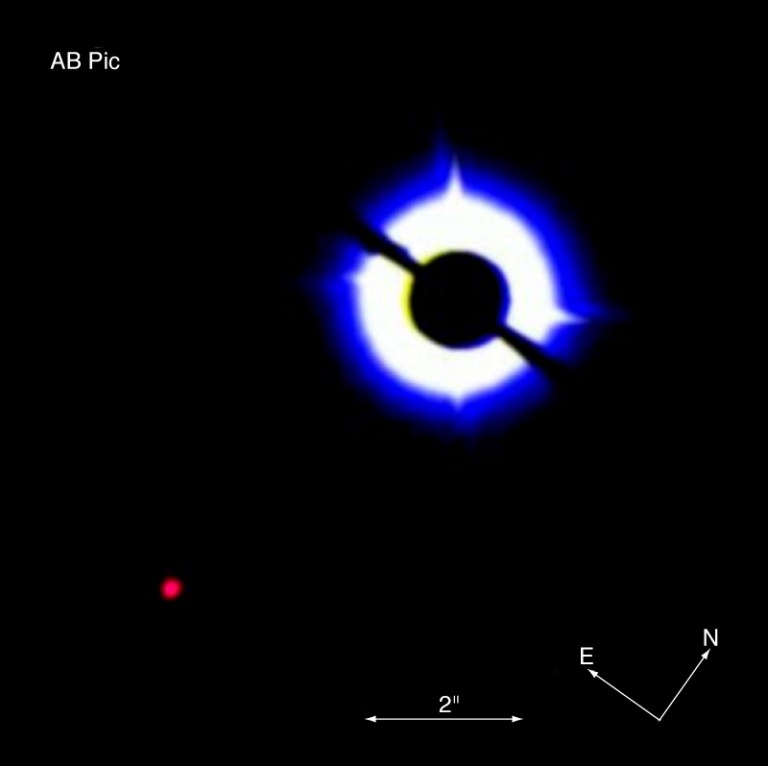
The Star AB Pictoris and its Companion – Phot-14d-05-normal courtesy of Openverse
Key points regarding Pictor:
- Meaning: The term “Pictor” translates to “The Painter” in Latin.
- Notable stars: The Pictor constellation starts with Alpha Pictoris, the brightest star in the Pictor constellation, located about 97 light years from the Sun. It is a white main sequence star and has an apparent magnitude of 3.27. Estimated to be around 660 million years old, it is known for its low abundance of iron peak elements and high rotational speed. Alpha Pictoris contains more mass and is brighter than the Sun, and it may be part of a binary system due to its X-ray emissions. Beta Pictoris is the second brightest star in the constellation and is located approximately 63.4 light years away. It has a magnitude of 3.861 and is a white main sequence dwarf. This star has a debris disk and a young gas giant planet observed in 2009. Gamma Pictoris, the third brightest star, is an orange giant, while Delta Pictoris, a binary system, exhibits luminosity variations. Kapteyn’s Star, a red dwarf 12.76 light years away, is known for its high proper motion and variable brightness. AB Pictoris, an orange main sequence star, is about 148 light years from the Sun and shows variability due to rotational activity.
- Other features: Pictor is home to HD 40307, an orange main sequence dwarf star with a classification of K2.5 V, located about 41. 8 light years from Earth. It has a visual magnitude of 7.17, a mass 0.75 times that of the Sun, and a radius 0.716 times solar. The star hosts 6 confirmed planets, with HD 40307 g classified as a super-Earth in the habitable zone. HD 41004 is a multiple star system with an orange dwarf star of K1 V type, 138. 6 light years away. It has a planet at least 2.56 times Jupiter’s mass with an orbital period of 963 days. Its secondary component is a red dwarf with a brown dwarf orbiting it every 1.3283 days. NGC 1705 is a peculiar Blue Compact Dwarf galaxy located 17 million light years away, known for containing massive young stars. It belongs to the Dorado Group of galaxies. Pictor A is a double lobed radio galaxy with a supermassive black hole at its center that has a relativistic jet extending 800,000 light years. SPT-CL J0546-5345 is a massive galaxy cluster, among the largest in the early universe, located approximately 7 billion light years from Earth. If observed today, it would appear about four times larger and was nearly as massive as the Coma Cluster 7 billion years ago.
- Mythology: The Pictor constellation lacks any mythological associations. It was established by Nicolas Louis de Lacaille in 1756, originally referred to as le Chevalet et la Palette, translating to “the easel and palette.” In 1763, de Lacaille designated the constellation as Equuleus Pictoris on his planisphere. The name was later abbreviated to Pictor in 1845 by the English astronomer Francis Baily, following a recommendation from the English astronomer and mathematician John Herschel.
- Visibility: Pictor ranks as the 59th largest constellation, covering an area of 247 square degrees. It is situated in the first quadrant of the southern hemisphere (SQ1) and is observable at latitudes ranging from +26° to -90°. Pictor is located between the luminous star Canopus, situated in the Carina constellation, and the Large Magellanic Cloud, which is found in the constellations of Dorado and Mensa. The constellations that border Pictor include Caelum, Carina, Columba, Dorado, Puppis, and Volans. It is part of the Lacaille family of constellations, which also includes Antlia, Caelum, Circinus, Fornax, Horologium, Mensa, Microscopium, Norma, Octans, Reticulum, Sculptor, and Telescopium. Within Pictor, there are three stars known to host planets, while it does not feature any Messier objects. The most luminous star in this constellation is Alpha Pictoris, which has an apparent magnitude of 3.30. Additionally, there are no meteor showers linked to Pictor, and it lacks any formally designated stars.
⁺‧₊☽◯☾₊‧⁺⋆⁺‧₊☽◯☾₊‧⁺⋆⁺‧₊☽◯☾₊‧⁺⋆⁺‧₊☽◯☾₊‧⁺⋆⁺‧₊☽◯☾₊‧⁺⋆⁺‧₊☽◯☾₊‧⁺⋆
Constellations:
| Constellations by Month | ||
| JANUARY [8] | FEBRUARY [7] | MARCH [7] |
| Taurus | Camelopardalis | Lynx |
| Orion | Auriga | Cancer |
| Lepus | Gemini | Canis Minor |
| Caelum | Monoceros | Pyxis |
| Reticulum | Canis Major | Vela |
| Dorado | Columba | Carina |
| Pictor | Puppis | Volans |
| Mensa | ||
| APRIL [8] | MAY [7] | JUNE [6] |
| Ursa Major | Canes Venatici | Ursa Minor |
| Leo Minor | Coma Berenices | Boötes |
| Leo | Virgo | Libra |
| Sextans | Corvus | Lupus |
| Crater | Centaurus | Circinus |
| Hydra | Crux | Apus |
| Antlia | Musca | |
| Chamaeleon | ||
| JULY [9] | AUGUST [9] | SEPTEMBER [6] |
| Draco | Lyra | Cygnus |
| Corona Borealis | Vulpecula | Delphinus |
| Hercules | Sagitta | Equuleus |
| Serpens | Aquila | Capricornus |
| Ophiuchus | Scutum | Microscopium |
| Scorpius | Sagittarius | Indus |
| Norma | Corona Australis | |
| Ara | Telescopium | |
| Triangulum Australe | Pavo | |
| OCTOBER [7] | NOVEMBER [8] | DECEMBER [6] |
| Cepheus | Cassiopeia | Perseus |
| Lacerta | Andromeda | Triangulum |
| Pegasus | Pisces | Aries |
| Aquarius | Cetus | Eridanus |
| Piscis Austrinus | Sculptor | Fornax |
| Grus | Phoenix | Horologium |
| Octans | Tucana | |
| Hydrus | ||

A Trio of Super-Earths (artist’s impression) courtesy of Openverse
Constellations of the Month:
January – Pictor
Material may be shared for personal and educational use, Share with family and friends. The material cannot be used in an educational setting whereby a “book fee” is charged in or above tuition costs, and the material here is being used without paying a licensing fee.. AI must file an application for use of such material.
| You May Also Like. . . | |
 NASA 1997 Liftoff Special |
 NASA Mission Patch Party |
More on Versatileer:
![Cute pink kids flower jewelry.jpg]()
Happy National Jewel Day – 2024
03/13/2024![20211019_212003.jpg]()
Featured Photos: The Final Day of the 13 Days of Halloween – Day 13: Dark Shadows; & A Surprise
10/30/2021![20230831_09_00 + 20230823_09_00__two_atl_2d0__Franklin.jpg]()
From the Satellite...Atlantic Category 4 Hurricane Franklin on .GIPHY, Video + 2023 Season Info
02/15/2024![Scentsy Washer Whiffs_BUTTON.jpg]()
Scentsy Washer Whiffs – Review
08/18/2023![wea03482.jpg]()
The Danger of Ice Storms – Winter Weather Series '25-'26 + Resources For Recovery
12/14/2025