Constellations of the Month: January – Dorado:
We continue January with the constellation of Dorado, “The Dolphinfish” (Coryphaena Hippurus) In Spanish.”

Dorado constellation map courtesy of Openverse
Dorado, “The Dolphinfish” – Dorado is a constellation is situated in the southern hemisphere. The Dorado constellation was established by the Dutch astronomer Petrus Plancius, based on the observations made by Dutch navigators Pieter Dirkszoon Keyser and Frederick de Houtman. This constellation was initially illustrated in Johann Bayer’s star atlas, Uranometria, published in 1603. Dorado features two stars that have confirmed planets and does not include any Messier objects. The most luminous star within this constellation is Alpha Doradus. Additionally, there are no meteor showers linked to this constellation. The constellation name Dorado is pronounced /dəˈrɑːdoʊ/. In English, the constellation is known as the Swordfish. The genitive form of Dorado, used in star names, is Doradus (pronunciation: /dəˈreɪdəs/). The three-letter abbreviation, adopted by the International Astronomical Union (IAU) in 1922, is Dor.
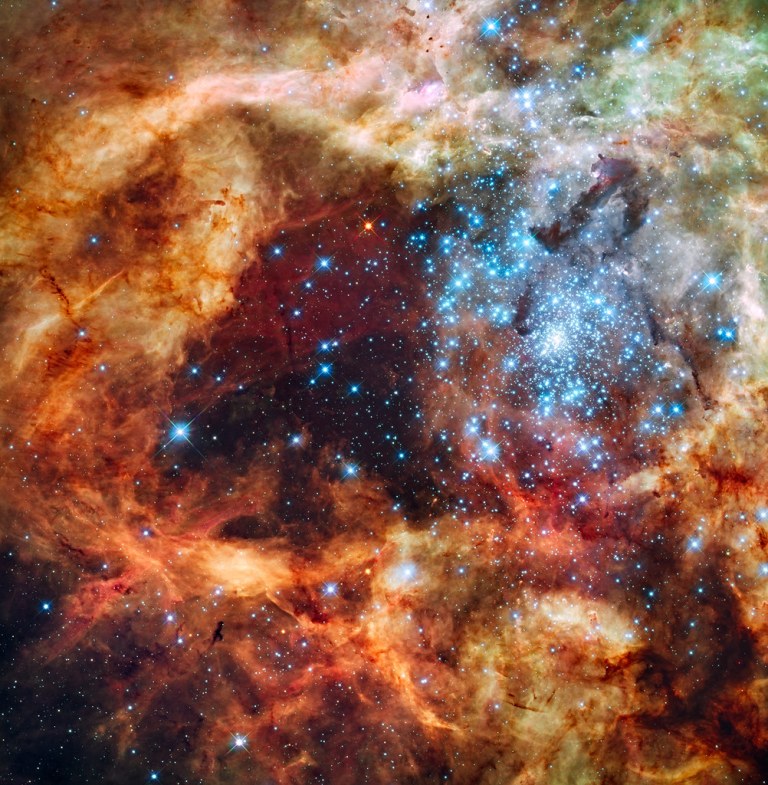
30 Doradus in the Large Magellanic Cloud courtesy of Openverse
Key points regarding Dorado:
- Meaning: The term “Dorado” translates to “The Dolphinfish” in Latin.
- Notable stars: The Dorado constellation starts with Alpha Doradus, the brightest star in its constellation, with brightness ranging from 3.26 to 3.30 magnitudes and located about 169 light years away. It is a binary star system that includes a giant star of spectral class A0III and a subgiant of spectral type B9IV. The primary star has a visual magnitude of 3.8, and the companion has a magnitude of 4.3. An optical companion star is 77 arc seconds away but is not physically connected to the main pair. Beta Doradus is the second brightest star and a Cepheid variable star, with brightness changing from 4. 05 to 3. 45 magnitudes, about 1,050 light years away. Gamma Doradus is a variable star with a magnitude of 4.25, located around 66.2 light years away. Delta Doradus is an A7V type star with a magnitude of 4.34, located about 145 light years away. R Doradus, a red giant classified as M8 III, is about 178 light years away. S Doradus is a hypergiant star in the Large Magellanic Cloud, too distant to see without aid, at 169,000 light years. Zeta Doradus, a yellow-white main sequence star of type F7 V, has a magnitude of 4.68 and is 38 light years from Earth, projected to move into the constellation Pictor around the year 6400.
- Other features: Dorado is home to HE 0437-5439 is a fast-moving star in Dorado, moving away from us at 723 kilometers per second. It is a main sequence star of spectral type BV, about 30 million years old, and located around 200,000 light years away with an apparent magnitude of 16. 3. Its mass is nine times that of the Sun. Discovered in 2005, it is unbound from the Milky Way and will eventually escape into intergalactic space. HE 0437-5439 is a fast-moving star in Dorado, traveling away from us at 723 kilometers per second. It has a mass nine times that of the Sun, is about 30 million years old, and is located approximately 200,000 light years away. Discovered in 2005, the star is unbound from the Milky Way and will eventually move into intergalactic space. The Large Magellanic Cloud, where this star is found, hosts around 700 open clusters, 400 planetary nebulae, and many supergiant stars. It is the fourth largest galaxy in the Local Group, rich in gas and undergoing intense star formation, with the Tarantula Nebula being a notable region. The Tarantula Nebula, confirmed as a nebula in 1751, is about 160,000 light years away and is a major star-forming area. SNR 0509-67.5 is a supernova remnant also located in the Large Magellanic Cloud. Additionally, SN 1987A, a significant supernova event, peaked at magnitude 2.9. The Ghost Head Nebula features two white patches and is a distinct star formation region discovered in 1834. NGC 1566 and NGC 1850 are also notable galaxies and star clusters in Dorado, the latter containing young stars unlike typical globular clusters.
- Mythology: The Dorado is a constellation that does not have any associated myths. Dorado was among the twelve constellations established by the Dutch astronomer Petrus Plancius, who primarily named the newly formed southern constellations after various animals. Additionally, Dorado has occasionally been known as the Swordfish constellation or Xipias.
- Visibility: Dorado is the 72nd largest constellation, covering 179 square degrees. It is in the southern hemisphere’s first quadrant and can be seen from latitudes +20° to -90°. Neighboring constellations include Caelum, Horologium, and others, and it is part of the Johann Bayer family.
⁺‧₊☽◯☾₊‧⁺⋆⁺‧₊☽◯☾₊‧⁺⋆⁺‧₊☽◯☾₊‧⁺⋆⁺‧₊☽◯☾₊‧⁺⋆⁺‧₊☽◯☾₊‧⁺⋆⁺‧₊☽◯☾₊‧⁺⋆
Constellations:
| Constellations by Month | ||
| JANUARY [8] | FEBRUARY [7] | MARCH [7] |
| Taurus | Camelopardalis | Lynx |
| Orion | Auriga | Cancer |
| Lepus | Gemini | Canis Minor |
| Caelum | Monoceros | Pyxis |
| Reticulum | Canis Major | Vela |
| Dorado | Columba | Carina |
| Pictor | Puppis | Volans |
| Mensa | ||
| APRIL [8] | MAY [7] | JUNE [6] |
| Ursa Major | Canes Venatici | Ursa Minor |
| Leo Minor | Coma Berenices | Boötes |
| Leo | Virgo | Libra |
| Sextans | Corvus | Lupus |
| Crater | Centaurus | Circinus |
| Hydra | Crux | Apus |
| Antlia | Musca | |
| Chamaeleon | ||
| JULY [9] | AUGUST [9] | SEPTEMBER [6] |
| Draco | Lyra | Cygnus |
| Corona Borealis | Vulpecula | Delphinus |
| Hercules | Sagitta | Equuleus |
| Serpens | Aquila | Capricornus |
| Ophiuchus | Scutum | Microscopium |
| Scorpius | Sagittarius | Indus |
| Norma | Corona Australis | |
| Ara | Telescopium | |
| Triangulum Australe | Pavo | |
| OCTOBER [7] | NOVEMBER [8] | DECEMBER [6] |
| Cepheus | Cassiopeia | Perseus |
| Lacerta | Andromeda | Triangulum |
| Pegasus | Pisces | Aries |
| Aquarius | Cetus | Eridanus |
| Piscis Austrinus | Sculptor | Fornax |
| Grus | Phoenix | Horologium |
| Octans | Tucana | |
| Hydrus | ||
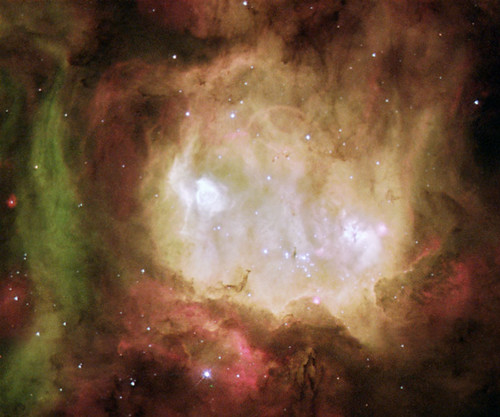
ghost-head-nebula courtesy of Openverse
Constellations of the Month:
January – Dorado
Material may be shared for personal and educational use, Share with family and friends. The material cannot be used in an educational setting whereby a “book fee” is charged in or above tuition costs, and the material here is being used without paying a licensing fee.. AI must file an application for use of such material.
| You May Also Like. . . | |
 NASA 1997 Liftoff Special |
 NASA Mission Patch Party |
More on Versatileer:
![Greetings from Delaware -- state capitol in Dover, state flower the peach blossom.jpg]()
Happy National Delaware Day – 2025
07/13/2025![Michigan & Wacker Chicago 1981]()
Featured Photo: Architecture, Part 3 – The Buildings of Chicago, Illinois – Michigan Avenue & Wacker...
07/05/2021![wp-17043078042674726882303276176761.jpg]()
Featured Photo: Winter Weather Special – Snow On a Pine Tree Up Close
01/07/2024![Yankee Woods Grove 6.jpg]()
Featured Photo: The Beauty of Fall Color – Day 6
10/25/2021![20211021_210051.jpg]()
Featured Photos: The 18th Hour of The 24 Hours of Halloween: Skull Side Graveyard
10/31/2021




























This is very interesting. Thanks for the other info.